







Question: Hi, please list out the formulas where necessary , graphs where necessary , if the question doesnt require it, its fine not have it but
Hi, please list out the formulas where necessary , graphs where necessary , if the question doesnt require it, its fine not have it but please do put it down if it helps you to explain . If the answer is provided, its because I struggled to understand the answer, please dont just reproduce it, but rather explain it and list out the formulas used with explanations OF FORMULAS USED IN THE QUESTION , the procedure etc.Thank you!
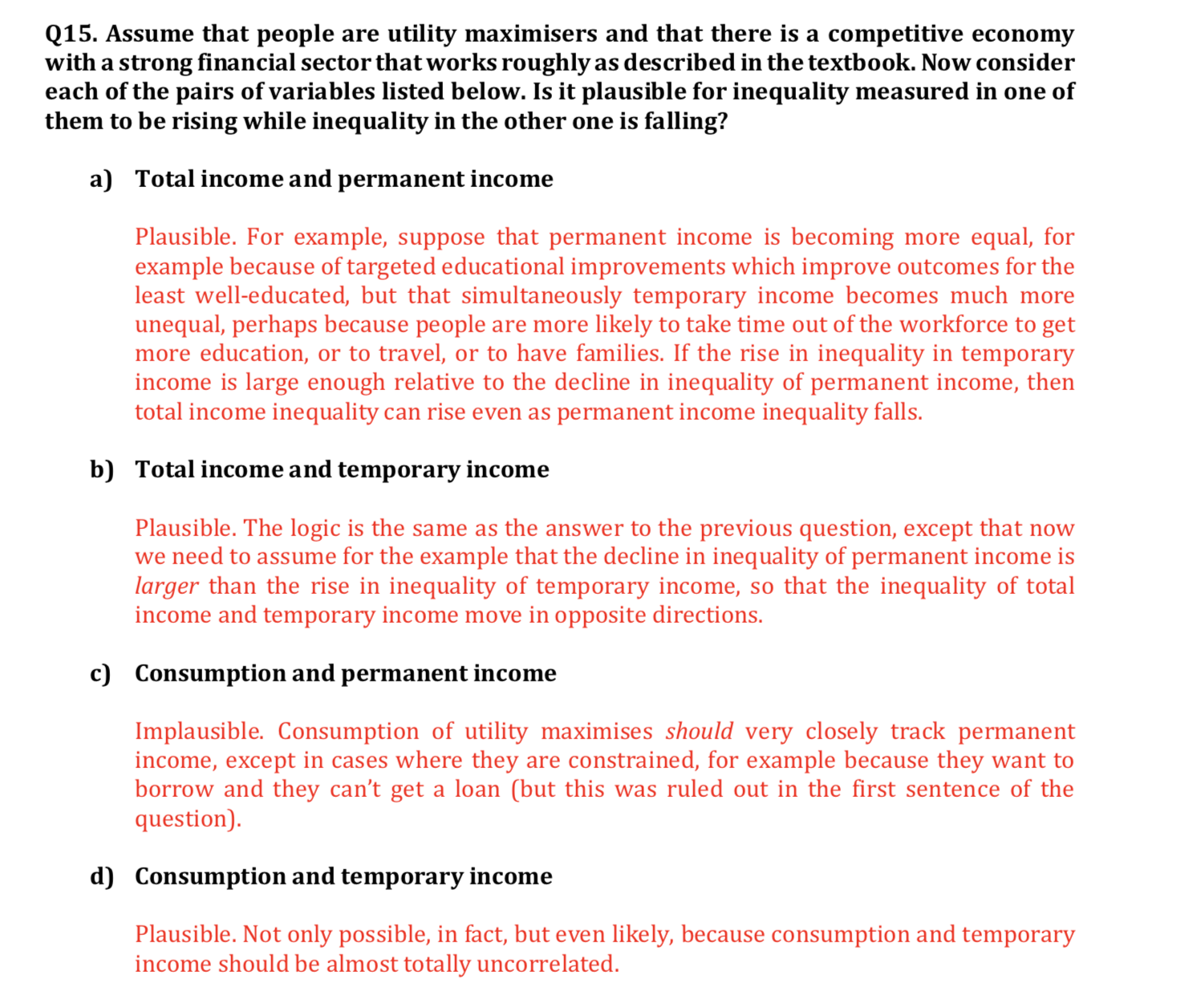
Q15. Assume that people are utility maximisers and that there is a competitive economy with a strong nancial sector that works roughly as describ ed in the textbook. Now consider each of the pairs of variables listed below. Is it plausible for inequality measured in one of them to be rising while inequality in the other one is falling? a) Total income and permanent income Plausible. For example, suppose that permanent income is becoming more equal, for example because of targeted educational improvements which improve outcomes for the least well-educated, but that simultaneously temporary income becomes much more unequal, perhaps because people are more likely to take time out of the workforce to get more education, or to travel, or to have families. If the rise in inequality in temporary income is large enough relative to the decline in inequality of permanent income, then total income inequality can rise even as permanent income inequality falls. b] Total income and temporary income Plausible. The logic is the same as the answer to the previous question, except that now we need to assume for the example that the decline in inequality of permanent income is larger than the rise in inequality of temporary income, so that the inequality of total income and temporary income move in opposite directions. c) Consumption and permanent income lmplausible. Consumption of utility maximises should very closely track permanent income, except in cases where they are constrained, for example because they want to borrow and they can't get a loan [but this was ruled out in the rst sentence of the question]. (1] Consumption and temporary income Plausible. Not only possible, in fact, but even likely, because consumption and temporary income should be almost totally uncorrelated
Step by Step Solution
There are 3 Steps involved in it

Get step-by-step solutions from verified subject matter experts
 Study Help