







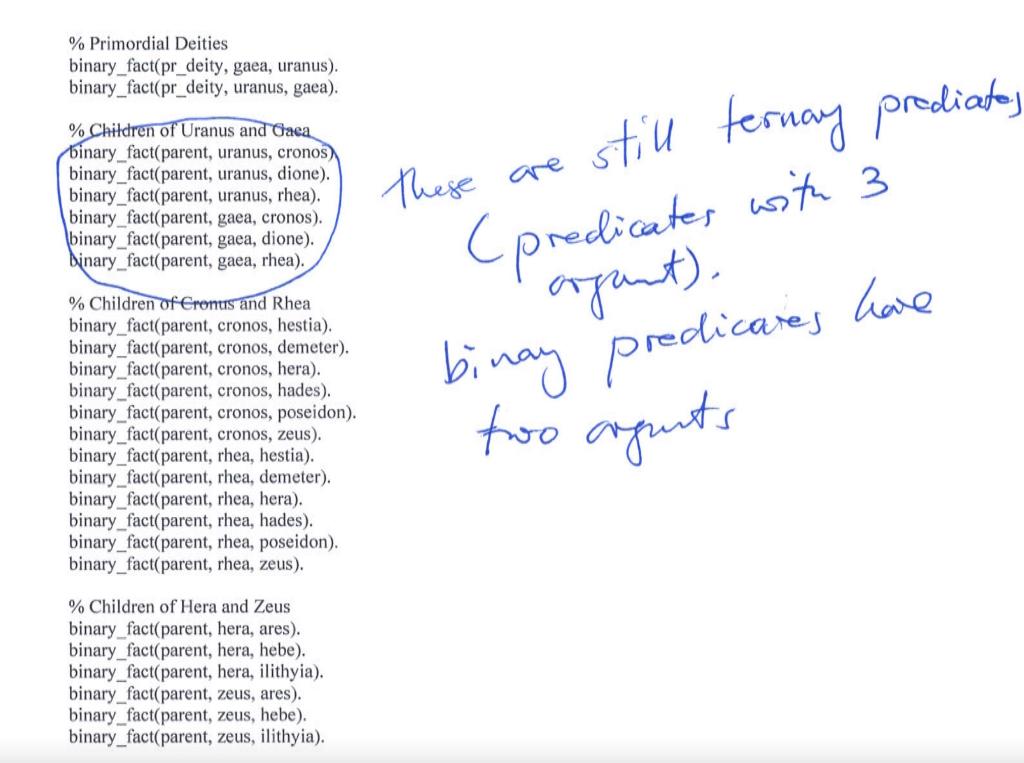
Question: HI ! please the assignment is asking for BINARY predicates. Whoever did this in the attached picture. Please can you redo it using BINARY predicates?
HI ! please the assignment is asking for BINARY predicates. Whoever did this in the attached picture. Please can you redo it using BINARY predicates?
You have been charged to develop a computational family tree for the goddesses and gods and in Greek mythology. The figure shows the family relations of 20 individuals.
1. Gaea and Uranus were the two primordial deities (i.e., they are the only two who do not have any parents). Uranus and Gaea had three off-springs: Cronus, Dione, and Rhea.
2. Rhea and Cronus had six off-springs: Hestia, Demeter, Hera, Hades, Poseidon, and Zeus. 3. Hera and Zeus were the parents of three children: Ares, Hebe, and Ilithyia. 4. Demeter and Zeus had one child together: Persephone. 5. Dione and Zeus had one off-spring, Aphrodite.
6. Aphrodite and Ares had one off-spring Harmonia. 7. Kadmos and Harmonia had one off- spring, Semele. 8. Semele and Zeus had one off-spring: Dionysus.
Task 1: Create a model of this family in Prolog. Start with facts (i.e., ground axioms) about the family. For the ground axioms choose a consistent scheme of BINARY predicates. Develop the facts such that there are no redundancies in the facts. Deliver a complete copy of your facts in correct Prolog syntax.
Task 2: Analyze the properties and potential dependencies of the following family relations: parent, child, silbling grandparent grandchild greatgrandchild
Task 3: Add rules (i.e., logical axioms) for the six family relations (Task 2), using only first- order predicate calculus notation. The rules should be able to determine the relations (as defined by you, but consistent with your cultural norm) for the following concepts). If you used one as your base predicates, then you do not need a rule for that. Define these rules as concisely as possible. It will help if you consult the properties and dependencies of these family relations (Task 3). You do not need to use the setoff predicate to eliminate duplicates in query results.
For all rules that you write, use only basic Prolog statements as introduced in class (i.e., only Horn clauses, with each rule having a single consequent predicate and all antecedent predicates linked by commas representing conjunctions). Do not use any other syntax, even if Prolog parses and processes it. Deliver a complete copy of your rules in correct Prolog syntax.
Show one query per relationship, and the results of those queries when executed in Prolog.
Task 4: Add a discussion of up to one page (double spaced) that addresses why you chose your scheme for the ground axioms. Elaborate what could have been at least one alternative to your chosen design. Provide arguments for why you did not choose that alternative.
binary_fact(pr_deity, gaea, uranus). binary_fact(pr_deity, uranus, gaea). \% Chirdren of Uranus and Gaea binary_fact(parent, uranus, cronos) binary_fact(parent, uranus, dione). binary_fact(parent, uranus, rhea). binary_fact(parent, gaea, cronos). binary_fact(parent, gaea, dione). binary_fact(parent, gaea, rhea). % Children of Gromus and Rhea binary_fact(parent, cronos, hestia). binary_fact(parent, cronos, demeter). binary_fact(parent, cronos, hera). binary_fact(parent, cronos, hades). binary_fact(parent, cronos, poseidon). binary_fact(parent, cronos, zeus). binary_fact(parent, rhea, hestia). binary_fact(parent, rhea, demeter). binary_fact(parent, rhea, hera). binary_fact(parent, rhea, hades). binary_fact(parent, rhea, poseidon). binary_fact(parent, rhea, zeus). % Children of Hera and Zeus binary_fact(parent, hera, ares). binary_fact(parent, hera, hebe). binary_fact(parent, hera, ilithyia). binary_fact(parent, zeus, ares). binary_fact(parent, zeus, hebe). binary fact(parent, zeus, ilithyia)
Step by Step Solution
There are 3 Steps involved in it

Get step-by-step solutions from verified subject matter experts
 Study Help