







Question: Hi there looking for help to understand (a) The values of the function at the given points are fo = f(x0) = Number and f1
Hi there looking for help to understand
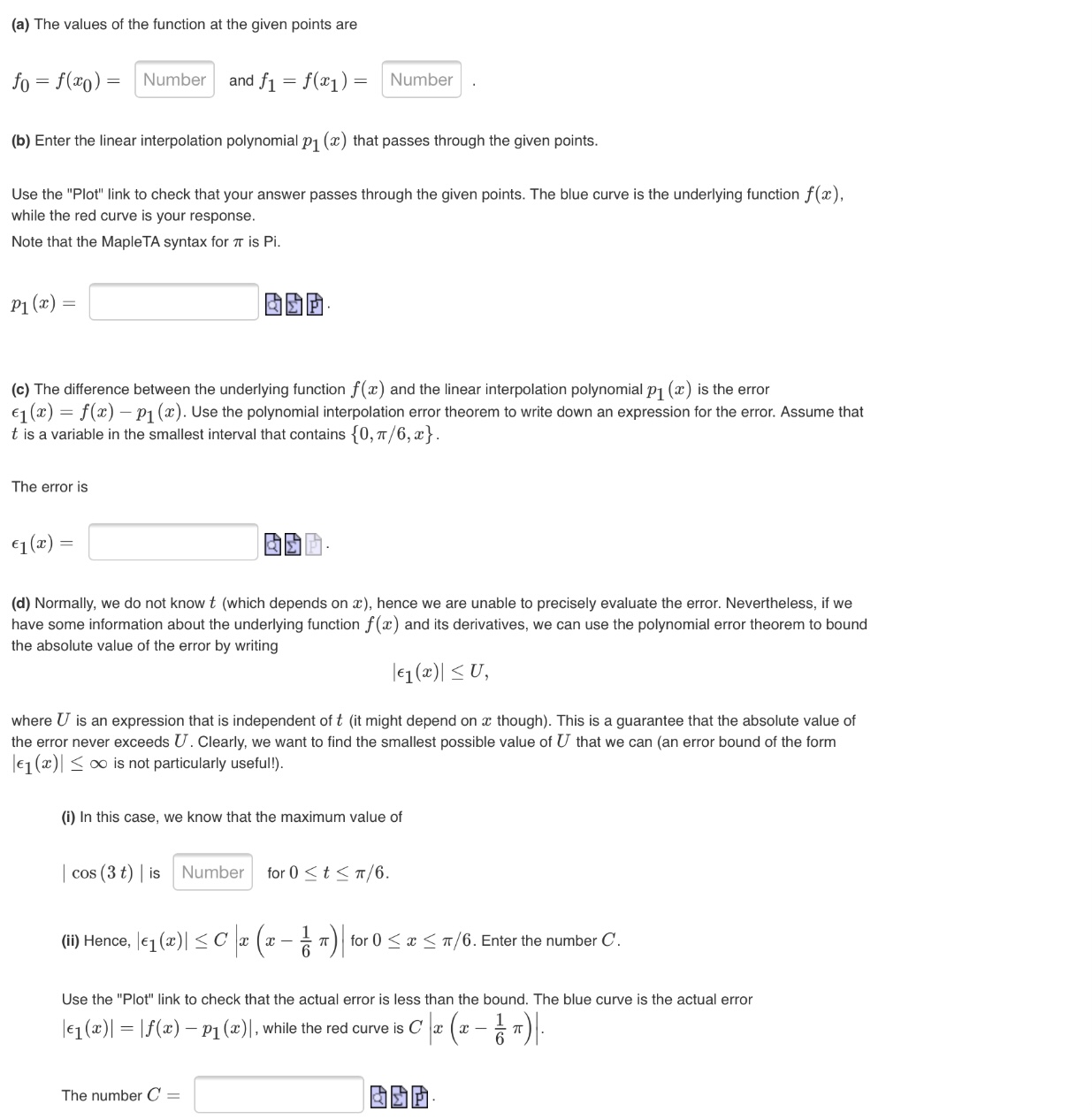
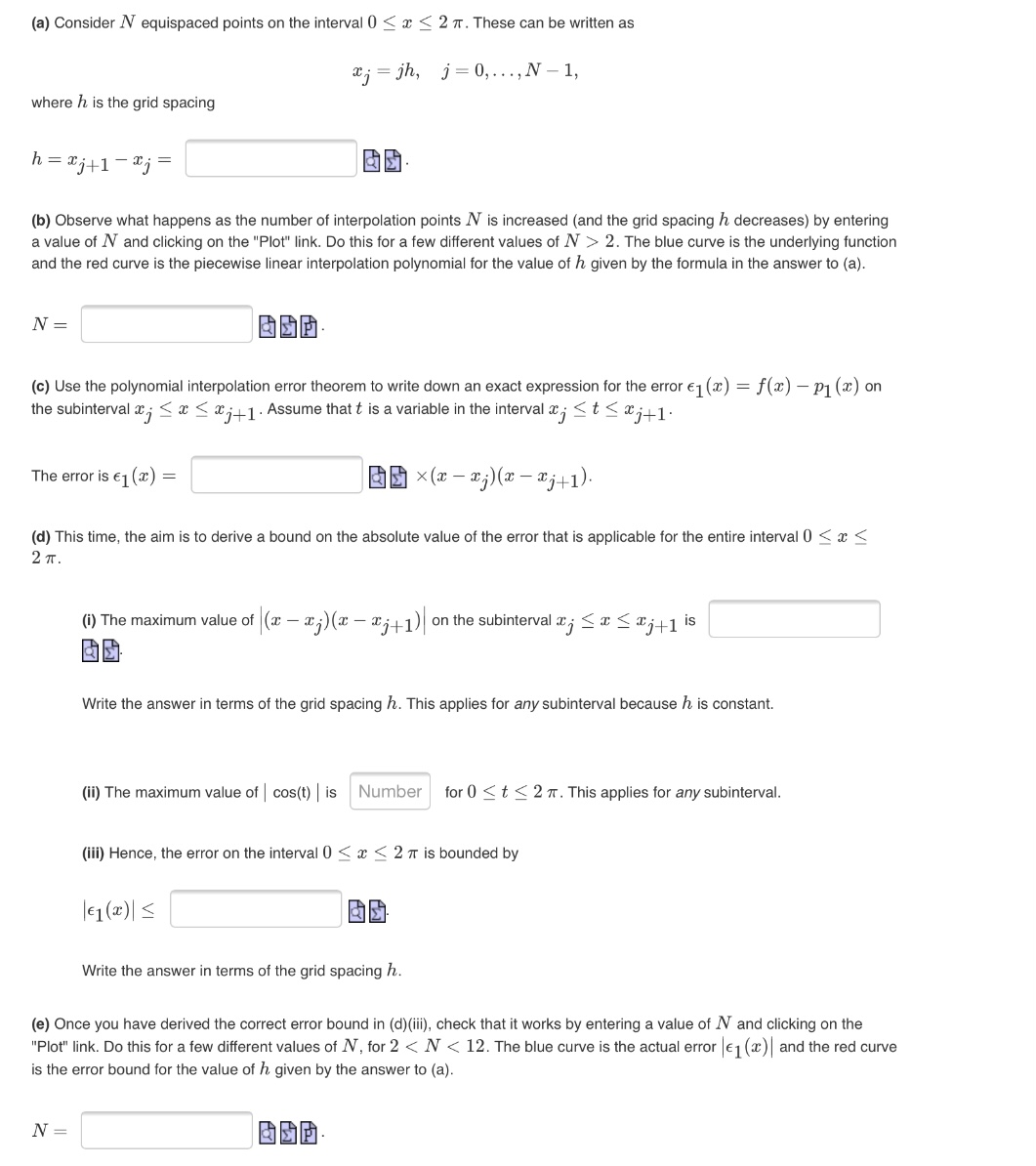
(a) The values of the function at the given points are fo = f(x0) = Number and f1 = f(21 ) = Number (b) Enter the linear interpolation polynomial p1 (a ) that passes through the given points. Use the "Plot" link to check that your answer passes through the given points. The blue curve is the underlying function f(a), while the red curve is your response. Note that the MapleTA syntax for 7 is Pi. P1 (2) = (c) The difference between the underlying function f() and the linear interpolation polynomial p1 ( ) is the error E1 (a) = f(ae) - P1 (a). Use the polynomial interpolation error theorem to write down an expression for the error. Assume that t is a variable in the smallest interval that contains {0, 7 /6, x}. The error is 61 () = (d) Normally, we do not know t (which depends on ), hence we are unable to precisely evaluate the error. Nevertheless, if we have some information about the underlying function f () and its derivatives, we can use the polynomial error theorem to bound the absolute value of the error by writing le1 (20) | SU, where U is an expression that is independent of t (it might depend on a though). This is a guarantee that the absolute value of the error never exceeds U. Clearly, we want to find the smallest possible value of U that we can (an error bound of the form E1 (a)| 2. The blue curve is the underlying function and the red curve is the piecewise linear interpolation polynomial for the value of h given by the formula in the answer to (a). N = 090 (c) Use the polynomial interpolation error theorem to write down an exact expression for the error e] (a) = f(a) - P1 (a) on the subinterval x ;
Step by Step Solution
There are 3 Steps involved in it

Get step-by-step solutions from verified subject matter experts
 Study Help