







Question: Hint for the question in the graph. Let's say a company had a cash outflow of 1,250,000 Swiss francs and a cash inflow of 800,000
Hint for the question in the graph. Let's say a company had a cash outflow of 1,250,000 Swiss francs and a cash inflow of 800,000 British pounds at the initial exchange rates of $0.80 per Swiss franc and $1.25 per British pound. This means that, in dollar terms, the company will pay about $1mn to the Swiss counterparty and receive about $1mn from the British counterparty. So, the cash inflow fully covers the cash outflow, and there is no net exposure.
Now, let's say both currencies depreciate against the dollar by about 20 percent because they are highly correlated, and the exchange rates are now, say, $0.64 per Swiss franc and $1.00 per British pound. The same expected cash outflow of 1,250,000 Swiss francs will now cost the firm about $800,000, and the same expected cash inflow of 800,000 British pounds will now bring the U.S. firm $800,000. So, the dollar inflow still covers the dollar outflow, even though both dollar amounts are smaller now. Hence, the low or no exposure.
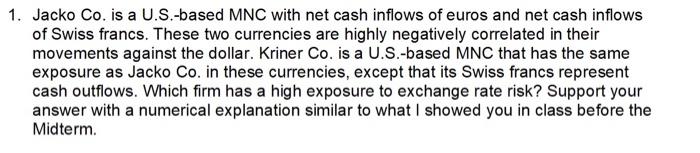
Jacko Co. is a U.S.-based MNC with net cash inflows of euros and net cash inflows of Swiss francs. These two currencies are highly negatively correlated in their movements against the dollar. Kriner Co. is a U.S.-based MNC that has the same exposure as Jacko Co. in these currencies, except that its Swiss francs represent cash outflows. Which firm has a high exposure to exchange rate risk? Support your answer with a numerical explanation similar to what I showed you in class before the Midterm
Step by Step Solution
There are 3 Steps involved in it
1 Expert Approved Answer
Step: 1 Unlock

Question Has Been Solved by an Expert!
Get step-by-step solutions from verified subject matter experts
Step: 2 Unlock
Step: 3 Unlock
 Study Help