







Question: Hola, ya van tres veces que me cancelan mi profesor en mi desarrollo de pr ctica . Con el uso registro de informaci n tablas.
Hola, ya van tres veces que me cancelan mi profesor en mi desarrollo de prcticaCon el uso registro de informacin tablas.
Necesito ayuda para desarrollar una practica de trabajo y energa en fisica clasica, tiene que ser cuantitativo. alguna idea para grado de universidad?
les entrego un ejemplo
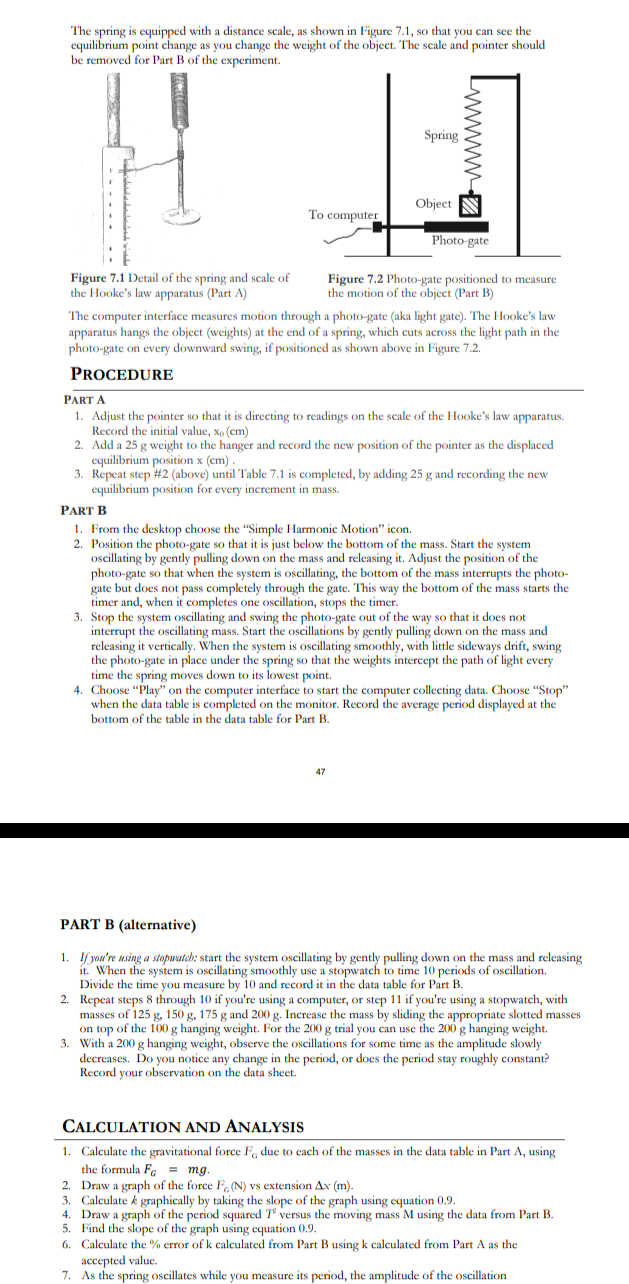
The spring is equipped with a distance scale, as shown in Figure so that you can see the equilibrium point change as you change the weight of the object. The scale and pointer should be removed for Part B of the experiment.
Figure Detail of the spring and scale of
Figure Photogate positioned to measure the Hooke's law apparatus Part A the motion of the object Part B
The computer interface measures motion through a photogate aka light gate The Hooke's law apparatus hangs the object weights at the end of a spring, which cuts across the light path in the photogate on every downward swing, if positioned as shown above in Figure
Procedure
Part A
Adjust the pointer so that it is directing to readings on the scale of the Hooke's law apparatus. Record the initial value,
Add a g weight to the hanger and record the new position of the pointer as the displaced equilibrium position
Repeat step #above until Table is completed, by adding g and recording the new equilibrium position for every increment in mass.
PART B
From the desktop choose the "Simple Harmonic Motion" icon.
Position the photogate so that it is just below the bottom of the mass. Start the system oscillating by gently pulling down on the mass and releasing it Adjust the position of the photogate so that when the system is oscillating, the bottom of the mass interrupts the photogate but does not pass completely through the gate. This way the bottom of the mass starts the timer and, when it completes one oscillation, stops the timer.
Stop the system oscillating and swing the photogate out of the way so that it does not interrupt the oscillating mass. Start the oscillations by gently pulling down on the mass and releasing it vertically. When the system is oscillating smoothly, with little sideways drift, swing the photogate in place under the spring so that the weights intercept the path of light every time the spring moves down to its lowest point.
Choose "Play" on the computer interface to start the computer collecting data. Choose "Stop" when the data table is completed on the monitor. Record the average period displayed at the bottom of the table in the data table for Part B
PART B alternative
If you're using a stopwatch: start the system oscillating by gently pulling down on the mass and releasing it When the system is oscillating smoothly use a stopwatch to time periods of oscillation. Divide the time you measure by and record it in the data table for Part B
Repeat steps through if you're using a computer, or step if you're using a stopwatch, with masses of and g Increase the mass by sliding the appropriate slotted masses on top of the g hanging weight. For the g trial you can use the g hanging weight.
With a g hanging weight, observe the oscillations for some time as the amplitude slowly decreases. Do you notice any change in the period, or does the period stay roughly constant? Record your observation on the data sheet.
CALCULATiON AND ANALYSIS
Calculate the gravitational force due to each of the masses in the data table in Part A using the formula
Draw a graph of the force vs extension
Calculate graphically by taking the slope of the graph using equation
Draw a graph of the period squared versus the moving mass M using the data from Part B
Find the slope of the graph using equation
Calculate the error of k calculated from Part B using k calculated from Part A as the accepted value.
As the spring oscillates while you measure its period, the amplitude of the oscillation ejemplo
ES URGENTE
Step by Step Solution
There are 3 Steps involved in it
1 Expert Approved Answer
Step: 1 Unlock

Question Has Been Solved by an Expert!
Get step-by-step solutions from verified subject matter experts
Step: 2 Unlock
Step: 3 Unlock
 Study Help