



Question: Homework 10. Analogies exist between rotational and translational physical quantities. Identify the rotational term analogous to each of the following: acceleration, force, mass, translational kinetic
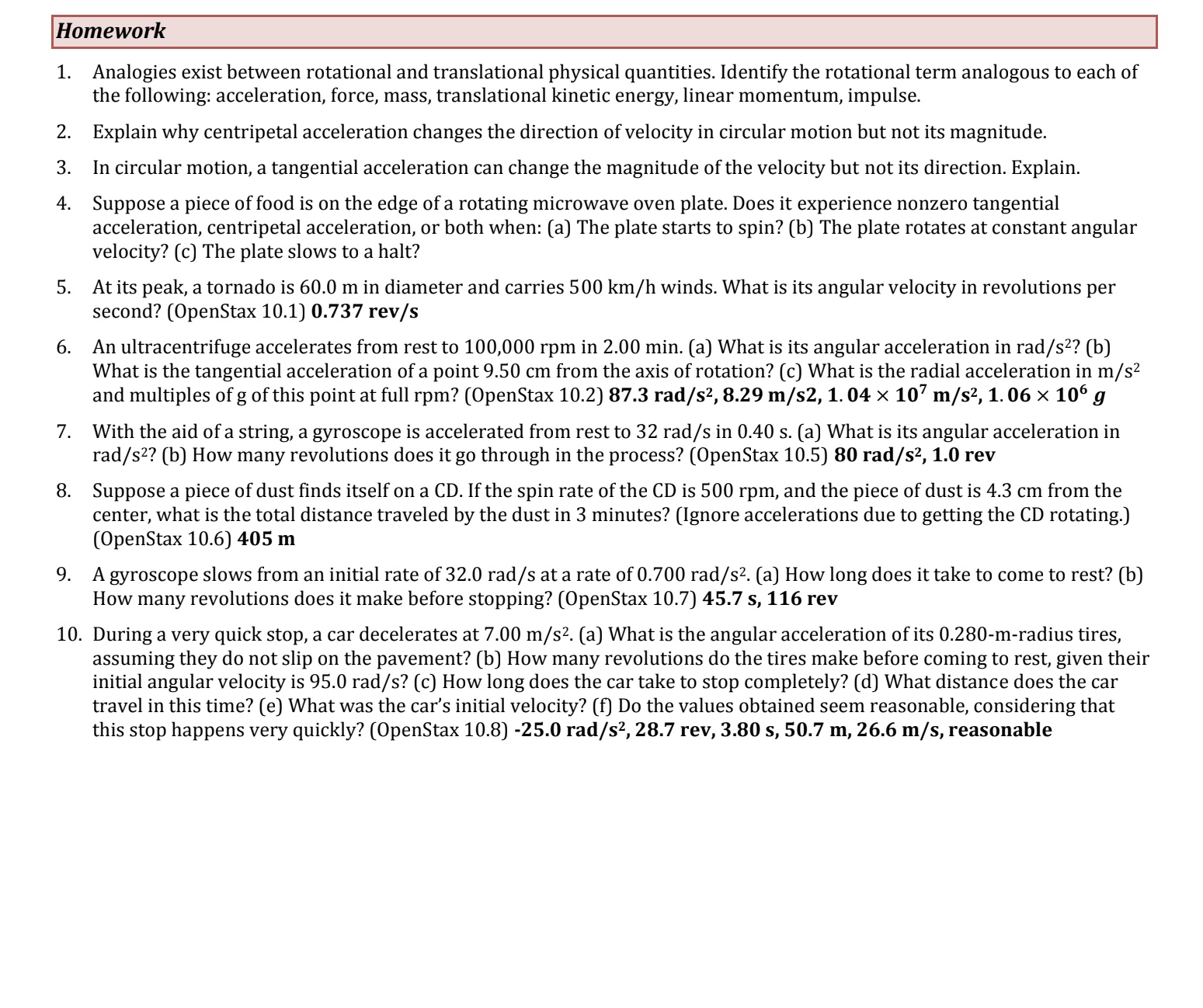
Homework 10. Analogies exist between rotational and translational physical quantities. Identify the rotational term analogous to each of the following: acceleration, force, mass, translational kinetic energy, linear momentum, impulse. Explain why centripetal acceleration changes the direction of velocity in circular motion but not its magnitude. In circular motion, a tangential acceleration can change the magnitude of the velocity but not its direction. Explain. Suppose a piece of food is on the edge of a rotating microwave oven plate. Does it experience nonzero tangential acceleration, centripetal acceleration, or both when: [a] The plate starts to spin? (b) The plate rotates at constant angular velocity? (c) The plate slows to a halt? At its peak, a tornado is 60.0 min diameter and carries 500 km/h winds. What is its angular velocity in revolutions per second? [OpenStax 10.1) 0.737 rev/s An ultracentrifuge accelerates from rest to 100,000 rpm in 2.00 min. (a) What is its angular acceleration in rad / 32? [b] What is the tangential acceleration of a point 9.50 cm from the axis of rotation? (c) What is the radial acceleration in m/s2 and multiples of g of this point at full rpm? [OpenStax 10.2) 87.3 rad/$2, 8.29 m/sZ, 1.04 x 10⁷ m/sz, 1.06 x 10" 3 With the aid of a string, a gyroscope is accelerated from rest to 32 rad/s in 0.40 s. [a] What is its angular acceleration in rad/52? (b) How many revolutions does it go through in the process? [OpenStax 10.5) 80 rad/$2, 1.0 rev Suppose a piece of dust nds itself on a CD. If the spin rate of the CD is 500 rpm, and the piece of dust is 4.3 cm from the center, what is the total distance traveled by the dust in 3 minutes? [Ignore accelerations due to getting the CD rotating.) [OpenStax 10.6) 405 m A gyroscope slows from an initial rate of 32.0 rad/s at a rate of 0.700 rad/52. (a) How long does it take to come to rest? (b) How many revolutions does it make before stopping? (OpenStax 10.7) 45.7 s, 116 rev During a very quick stop, a car decelerates at 7.00 m/sz. (a) What is the angular acceleration of its 0.280-m-radius tires, assuming they do not slip on the pavement? (b) How many revolutions do the tires make before coming to rest, given their initial angular velocity is 95.0 rad/s? (c) How long does the car take to stop completely? ((1) What distance does the car travel in this time? (e) What was the car's initial velocity? (i) Do the values obtained seem reasonable, considering that this stop happens very quickly? (OpenStax 10.8) -2 5.0 rad/52. 28.7 rev, 3.80 s, 50.7 m. 26.6 m/s, reasonable
Step by Step Solution
There are 3 Steps involved in it

Get step-by-step solutions from verified subject matter experts