







Question: Homework 11 Problem 1: A mass hanging from a spring oscillates with a period T = 0.35 5. Suppose the mass and spring are swung
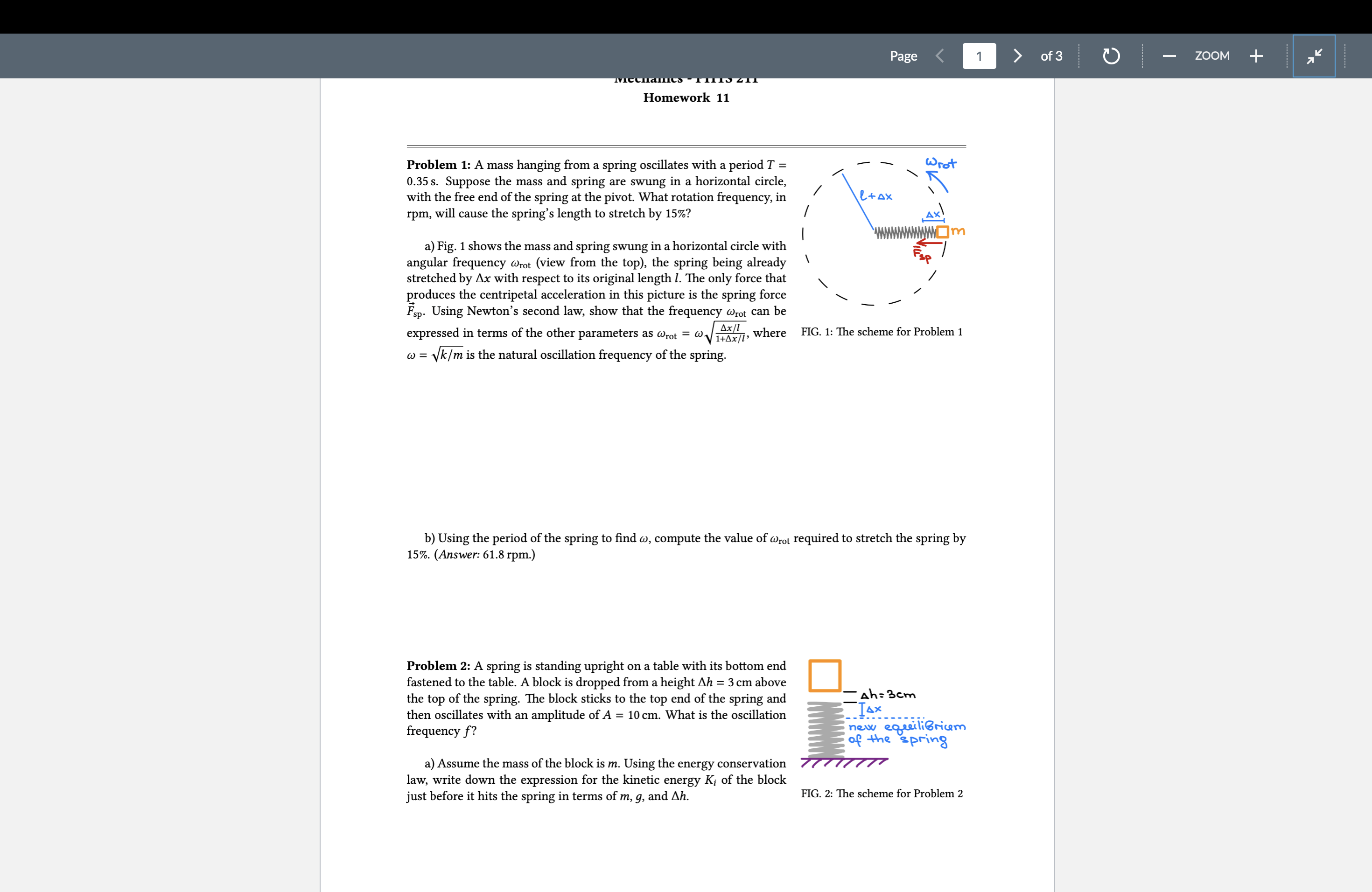
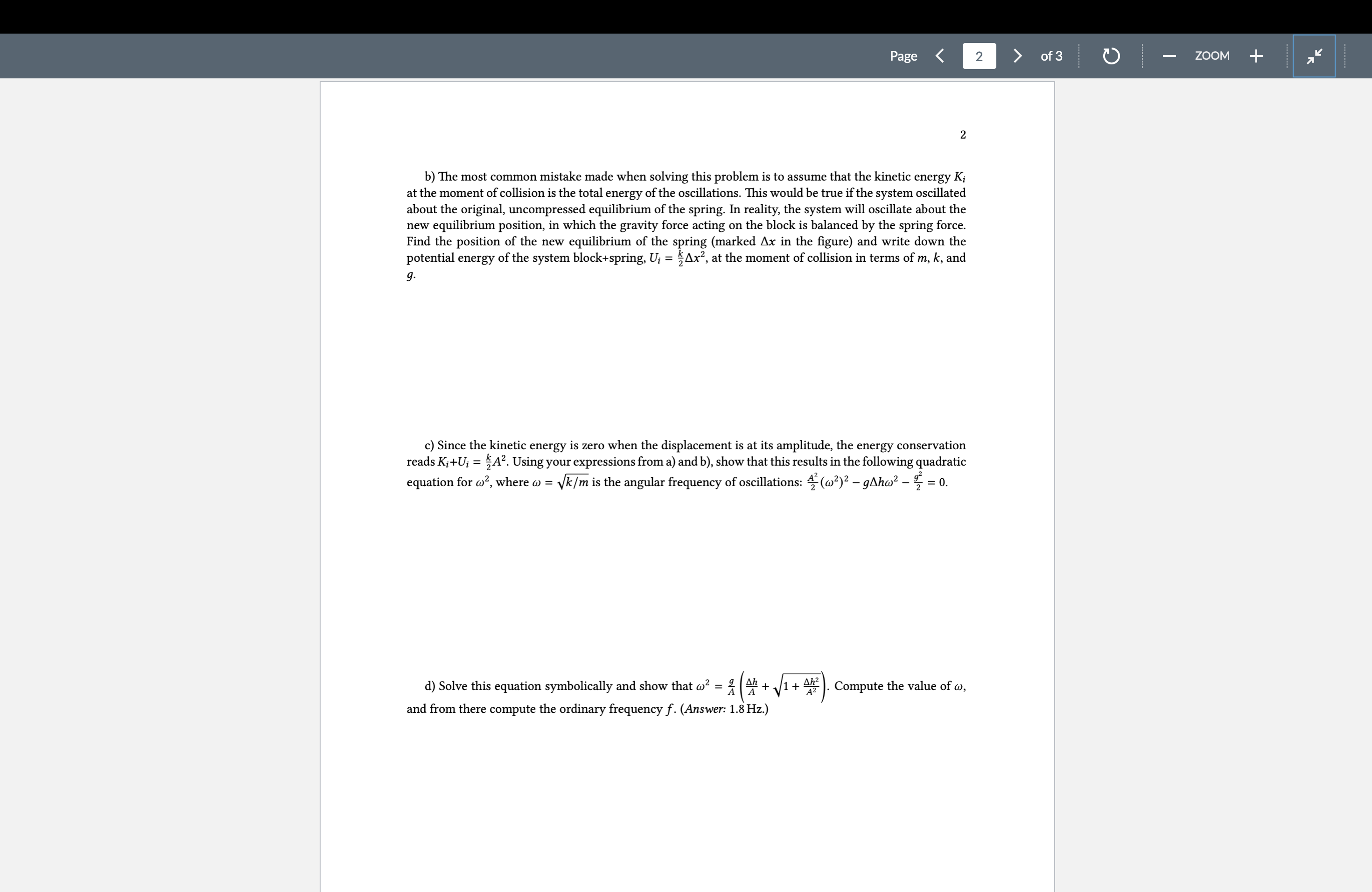
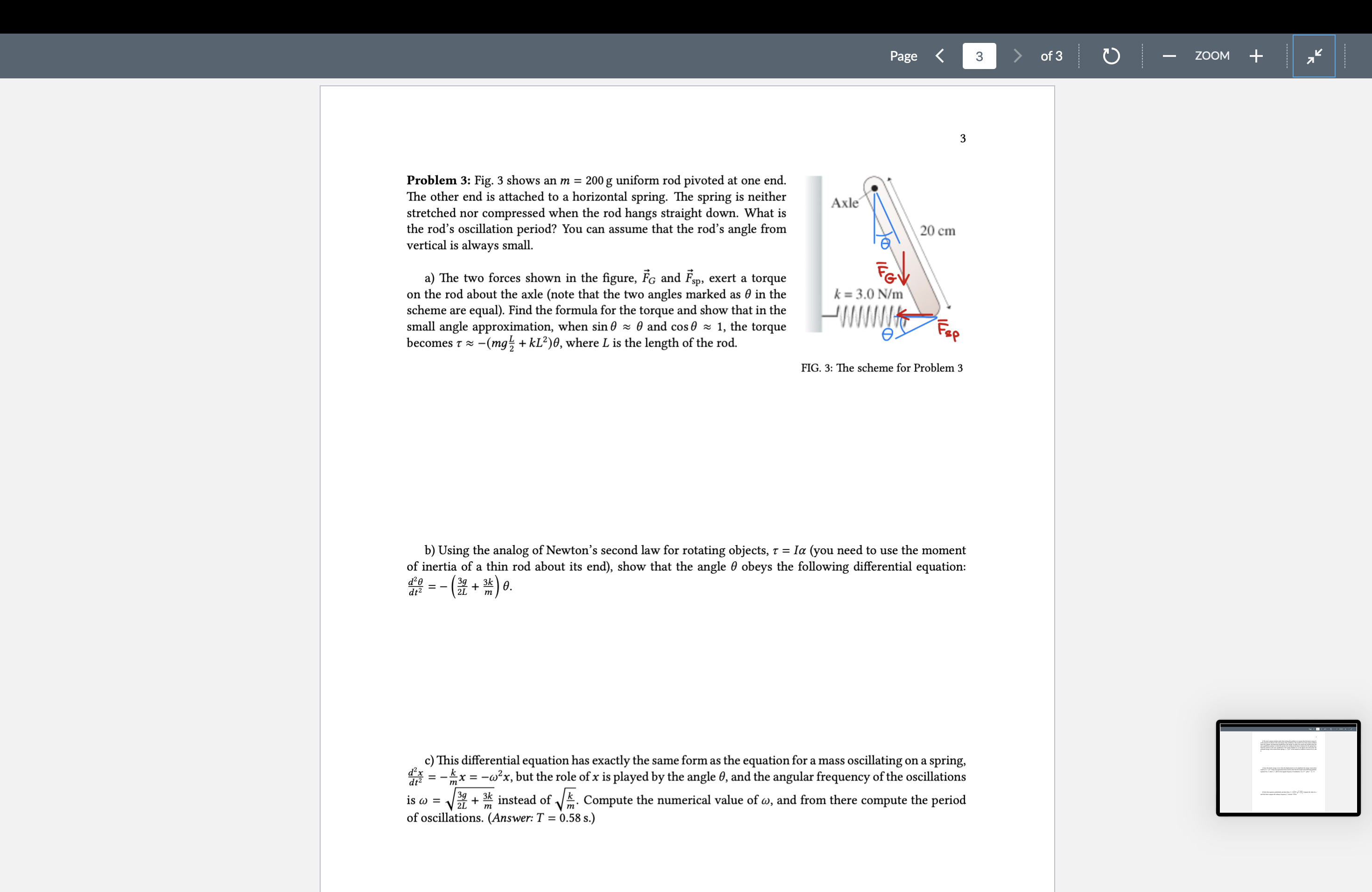
Homework 11 Problem 1: A mass hanging from a spring oscillates with a period T = 0.35 5. Suppose the mass and spring are swung in a horizontal circle, with the free end of the spring at the pivot. What rotation frequency, in rpm, will cause the spring's length to stretch by 15%? a) Fig. 1 shows the mass and spring swung in a horizontal circle with angular frequency mm (view from the top), the spring being already stretched by Ax with respect to its original length L The only force that produces the centripetal acceleration in this picture is the spring force Esp. Using Newton's second law, show that the frequency mm. can be Ax/l expressed in terms of the other parameters as mm, = a) m = k/m is the natural oscillation frequency of the spring. / \\ / L+Ax \\ x a l WNW \\ E\"? l \\ \\ / / / FIG 1: The scheme for Problem 1 b) Using the period of the spring to nd to, compute the value of mm required to stretch the spring by 15%. (Answer: 61.8 rpm.) Problem 2: A spring is standing upright on a table with its bottom end fastened to the table. A block is dropped from a height Ah : 3 cm above the top of the spring. The block sticks to the top end of the spring and then oscillates with an amplitude of A : 10 am What is the oscillation frequency f 7 3) Assume the mass of the block is m. Using the energy conservation law, write down the expression for the kinetic energy K. of the block just before it hits the spring in terms of m, g, and Ah. 0Q 4412 Spring FIG. 2: The scheme for Problem 2 b) The most common mistake made when solving this problem is to assume that the kinetic energy K.- at the moment of collision is the total energy of the oscillations This would be true if the system oscillated about the original, uncompressed equilibrium of the spring, In reality, the system will oscillate about the new equilibrium position, in which the gravity force acting on the block is balanced by the spring force. Find the position of the new equilibrium of the spring (marked Ax in the gure) and write down the potential energy ofthe system block+spring, U.- = Ax2, at the moment of collision in terms of m, k, and g. c) Since the kinetic energy is zero when the displacement is at its amplitude, the energy conservation reads K,+U. = 'E'Az, Using your expressions from a) and b), show that this results in the following quadratic equation for :02, where w = 1/k/m is the angular frequency of oscillations: '%2 (9)2 7 gAhw2 7 g = 0. d) Solve this equation symbolically and show that (02 = 1% (67" + ). Compute the Value of a), and from there compute the ordinary frequency f . (Answer: 1.8 Hz.) Problem 3: Fig 3 shows an m = 200 g uniform rod pivoted at one end. ' . ,' The other end is attached to a horizontal spring. The spring is neither \"10 ' stretched nor compressed when the rod hangs straight down. What is the rods oscillation period? You can assume that the rod's angle from _, 31) cm vertical is always small. 6 a) The two forces shown in the gure, F}; and 55p, exert a torque FG-i '. on the rod about the axle (note that the two angles marked as 0 in the A = H) .\\/In ' scheme are equal). Find the formula for the torque and show that in the _1 ' l ' l l l (V . . i . i 9i F\"? small angle approximation, when sin 9 z 9 and cos 9 z 1, the torque becomes 1' 2 (mg%' + kL2)9, where L is the length of the rod. FIG. 3: The scheme for Problem 3 b) Using the analog of Newton's second law for rotating objects, 1' = Id (you need to use the moment of inertia of a thin rod about its end), show that the angle 9 obeys the following differential equation: ,_ 31 i aii (2L+m)9' c) This differential equation has exactly the same form as the equation for a mass oscillating on a spring, 7% = x = wzx. but the role of x is played by the angle 9. and the angular frequency of the oscillations is w = , a? + % instead of m. Compute the numerical value of a), and from there compute the period of oscillations (Answer: T = 058 si)
Step by Step Solution
There are 3 Steps involved in it

Get step-by-step solutions from verified subject matter experts
 Study Help