







Question: Homework 3: chapters 4 Receivables and chapter 5 Inventory 1. Claims for which formal instruments of credit are issued as proof of the debt are
Homework 3: chapters 4 Receivables and chapter 5 Inventory 1. Claims for which formal instruments of credit are issued as proof of the debt are a. accounts receivable. b. interest receivable. c. notes receivable. d. other receivables. 2- To be classified as a current asset, an investment must meet the following criteria: A- The investment must be liquid (easily convertible to cash); and B- The investor must intend to either convert the investment to cash within one year C- can be use it to pay a current liability. D- All of them 3- Companies invest in debt or equity securities of other companies for many reasons such as: A-Having excess cash that is not immediately needed. B- A company may invest the cash in hopes of earning additionally income from investments. C- Long-term strategic reasons such as obtaining the ability to influence another company. D- All of them 4- There are several strategies for increasing the current ratio. A-Launch a major sales effort to increase cash and receivables to improve the current ratio. B-Pay off some current liabilities before year end. C-Reclassifying investments as current assets. D- All of them 5- A gross profit percentage of 38% means each $1 of sales generates A- $0.38 of gross profit. B- $38 of gross profit. C- $3.8 of gross profit. 6- The inventory turnover A- Is the Ratio of cost of goods sold to average inventory B- Indicates how rapidly inventory is sold C- Varies from industry to industry D- All of them
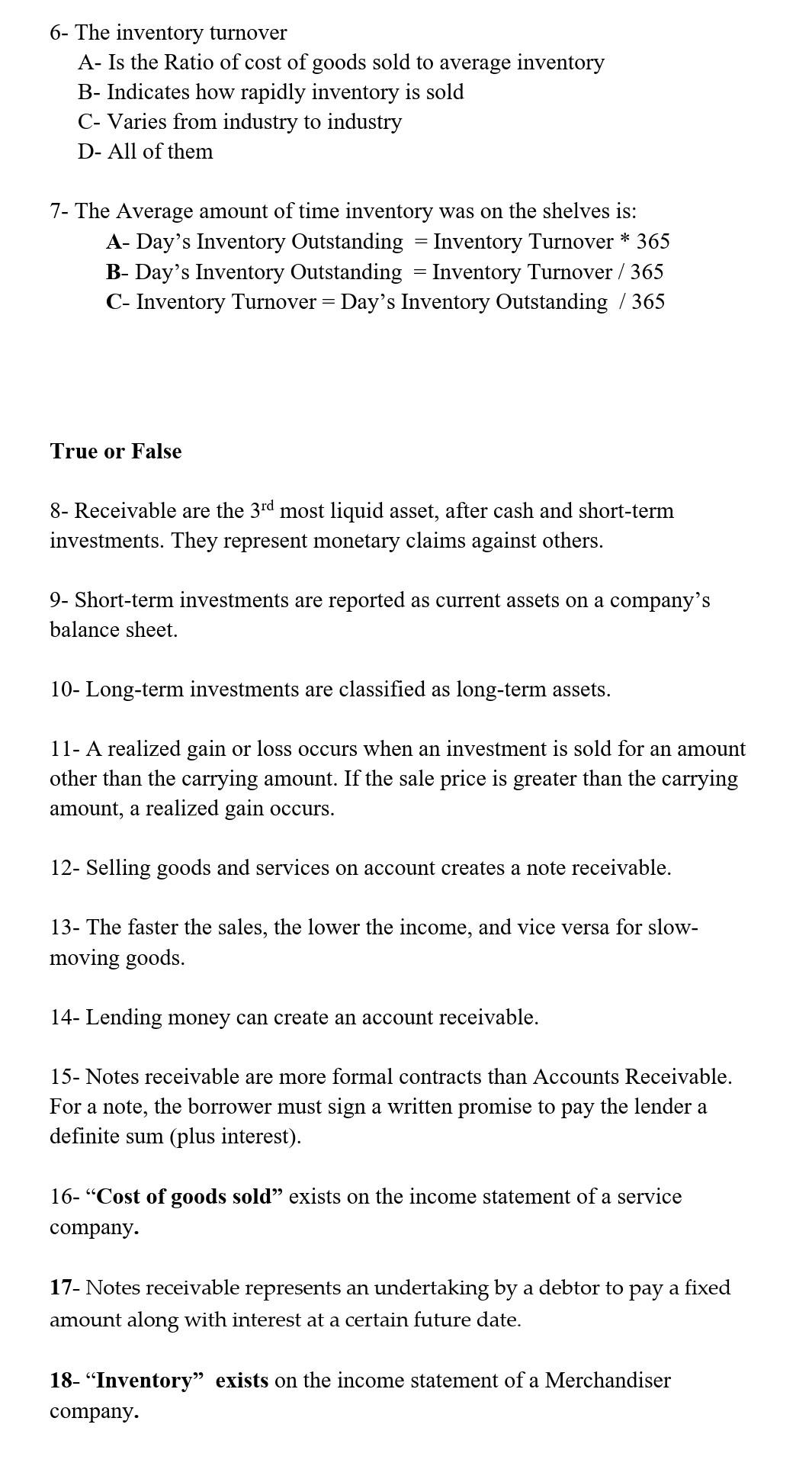
6- The inventory turnover A- Is the Ratio of cost of goods sold to average inventory B- Indicates how rapidly inventory is sold C- Varies from industry to industry D- All of them 7- The Average amount of time inventory was on the shelves is: A- Day's Inventory Outstanding = Inventory Turnover 365 B- Day's Inventory Outstanding = Inventory Turnover /365 C- Inventory Turnover = Day's Inventory Outstanding /365 True or False 8- Receivable are the 3rd most liquid asset, after cash and short-term investments. They represent monetary claims against others. 9- Short-term investments are reported as current assets on a company's balance sheet. 10- Long-term investments are classified as long-term assets. 11- A realized gain or loss occurs when an investment is sold for an amount other than the carrying amount. If the sale price is greater than the carrying amount, a realized gain occurs. 12- Selling goods and services on account creates a note receivable. 13- The faster the sales, the lower the income, and vice versa for slowmoving goods. 14- Lending money can create an account receivable. 15- Notes receivable are more formal contracts than Accounts Receivable. For a note, the borrower must sign a written promise to pay the lender a definite sum (plus interest). 16- "Cost of goods sold" exists on the income statement of a service company. 17- Notes receivable represents an undertaking by a debtor to pay a fixed amount along with interest at a certain future date. 18- "Inventory" exists on the income statement of a Merchandiser company
Step by Step Solution
There are 3 Steps involved in it

Get step-by-step solutions from verified subject matter experts
 Study Help