







Question: Homework about stack I need this. C or C++ does not matter. Stacks Lab Objectives: Base Conversion using stack (Binary to decimal) Postfix Calculator Study
Homework about stack I need this. C or C++ does not matter.
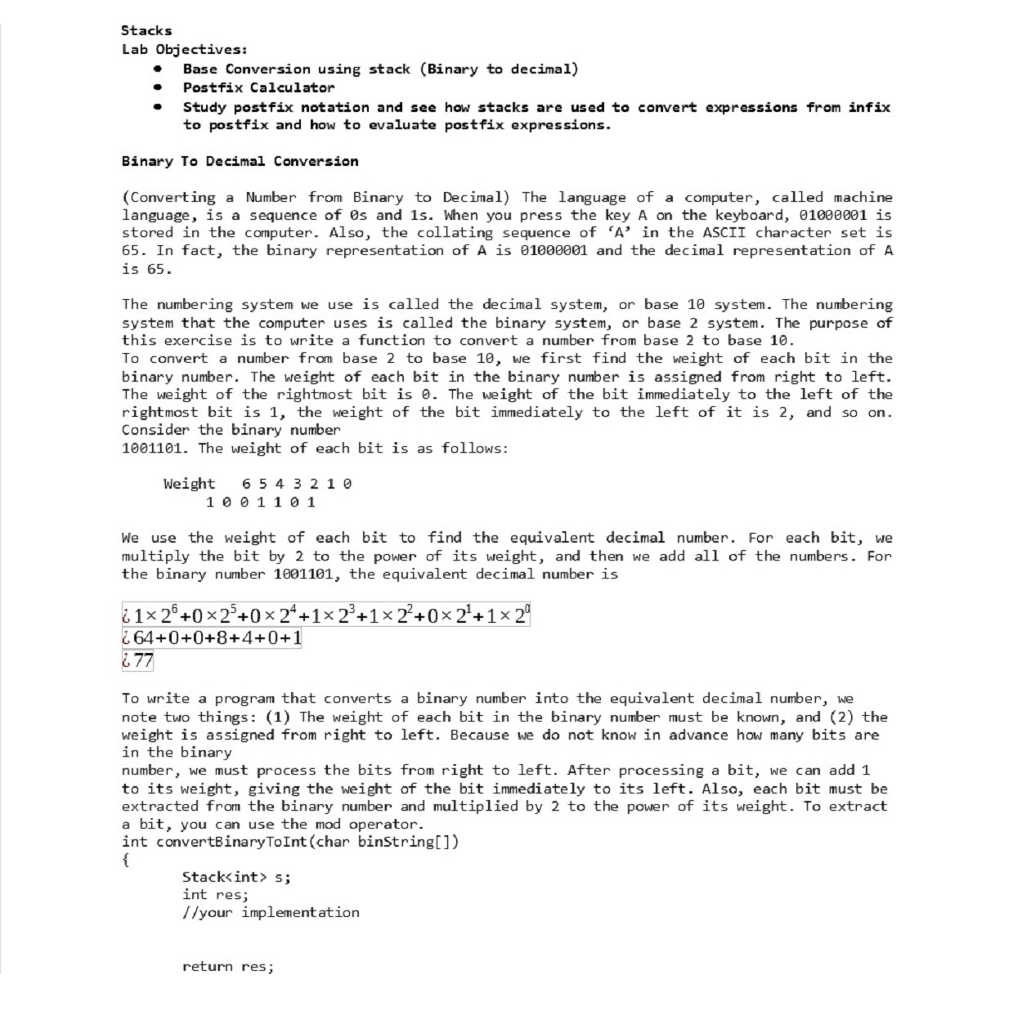
Stacks Lab Objectives: Base Conversion using stack (Binary to decimal) Postfix Calculator Study postfix not at? n and see how stacks are us ed to c nvert expressions from infix to postfix and how to evaluate postfix expressions. Binary To Decimal Conversion (Converting a Number from Binary to Decimal) The language of a computer, called machine language, is a sequence of s and 1s. When you press the key A on the keyboard, 01000001 is stored in the computer. Also, the collating sequence of A' in the ASCII character set is 65. In fact, the binary representation of A is 01000ee1 and the decimal representation ofA is 65 The numbering system we use is called the decimal system, or base 10 system. The numbering system that the computer uses is called the binary system, or base 2 system. The purpose of this exercise is to write a function to convert a number from base 2 to base 10. To convert a number from base 2 to base 10, we first find the weight of each bit in the binary number. The weight of each bit in the binary number is assigned from right to left. The weight of the rightmost bit is e. The weight of the bit immediately to the left of the rightmost bit is 1, the weight of the bit immediately to the left of it is 2, and so on Consider the binary number 1001101. The weight of each bit is as follows: Weight 6 5 4 3 2 1 0 10 0 11 01 We use the weight of each bit to find the equivalent decimal number. For each bit, we multiply the bit by 2 to the power of its weight, and then we add all of the numbers. Fon the binary number 1001101, the equivalent decimal number is , 1x26 +0 x2"40x24+1x2+1x2+0x2+1x2 , 64+0+0+8+4+0+1 877 To write a program that converts a binary number into the equivalent decimal number, we note two things: (1) The weight of each bit in the binary number must be known, and (2) the weight is assigned from right to left. Because we do not know in advance how many bits are in the binary number, we must process the bits from right to left. After processing a bit, we can add 1 to its weight, giving the weight of the bit immediately to its left. Also, each bit must be extracted from the binary number and multiplied by 2 to the power of its weight. To extract a bit, you can use the mod operator. int convertBinaryToInt (char binString]) Stack
Step by Step Solution
There are 3 Steps involved in it

Get step-by-step solutions from verified subject matter experts
 Study Help