





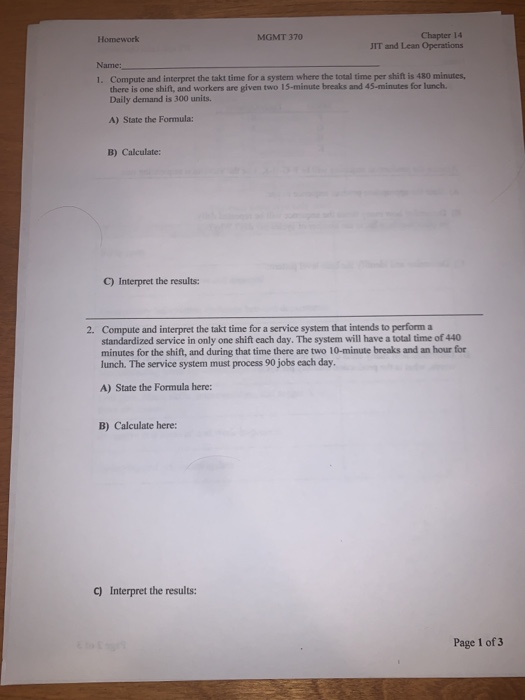
Question: Homework MGMT 370 Chapter 14 JIT and Lean Operations Name: 1. Compute and interpret the takt time for a system where the total time per
Homework MGMT 370 Chapter 14 JIT and Lean
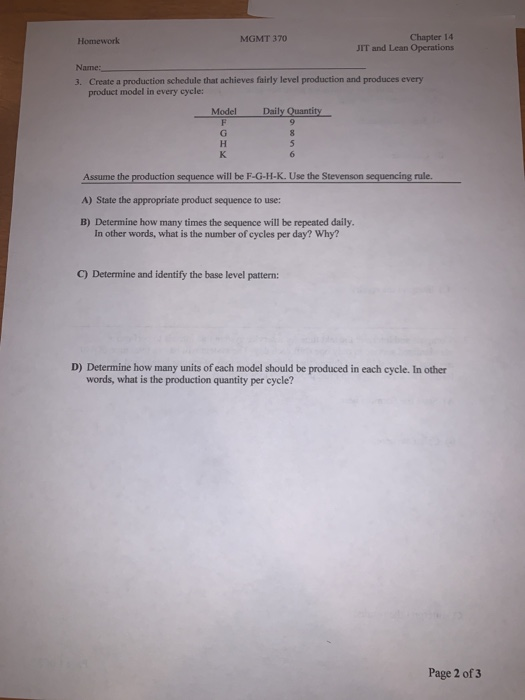
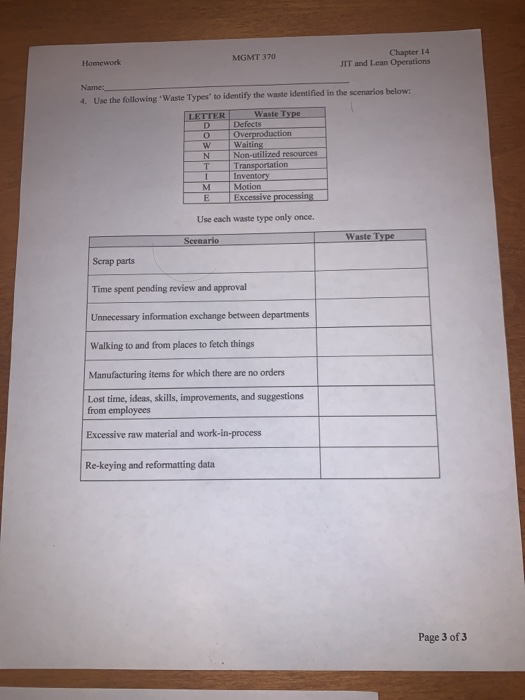
Homework MGMT 370 Chapter 14 JIT and Lean Operations Name: 1. Compute and interpret the takt time for a system where the total time per shift is 480 minutes, there is one shift, and workers are given two 15-minute breaks and 45 minutes for lunch. Daily demand is 300 units. A) State the Formula: B) Calculate: C) Interpret the results: 2. Compute and interpret the takt time for a service system that intends to perform a standardized service in only one shift each day. The system will have a total time of 440 minutes for the shift, and during that time there are two 10-minute breaks and an hour for lunch. The service system must process 90 jobs each day, A) State the Formula here: B) Calculate here: C) Interpret the results: Page 1 of 3 Homework MGMT 370 Chapter 14 JIT and Lean Operations Name: 3. Create a production schedule that achieves fairly level production and produces every product model in every cycle: Model F G H K Daily Quantity 9 8 5 6 Assume the production sequence will be F-G-H-K. Use the Stevenson sequencing rule. A) State the appropriate product sequence to use: B) Determine how many times the sequence will be repeated daily. In other words, what is the number of cycles per day? Why? C) Determine and identify the base level pattern: D) Determine how many units of each model should be produced in each cycle. In other words, what is the production quantity per cycle? Page 2 of 3 Homework MGMT 370 Chapter 14 JIT and Lean Operations Name: 4. Use the following 'Waste Types to identify the waste identified in the scenarios below: LETTER Waste Type D Defects 0 Overproduction w Waiting N Non-utilized resources T Transportation 1 Inventory M Motion E Excessive processing Use each waste type only once. Waste Type Scenario Scrap parts Time spent pending review and approval Unnecessary information exchange between departments Walking to and from places to fetch things Manufacturing items for which there are no orders Lost time, ideas, skills, improvements, and suggestions from employees Excessive raw material and work-in-process Re-keying and reformatting data Page 3 of 3
Step by Step Solution

There are 3 Steps involved in it

1 Expert Approved Answer
Step: 1 Unlock blur-text-image

Question Has Been Solved by an Expert!

Get step-by-step solutions from verified subject matter experts

Step: 2 Unlock
Step: 3 Unlock

Students Have Also Explored These Related General Management Questions!