







Question: homework : You are responsible for the case study in this week's section, You should criticize the case, max 1 page... Case study - XYZ:
homework :
You are responsible for the case study in this week's section, You should criticize the case, max 1 page...
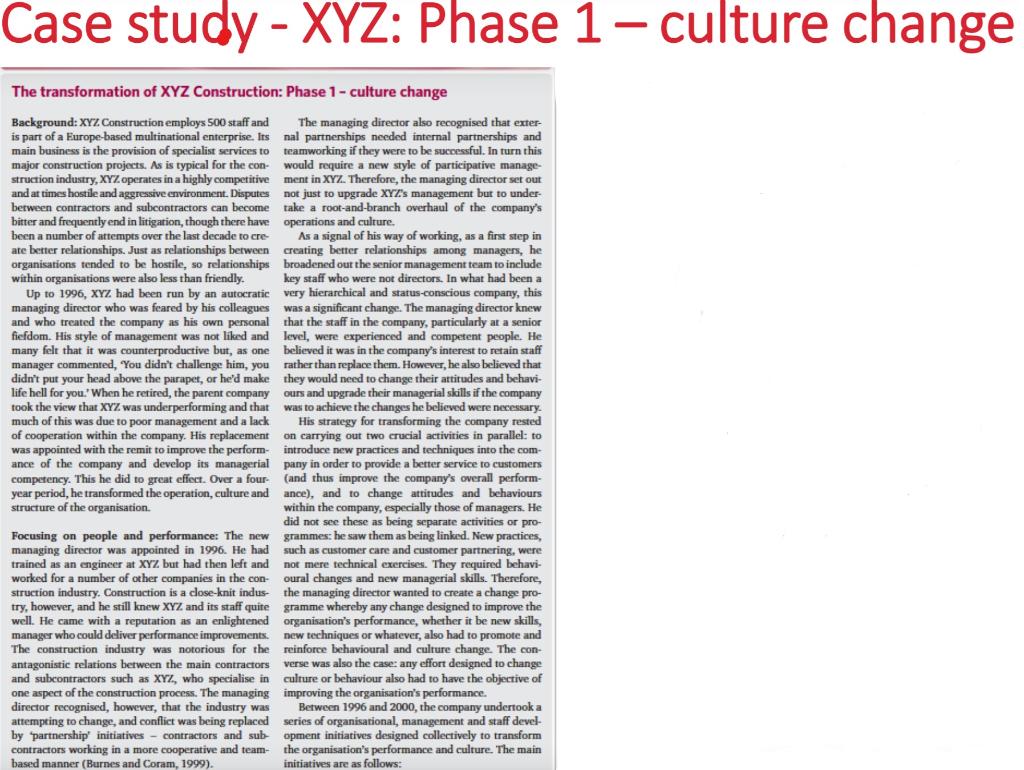
Case study - XYZ: Phase 1 - culture change The transformation of XYZ Construction: Phase 1 - culture change Background: XYZ Construction employs 500 staff and The managing director also recognised that exter- is part of a Europe-based multinational enterprise. Its nal partnerships needed internal partnerships and main business is the provision of specialist services to teamworking if they were to be successful. In turn this major construction projects. As is typical for the con- would require a new style of participative manage- struction industry, XYZ operates in a highly competitive ment in XYZ. Therefore, the managing director set out and at times hostile and aggressive environment. Disputes not just to upgrade XYZ's management but to under- berween contractors and subcontractors can become take a root-and-branch overhaul of the company's bitter and frequently end in litigation, though there have operations and culture. been a number of attempts over the last decade to cre As a signal of his way of working, as a first step in are better relationships. Just as relationships between creating better relationships among managers, he organisations tended to be hostile, so relationships broadened out the senior management team to include within organisations were also less than friendly key staff who were not directors. In what had been a Up to 1996, XYZ had been run by an autocratic very hierarchical and status-conscious company, this managing director who was feared by his colleagues was a significant change. The managing director knew and who treated the company as his own personal that the staff in the company, particularly at a senior fiefdom. His style of management was not liked and level, were experienced and competent people. He many felt that it was counterproductive but, as one believed it was in the company's interest to retain staff manager commented, 'You didn't challenge him, you rather than replace them. However, he also believed that didn't put your head above the parapet, or he'd make they would need to change their attitudes and behavi- life hell for you. When he retired, the parent company ours and upgrade their managerial skills if the company took the view that XYZ was underperforming and that was to achieve the changes he believed were necessary much of this was due to poor management and a lack His strategy for transforming the company rested of cooperation within the company. His replacement on carrying out two crucial activities in parallel: to was appointed with the remit to improve the perform- introduce new practices and techniques into the com- ance of the company and develop its managerial pany in order to provide a better service to customers competency. This he did to great effect. Over a four- (and thus improve the company's overall perform- year period, he transformed the operation, culture and ance), and to change attitudes and behaviours structure of the organisation. within the company, especially those of managers. He did not see these as being separate activities or pro- Focusing on people and performance: The new grammes: he saw them as being linked. New practices, managing director was appointed in 1996. He had such as customer care and customer partnering, were trained as an engineer at XYZ but had then left and not mere technical exercises. They required behavi- worked for a number of other companies in the con oural changes and new managerial skills. Therefore, struction industry. Construction is a close-knit indus- the managing director wanted to create a change pro- try, however, and he still knew XYZ and its staff quite gramme whereby any change designed to improve the well. He came with a reputation as an enlightened organisation's performance, whether it be new skills, manager who could deliver performance improvements. new techniques or whatever, also had to promote and The construction industry was notorious for the reinforce behavioural and culture change. The con- antagonistic relations between the main contractors verse was also the case any effort designed to change and subcontractors such as XYZ, who specialise culture or behaviour also had to have the objective of one aspect f the construction process. The managing improving the organisation's performance. director recognised, however, that the industry was Between 1996 and 2000, the company undertook a attempting to change, and conflict was being replaced series of organisational, management and staff devel by partnership initiatives contractors and sub opment initiatives designed collectively to transform contractors working in a more cooperative and team- the organisation's performance and culture. The main based manner (Burnes and Coram, 1999). initiatives are as followsStep by Step Solution
There are 3 Steps involved in it
1 Expert Approved Answer
Step: 1 Unlock

Question Has Been Solved by an Expert!
Get step-by-step solutions from verified subject matter experts
Step: 2 Unlock
Step: 3 Unlock
 Study Help