







Question: Hooke's Law: Suppose we have a spring with an unknown spring constant k. We are inter- ested in finding the specific value of k
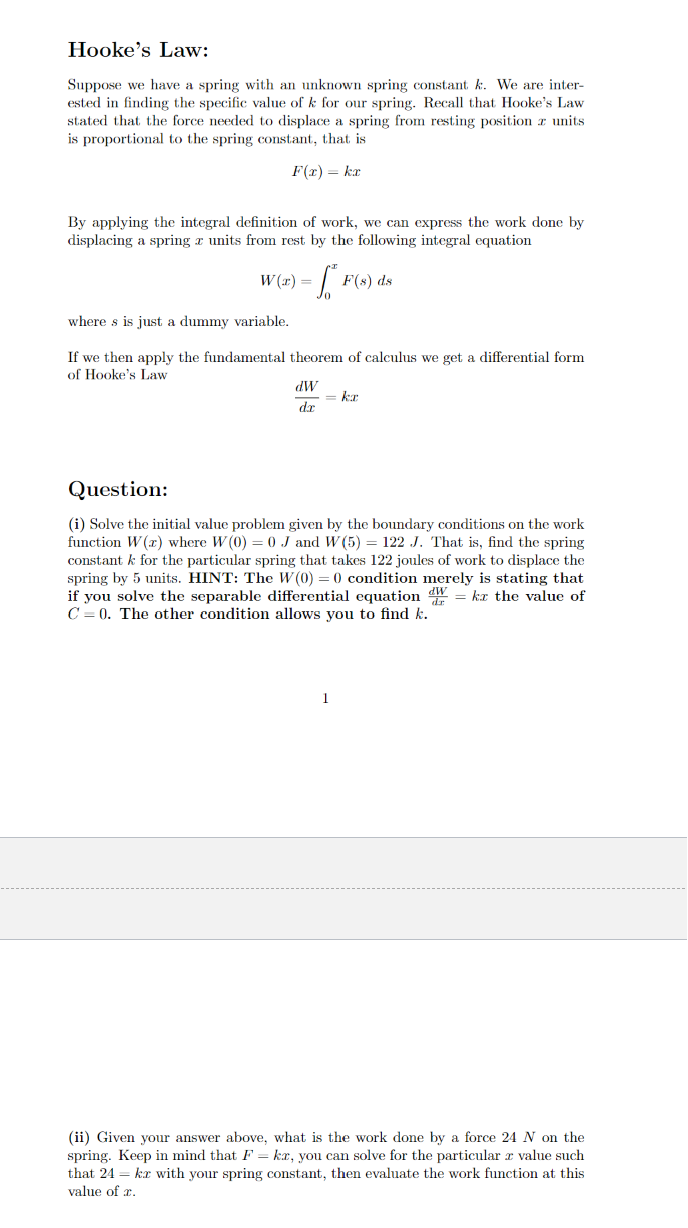
Hooke's Law: Suppose we have a spring with an unknown spring constant k. We are inter- ested in finding the specific value of k for our spring. Recall that Hooke's Law stated that the force needed to displace a spring from resting position units is proportional to the spring constant, that is F(x) = kx By applying the integral definition of work, we can express the work done by displacing a spring units from rest by the following integral equation W(x) = - f* F(s) ds where s is just a dummy variable. If we then apply the fundamental theorem of calculus we get a differential form of Hooke's Law dW dr = ka Question: (i) Solve the initial value problem given by the boundary conditions on the work function W(z) where W (0) = 0 J and W(5) = 122 J. That is, find the spring constant k for the particular spring that takes 122 joules of work to displace the spring by 5 units. HINT: The W(0) = 0 condition merely is stating that if you solve the separable differential equation = kr the value of C = 0. The other condition allows you to find k. 1 (ii) Given your answer above, what is the work done by a force 24 N on the spring. Keep in mind that F = kr, you can solve for the particular z value such that 24 = kr with your spring constant, then evaluate the work function at this value of a.
Step by Step Solution
There are 3 Steps involved in it
i To solve the initial value problem we have the differential equation ddxW ... View full answer

Get step-by-step solutions from verified subject matter experts
 Study Help