







Question: Data Table 1 Force (N) Stretch (m) k (N/m) PART B: THE OTHER MATTER Step 1: Describe a method to determine the mass of the
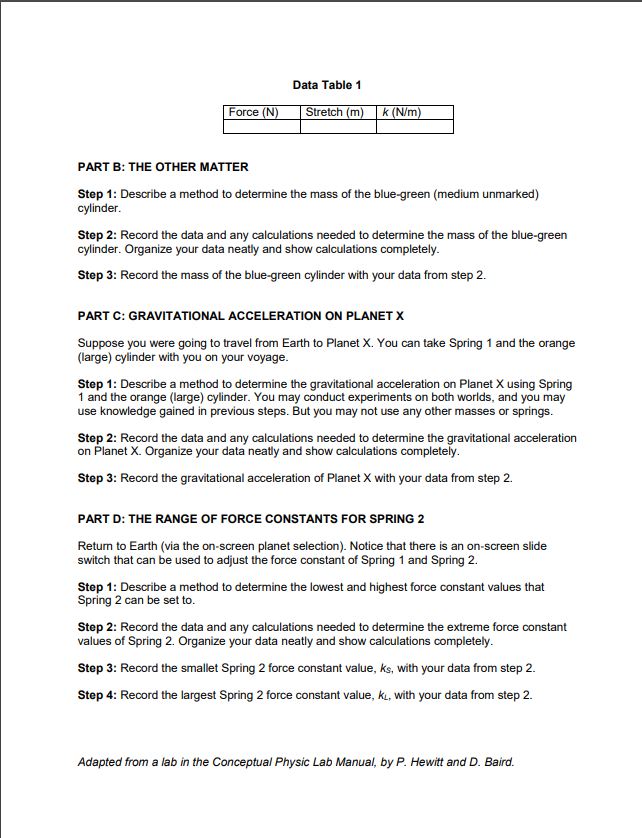
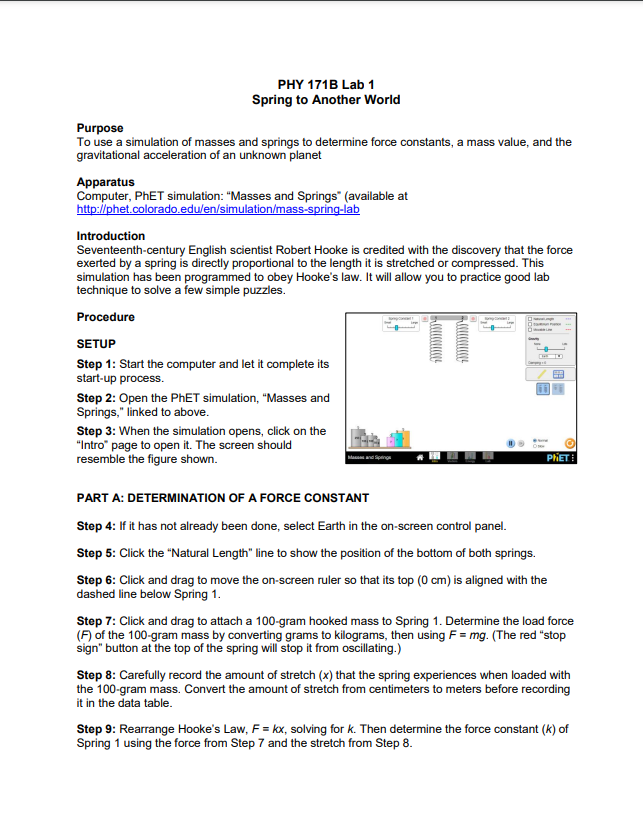
Data Table 1 Force (N) Stretch (m) k (N/m) PART B: THE OTHER MATTER Step 1: Describe a method to determine the mass of the blue-green (medium unmarked) cylinder. Step 2: Record the data and any calculations needed to determine the mass of the blue-green cylinder. Organize your data neatly and show calculations completely. Step 3: Record the mass of the blue-green cylinder with your data from step 2. PART C: GRAVITATIONAL ACCELERATION ON PLANET X Suppose you were going to travel from Earth to Planet X. You can take Spring 1 and the orange (large) cylinder with you on your voyage. Step 1: Describe a method to determine the gravitational acceleration on Planet X using Spring 1 and the orange (large) cylinder. You may conduct experiments on both worlds, and you may use knowledge gained in previous steps. But you may not use any other masses or springs. Step 2: Record the data and any calculations needed to determine the gravitational acceleration on Planet X. Organize your data neatly and show calculations completely. Step 3: Record the gravitational acceleration of Planet X with your data from step 2. PART D: THE RANGE OF FORCE CONSTANTS FOR SPRING 2 Return to Earth (via the on-screen planet selection). Notice that there is an on-screen slide switch that can be used to adjust the force constant of Spring 1 and Spring 2. Step 1: Describe a method to determine the lowest and highest force constant values that Spring 2 can be set to. Step 2: Record the data and any calculations needed to determine the extreme force constant values of Spring 2. Organize your data neatly and show calculations completely. Step 3: Record the smallet Spring 2 force constant value, ks, with your data from step 2. Step 4: Record the largest Spring 2 force constant value, ki, with your data from step 2. Adapted from a lab in the Conceptual Physic Lab Manual, by P. Hewitt and D. Baird.PHY 171B Lab 1 Spring to Another World Purpose To use a simulation of masses and springs to determine force constants, a mass value, and the gravitational acceleration of an unknown planet Apparatus Computer, PhET simulation: "Masses and Springs" (available at http://phet.colorado.edu/en/simulation/mass-spring-lab Introduction Seventeenth-century English scientist Robert Hooke is credited with the discovery that the force exerted by a spring is directly proportional to the length it is stretched or compressed. This simulation has been programmed to obey Hooke's law. It will allow you to practice good lab technique to solve a few simple puzzles. Procedure SETUP Step 1: Start the computer and let it complete its start-up process. Step 2: Open the PhET simulation, "Masses and Springs," linked to above. Step 3: When the simulation opens, click on the "Intro" page to open it. The screen should resemble the figure shown. PHET PART A: DETERMINATION OF A FORCE CONSTANT Step 4: If it has not already been done, select Earth in the on-screen control panel. Step 5: Click the "Natural Length" line to show the position of the bottom of both springs. Step 6: Click and drag to move the on-screen ruler so that its top (0 cm) is aligned with the dashed line below Spring 1. Step 7: Click and drag to attach a 100-gram hooked mass to Spring 1. Determine the load force (F) of the 100-gram mass by converting grams to kilograms, then using F = mg. (The red "stop sign" button at the top of the spring will stop it from oscillating.) Step 8: Carefully record the amount of stretch (x) that the spring experiences when loaded with the 100-gram mass. Convert the amount of stretch from centimeters to meters before recording it in the data table. Step 9: Rearrange Hooke's Law, F = kx, solving for k. Then determine the force constant (k) of Spring 1 using the force from Step 7 and the stretch from Step 8
Step by Step Solution
There are 3 Steps involved in it

Get step-by-step solutions from verified subject matter experts
 Study Help