



Question: How can I change the information listed into ten commandments as it relates to Clinical Decision Support for breast cancer screening? CHAPTER 6 Patients, Doctors,
How can I change the information listed into ten commandments as it relates to Clinical Decision Support for breast cancer screening? 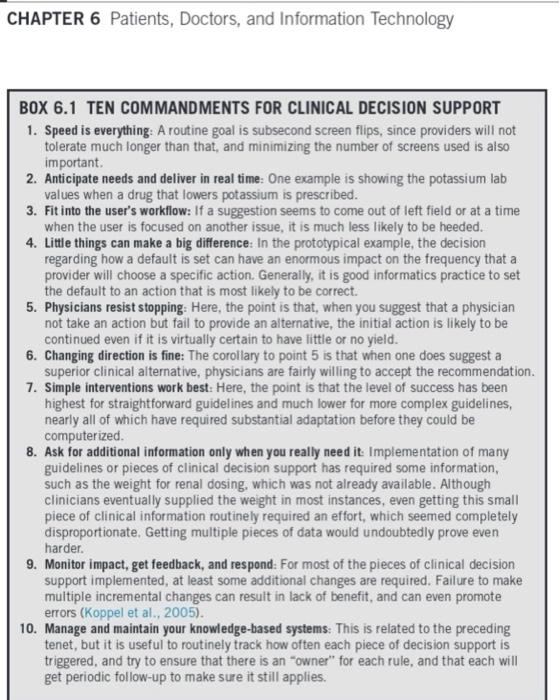
CHAPTER 6 Patients, Doctors, and Information Technology BOX 6.1 TEN COMMANDMENTS FOR CLINICAL DECISION SUPPORT 1. Speed is everything: A routine goal is subsecond screen flips, since providers will not tolerate much longer than that, and minimizing the number of screens used is also important 2. Anticipate needs and deliver in real time: One example is showing the potassium lab values when a drug that lowers potassium is prescribed. 3. Fit into the user's workflow: If a suggestion seems to come out of left field or at a time when the user is focused on another issue, it is much less likely to be heeded. 4. Little things can make a big difference: In the prototypical example, the decision regarding how a default is set can have an enormous impact on the frequency that a provider will choose a specific action. Generally, it is good informatics practice to set the default to an action that is most likely to be correct. 5. Physicians resist stopping: Here, the point is that, when you suggest that a physician not take an action but fail to provide an alternative, the initial action is likely to be continued even if it is virtually certain to have little or no yield. 6. Changing direction is fine: The corollary to point 5 is that when one does suggest a superior clinical alternative, physicians are fairly willing to accept the recommendation. 7. Simple interventions work best: Here, the point is that the level of success has been highest for straightforward guidelines and much lower for more complex guidelines, nearly all of which have required substantial adaptation before they could be computerized. 8. Ask for additional information only when you really need it. Implementation of many guidelines or pieces of clinical decision support has required some information, such as the weight for renal dosing, which was not already available. Although clinicians eventually supplied the weight in most instances, even getting this small piece of clinical information routinely required an effort, which seemed completely disproportionate. Getting multiple pieces of data would undoubtedly prove even harder. 9. Monitor impact, get feedback, and respond: For most of the pieces of clinical decision support implemented, at least some additional changes are required. Failure to make multiple incremental changes can result in lack of benefit, and can even promote errors (Koppel et al., 2005). 10. Manage and maintain your knowledge-based systems: This is related to the preceding tenet, but it is useful to routinely track how often each piece of decision support is triggered, and try to ensure that there is an owner" for each rule, and that each will get periodic follow-up to make sure it still applies
Step by Step Solution
There are 3 Steps involved in it
1 Expert Approved Answer
Step: 1 Unlock

Question Has Been Solved by an Expert!
Get step-by-step solutions from verified subject matter experts
Step: 2 Unlock
Step: 3 Unlock