







Question: How can I solve this question? This question allows you to demonstrate your understanding of the different number bases associated with CCNA1. To obtain the
How can I solve this question?
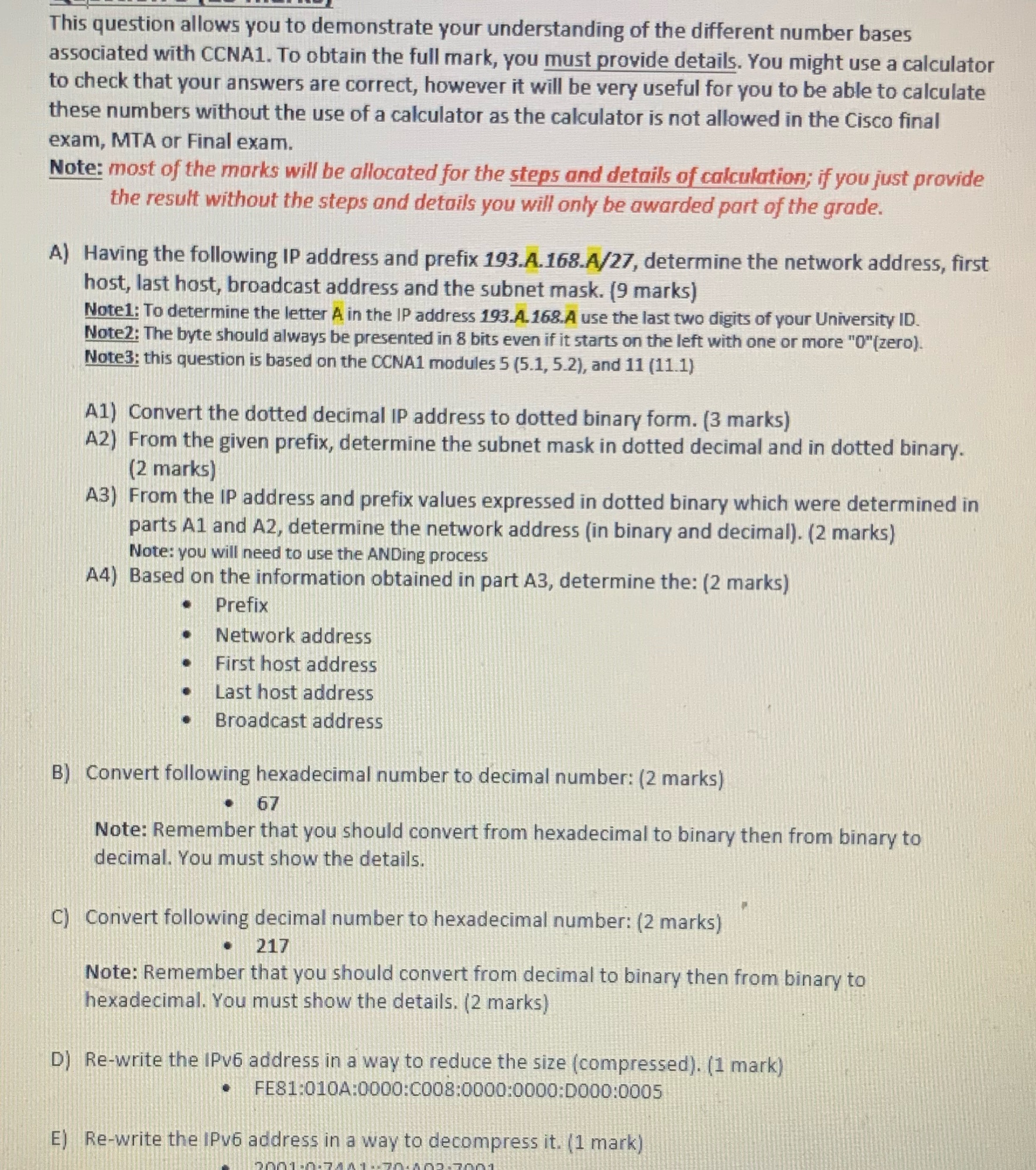
This question allows you to demonstrate your understanding of the different number bases associated with CCNA1. To obtain the full mark, you must provide details. You might use a calculator to check that your answers are correct, however it will be very useful for you to be able to calculate these numbers without the use of a calculator as the calculator is not allowed in the Cisco final exam, MTA or Final exam. Note: most of the marks will be allocated for the steps and details of calculation; if you just provide the result without the steps and details you will only be awarded part of the grade. A) Having the following IP address and prefix 193.A.168.A/27, determine the network address, first host, last host, broadcast address and the subnet mask. (9 marks) Note1: To determine the letter A in the IP address 193.A.168.A use the last two digits of your University ID. Note2: The byte should always be presented in 8 bits even if it starts on the left with one or more "0"(zero). Note3: this question is based on the CCNA1 modules 5 (5.1, 5.2), and 11 (11.1) A1) Convert the dotted decimal IP address to dotted binary form. (3 marks) A2) From the given prefix, determine the subnet mask in dotted decimal and in dotted binary. (2 marks) A3) From the IP address and prefix values expressed in dotted binary which were determined in parts A1 and A2, determine the network address (in binary and decimal). (2 marks) Note: you will need to use the ANDing process A4) Based on the information obtained in part A3, determine the: (2 marks) Prefix Network address First host address Last host address Broadcast address B) Convert following hexadecimal number to decimal number: (2 marks) 67 Note: Remember that you should convert from hexadecimal to binary then from binary to decimal. You must show the details. C) Convert following decimal number to hexadecimal number: (2 marks) 217 Note: Remember that you should convert from decimal to binary then from binary to hexadecimal. You must show the details. (2 marks) D) Re-write the IPv6 address in a way to reduce the size (compressed). (1 mark) FE81:010A:0000:C008:0000:0000:D000:0005 . E) Re-write the IPv6 address in a way to decompress it. (1 mark) 2001-0-7441--70-603-3001
Step by Step Solution
There are 3 Steps involved in it

Get step-by-step solutions from verified subject matter experts
 Study Help