







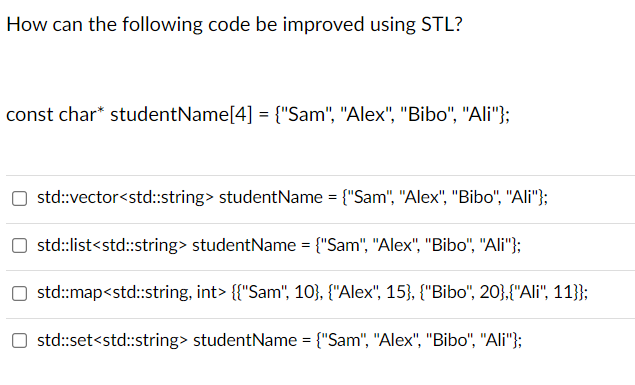
Question: How can the following code be improved using STL? const char* studentName[4] = {Sam, Alex, Bibo, Ali); std::vector studentName = {Sam, Alex, Bibo, Ali); std::list
![studentName[4] = {"Sam", "Alex", "Bibo", "Ali"); std::vector studentName = {"Sam", "Alex", "Bibo",](https://dsd5zvtm8ll6.cloudfront.net/si.experts.images/questions/2024/09/66f3da2f6f4a0_13566f3da2f10bbc.jpg)
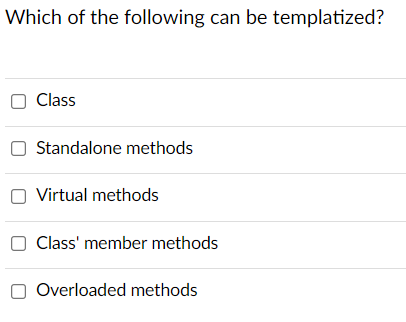
How can the following code be improved using STL? const char* studentName[4] = {"Sam", "Alex", "Bibo", "Ali"); std::vector<:string> studentName = {"Sam", "Alex", "Bibo", "Ali"); std::list<:string> studentName = {"Sam", "Alex", "Bibo", "Ali"); = std::map<:string int> {{"Sam", 10}, {"Alex", 15}, {"Bibo", 20},{"Ali", 11}}; std::set<:string> studentName = {"Sam", "Alex", "Bibo", "Ali"); = What is true about a shared pointer? When an object deletes a shared_ptr, the reference count decreases. The shared_ptr class uses reference counting internally to track the objects that share the pointer. When the reference count in a shared_ptr is 0, the pointer is deleted. O When an object copies a shared_ptr, the reference count increases. O All are correct Which of the following can be templatized? Class Standalone methods Virtual methods Class' member methods Overloaded methods
Step by Step Solution
There are 3 Steps involved in it

Get step-by-step solutions from verified subject matter experts
 Study Help