Question: How did ChotuKool conducted research (collected data) about the needs of potential consumers? What were the techniques they used? Explain these techniques in more detail.
- How did ChotuKool conducted research (collected data) about the needs of potential consumers? What were the techniques they used? Explain these techniques in more detail.
- How did the company benefit from this bottom-up (consumer-centric) approach in collecting data? What were the advantages of the techniques they used as opposed to most overused techniques such as distributing questionnaires? Accordingly, what did they find out about consumer needs? How did co-creation happen?
- The case gives a good idea about the Product P (innovation) and the Price P of the marketing mix. What would be your suggestions for the Place P and thePromotionofChotuKool?
-
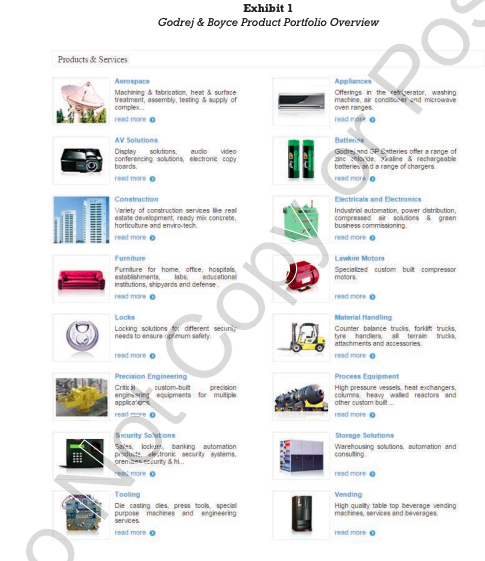
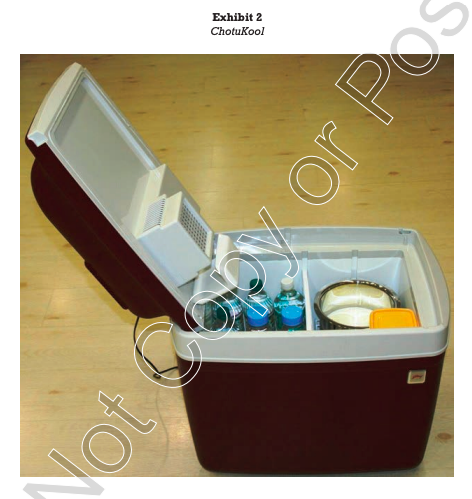
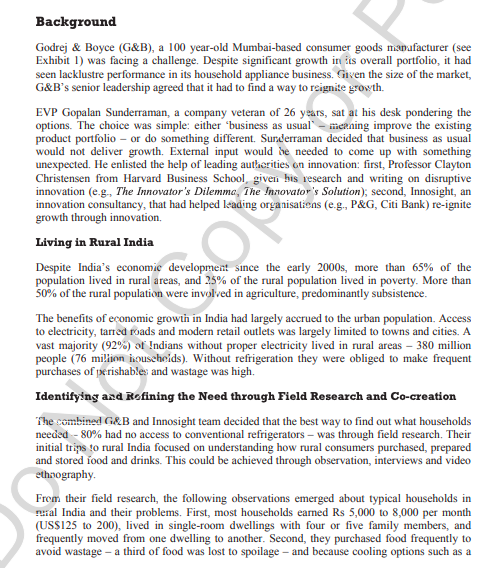
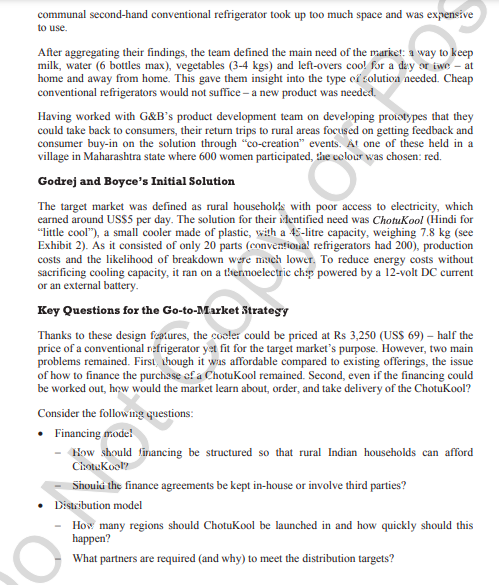
Background Godrej & Boyce (G&B), a 100 year-old Mumbai-based consumer goods manufacturer (see Exhibit I) was facing a challenge. Despite significant growth in its overall portfolio, it had seen lacklustre performance in its household appliance business. Given the size of the market, G&B's senior leadership agreed that it had to find a way to reignite growth. EVP Gopalan Sunderraman, a company veteran of 26 years, sat at his desk pondering the options. The choice was simple: either business as usual' - meaning improve the existing product portfolio - or do something different. Surderraman decided that business as usual would not deliver growth. External input would he needed to come up with something unexpected. He enlisted the help of leading authorities on innovation: first, Professor Clayton Christensen from Harvard Business School, given bis research and writing on disruptive innovation (e.g., The Innovator's Dilemma, The Innovator's Solution); second, Innosight, an innovation consultancy, that had helped leading organisations (eg, P&G, Citi Bank) re-ignite growth through innovation, Living in Rural India Despite India's economic development since the early 2000s, more than 65% of the population lived in rural areas, and 25% of the rural population lived in poverty. More than 50% of the rural population were involved in agriculture, predominantly subsistence. The benefits of economic growth in India had largely accrued to the urban population Access to electricity, tarted roads and modern retail outlets was largely limited to towns and cities. A vast majority (92%) of Indians without proper electricity lived in rural areas - 380 million people (76 million househeids). Without refrigeration they were obliged to make frequent purchases of perishables and wastage was high. Identifying and Refining the Need through Field Research and Co-creation The combined G&B and Innosight team decided that the best way to find out what households needed - 80% had no access to conventional refrigerators was through field research. Their initial trips to rural India focused on understanding how rural consumers purchased, prepared and stored food and drinks. This could be achieved through observation, interviews and video ethnography From their field research, the following observations emerged about typical households in rural India and their problems. First, most households earned Rs 5,000 to 8,000 per month (US$125 to 200), lived in single-room dwellings with four or five family members, and frequently moved from one dwelling to another. Second, they purchased food frequently to avoid wastage - a third of food was lost to spoilage - and because cooling options such as a communal second-hand conventional refrigerator took up too much space and was expensive to use. After aggregating their findings, the team defined the main need of the market: a way to keep milk, water (6 bottles max), vegetables (3-4 kgs) and left-overs cool for a day or iwe - at home and away from home. This gave them insight into the type of solution needed. Cheap conventional refrigerators would not suffice- a new product was needed. Having worked with G&B's product development team on developing prototypes that they could take back to consumers, their return trips to rural areas focused on getting feedback and consumer buy-in on the solution through co-creation" events. At one of these held in a village in Maharashtra state where 600 women participated, the colour was chosen: red. Godrej and Boyce's Initial Solution The target market was defined as rural households with poor access to electricity, which earned around US$5 per day. The solution for their identified need was ChotuKool (Hindi for "little cool"), a small cooler made of plastic, with a 45-litre capacity, weighing 7.8 kg (see Exhibit 2). As it consisted of only 20 parts (conventional refrigerators had 200), production costs and the likelihood of breakdown were much lower. To reduce energy costs without sacrificing cooling capacity, it ran on a thermoelectric chip powered by a 12-volt DC current or an external battery. Key Questions for the Go-to-Market Strategy Thanks to these design features, the cooler could be priced at Rs 3,250 (USS 69) - half the price of a conventional refrigerator yet fit for the target market's purpose. However, two main problems remained. First, though it was affordable compared to existing offerings, the issue of how to finance the purchase of a ChotuKool remained. Second, even if the financing could be worked out, how would the market learn about, order, and take delivery of the ChotuKool? Consider the following questions: Financing mode! - How should financing be structured so that rural Indian households can afford ChoteKool? Should the finance agreements be kept in-house or involve third parties? Distribution model How many regions should Chotukool be launched in and how quickly should this happen? What partners are required (and why) to meet the distribution targets? Exhibit 1 Godrej & Boyce Product Portfolio Overview Products & Services Aerospace Machining & fabrication, hent surface treatment, assembly testing & supply of complexe. 20 Appliances Offerings in the refrigerator, washing machine, air conditioner and microwave oven ranges read AV Solutions Display Solutions, audio video conferencing solution electronic copy boards. read more Batte Godrej Petteries offer a range of ne deine & rechargeable batteries and a range of chargers read more Construction Variety of construction services like real estate development ready ma concrete horticulture and envirotech read more Electrical and Electronics Industrial automation power distribution, compressed & green business commissioning read more Furniture Furniture for home office, hospitais establishments labs educational institutions, shipyards and defense read more Lawim Motors Special custom but compressor motors read more Locks Locking solutions for different secun, needs to ensure opmum safety Material Handling Counter balance trucks, for at trucks tyre handlers terrain trucks attachments and accessories read more read more Sk Precision Engineering Critics custom-built precision engine sing equipments for multiple applicario reader Process Equipment High pressure vessels, heat exchangers, columns, heavy walled reactors and other custom built read more Sucurity Solutions Sales lockan banking automation pidetron security systems orencecurty&HL.. more Storage Solutions Warehousing solutions, automation and consulting read more Tooling Die casting dies. press tools Special purpose machines and engineering services read more Vending High quality table top beverage vending machines services and beverages read more lot ChotuKool Exhibit 2 v or P Background Godrej & Boyce (G&B), a 100 year-old Mumbai-based consumer goods manufacturer (see Exhibit I) was facing a challenge. Despite significant growth in its overall portfolio, it had seen lacklustre performance in its household appliance business. Given the size of the market, G&B's senior leadership agreed that it had to find a way to reignite growth. EVP Gopalan Sunderraman, a company veteran of 26 years, sat at his desk pondering the options. The choice was simple: either business as usual' - meaning improve the existing product portfolio - or do something different. Surderraman decided that business as usual would not deliver growth. External input would he needed to come up with something unexpected. He enlisted the help of leading authorities on innovation: first, Professor Clayton Christensen from Harvard Business School, given bis research and writing on disruptive innovation (e.g., The Innovator's Dilemma, The Innovator's Solution); second, Innosight, an innovation consultancy, that had helped leading organisations (eg, P&G, Citi Bank) re-ignite growth through innovation, Living in Rural India Despite India's economic development since the early 2000s, more than 65% of the population lived in rural areas, and 25% of the rural population lived in poverty. More than 50% of the rural population were involved in agriculture, predominantly subsistence. The benefits of economic growth in India had largely accrued to the urban population Access to electricity, tarted roads and modern retail outlets was largely limited to towns and cities. A vast majority (92%) of Indians without proper electricity lived in rural areas - 380 million people (76 million househeids). Without refrigeration they were obliged to make frequent purchases of perishables and wastage was high. Identifying and Refining the Need through Field Research and Co-creation The combined G&B and Innosight team decided that the best way to find out what households needed - 80% had no access to conventional refrigerators was through field research. Their initial trips to rural India focused on understanding how rural consumers purchased, prepared and stored food and drinks. This could be achieved through observation, interviews and video ethnography From their field research, the following observations emerged about typical households in rural India and their problems. First, most households earned Rs 5,000 to 8,000 per month (US$125 to 200), lived in single-room dwellings with four or five family members, and frequently moved from one dwelling to another. Second, they purchased food frequently to avoid wastage - a third of food was lost to spoilage - and because cooling options such as a communal second-hand conventional refrigerator took up too much space and was expensive to use. After aggregating their findings, the team defined the main need of the market: a way to keep milk, water (6 bottles max), vegetables (3-4 kgs) and left-overs cool for a day or iwe - at home and away from home. This gave them insight into the type of solution needed. Cheap conventional refrigerators would not suffice- a new product was needed. Having worked with G&B's product development team on developing prototypes that they could take back to consumers, their return trips to rural areas focused on getting feedback and consumer buy-in on the solution through co-creation" events. At one of these held in a village in Maharashtra state where 600 women participated, the colour was chosen: red. Godrej and Boyce's Initial Solution The target market was defined as rural households with poor access to electricity, which earned around US$5 per day. The solution for their identified need was ChotuKool (Hindi for "little cool"), a small cooler made of plastic, with a 45-litre capacity, weighing 7.8 kg (see Exhibit 2). As it consisted of only 20 parts (conventional refrigerators had 200), production costs and the likelihood of breakdown were much lower. To reduce energy costs without sacrificing cooling capacity, it ran on a thermoelectric chip powered by a 12-volt DC current or an external battery. Key Questions for the Go-to-Market Strategy Thanks to these design features, the cooler could be priced at Rs 3,250 (USS 69) - half the price of a conventional refrigerator yet fit for the target market's purpose. However, two main problems remained. First, though it was affordable compared to existing offerings, the issue of how to finance the purchase of a ChotuKool remained. Second, even if the financing could be worked out, how would the market learn about, order, and take delivery of the ChotuKool? Consider the following questions: Financing mode! - How should financing be structured so that rural Indian households can afford ChoteKool? Should the finance agreements be kept in-house or involve third parties? Distribution model How many regions should Chotukool be launched in and how quickly should this happen? What partners are required (and why) to meet the distribution targets? Exhibit 1 Godrej & Boyce Product Portfolio Overview Products & Services Aerospace Machining & fabrication, hent surface treatment, assembly testing & supply of complexe. 20 Appliances Offerings in the refrigerator, washing machine, air conditioner and microwave oven ranges read AV Solutions Display Solutions, audio video conferencing solution electronic copy boards. read more Batte Godrej Petteries offer a range of ne deine & rechargeable batteries and a range of chargers read more Construction Variety of construction services like real estate development ready ma concrete horticulture and envirotech read more Electrical and Electronics Industrial automation power distribution, compressed & green business commissioning read more Furniture Furniture for home office, hospitais establishments labs educational institutions, shipyards and defense read more Lawim Motors Special custom but compressor motors read more Locks Locking solutions for different secun, needs to ensure opmum safety Material Handling Counter balance trucks, for at trucks tyre handlers terrain trucks attachments and accessories read more read more Sk Precision Engineering Critics custom-built precision engine sing equipments for multiple applicario reader Process Equipment High pressure vessels, heat exchangers, columns, heavy walled reactors and other custom built read more Sucurity Solutions Sales lockan banking automation pidetron security systems orencecurty&HL.. more Storage Solutions Warehousing solutions, automation and consulting read more Tooling Die casting dies. press tools Special purpose machines and engineering services read more Vending High quality table top beverage vending machines services and beverages read more lot ChotuKool Exhibit 2 v or P









 Study Help