Question: How did Starbucks create its uniqueness in the first place? Why was the uniqueness so successful? To be a source of competitive advantage over time,
- How did Starbucks create its uniqueness in the first place? Why was the uniqueness so successful?
- To be a source of competitive advantage over time, core competencies need to be continuously honed and upgraded. Why and how did starbucks lose its uniqueness and struggle in the mid-2000s? What strategic initiatives did Howard Schultz, following his return as a CEO in 2008, put in place to re-create Starbucks' uniqueness?
- Howard Schultz, as the creator of the Starbucks brand that we know today, is a larger than life figure in the company and business community. Do you think it is difficult to follow such an iconic leader? Why, or why not?
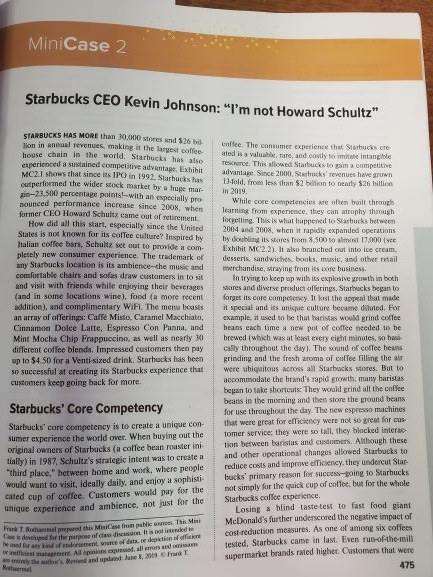
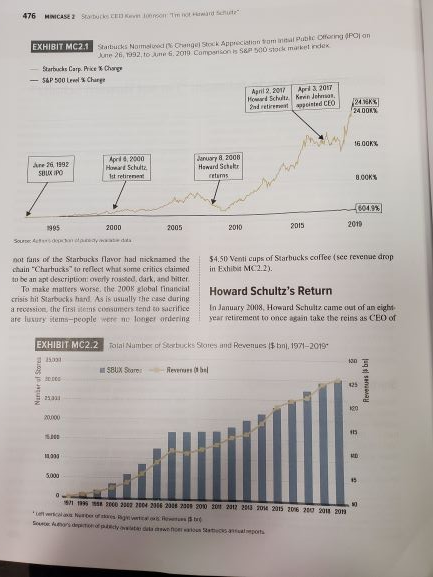
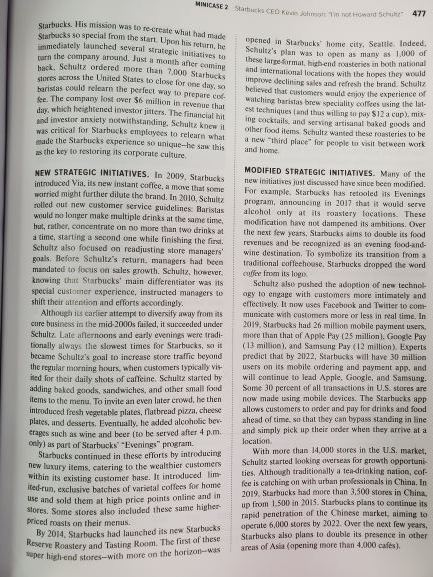
MiniCase 2 Starbucks CEO Kevin Johnson: "I'm not Howard Schultz" STARBUCKS HAS MORE than 30.000 stores and 5363 Mon in annual revenues, making it the largest coffice house chain in the world. Starbucks has also experienced a sustained competitive advantage Exhibit MC2.I shows that since its 1PO in 1992. Starbucks has cutperformed the wider stock market by a huge mar- -23.500 percentage points with an especially pro nounced performance increase since 2008, when former CEO Howard Schultz came out of retirement. How did all this start, especially since the United States is not known for its coffee culture Inspired by Italian coffee bars, Schultz set out to provide a com- pletely new consumer experience. The trademark of any Starbucks location is its ambience-the music and comfortable chairs and safas draw customers in to sit and visit with friends while enjoying their beverages (and in some locations wine), food ( more recent addition), and complimentary WIF. The menu boasts an array of offerings: Caf Misto Caramel Macchiata, Cinnamon Dolce Latte. Espresso Con Panna, and Mint Mocha Chip Frappuccino, as well as nearly 30 different coffee blends. Impressed customers then pay up to $4.50 for a Venti sized drink. Starbucks has been so successful at creating its Starbucks experience that customers keep going back for more. coffee. The consumer experience that Starbucks cre ated is valuable rare and costly to imite intangible Tere. This allowed Starbucks to gain a competitive advantage. Since 2000, Starbucks' revenues have grown 134old, from less than $2 bilion to nearly $26 billion in 2019 While core competencies are often built through learning from experience, they can atrophy through forgetting. This is what happened to Starbucks between 2004 and 2008, when it rapidly expanded operations hy Gobling its stores from 8.500 to almost 17,000 (se Exhibit MC2.2. i also branched out into ice cream desseris, sandwiches, books, music, and other retail merchandise, straying from its core business. In trying to keep up with its explosive growth in both stores and diverse product offerings, Starbucks began to forget its core competency. It is the appeal that made it special and its unique culture became diluted. For example, it used to be that barists would grind coffee beans cach time a new pot of coffee needed to be brewed which was at least every cight minutes, so hasi cally throughout the day). The sound of coffee beans grinding and the fresh aroma of coffee filling the air were ubiquitous across all Starbucks stores. But to accommodate the brand's rapid growth, many baristas began to take shortcuts: They would grind all the coffee beans in the morning and then store the ground beans for use throughout the day. The new espresso machines that were great for efficiency were not so great for cus tomer service they were so call, they blocked interac- tion between baristas and customers. Although these and other operational changes allowed Starbucks to reduce costs and improve efficiency, they undercut Star- bucks' primary reason for success-going to Starbucks not simply for the quick cup of coffee, but for the whole Starbucks coffee experience. Losing a blind taste-test to fast food giant McDonald's further underscored the negative impact of cost reduction measures. As one of among six coffees tested, Starbucks came in last. Even run-of-the-mill supermarket brands rated higher. Customers that were 475 Starbucks' Core Competency Starbucks' core competency is to create a unique con- sumer experience the world over. When buying out the original owners of Starbucks (a coffee bean roaster ini tially) in 1987, Schultz's strategic intent was to create a "third place," between home and work, where people would want to visit, ideally daily, and enjoy a sophisti cated cup of coffee. Customers would pay for the unique experience and ambience, not just for the hd Rathamal prepared the Minise from publik wees. Tok Mini Cees deed the profcas dels not intended warment les pied, all emonades new pallet, 2013 476 MINCASE ? Startup contract EXHIBIT MC2.1 Sucks Nordige Stock Appreciate computer Coming Poon June 6, 1992,10 6. 2019 Companion is S&P 500 stock marketindek Starbucks Carp.Price Charge - S&P 500L Charge April 2, 2017 April 2017 Howard Schule Kein Jean retireet pointed CEO 228 2400K 16.00KS are 26, 1992 SULIK IPO April, 2000 Howa Schult Istre Jawy 8 2008 Howard Schalter reams 0.00K 1995 2000 2005 2010 2015 2010 54.50 Venti cups of Starbucks coffee (see revenue drop in Exhibit MC2.2. not fans of the Starbucks flavor had micknamed the chain Charbucks to reflect what some critics claimed to be an apt description every rosso dark, and bitter To make matters worse, the 2008 global financial crisis hit Starbucks hand. As is usually the case during a recession, the first we consumers tend to sacrifice are luxury items-people were no longer andering Howard Schultz's Return In January 2008, Howard Schultz came out of an eight year retirement to once again take the reins as CEO of Nunt of Stores EXHIBIT MC2.2 Total Number of Serbucks Stores and Revenues in 1971-2019 15031 S8UX Soares Reverse 5. BOCCO 125 Revenues 180 000 500 1990 WE 31000 0 113 2002 2007 2006 2005 200 201 2011 2012 2013 2014 2015 2016 200 201 2013 Starbucks. His mission was to recreate what had made Reserve Roastery and Tasting Room. The first of these MINICASE 2 SEO Koisur 477 Starbucks so special from the start. Upon his return, he opened in Starbucks' home city, Seattle Indeed. mediately launched several strategic initiatives to Schultz's plan was to open as many as 1,000 of turn the company around. Just a month after coming These are format, high end roasteries in both national hack. Schultz ordered more than 7000 Starbucks and international locations with the hopes they would stores across the United States to close for one day, so improve declining sales and refresh the brand. Schultz baristas could relearn the perfect way to prepare co believed that customers would enjoy the experience of fee. The company lost over $6 million in revenue that watching baristas brew speciality coffees using the lat- day, which heightened investor jitters. The financial hit est techniques and thus willing to pay $12 a cup). min and investor anxiety notwithstanding. Schultz knew ing cocktails, and serving artisanat baked goods and was critical for Starbucks employees to relearn what other food items Schultz wanted these roasteries to be made the Starbucks experience so unique-he saw this a new "third place for people to visit between work and home as the key to restoring its corporate culture NEW STRATEGIC INITIATIVES. In 2009. Starbucks MODIFIED STRATEGIC INITIATIVES. Many of the introduced Via, its new instant coffee a move that some new initiatives just discussed have since been modified worried might further dilute the brand. In 2010. Schultz For example. Starbucks las retooled ils Evenings rolled out new customer service guidelines Baristas program, announcing in 2017 that it would serve would no longer make multiple drinks at the same time, aleohol only at its roastery locations. These modification have not dampened its ambitions. Over hut, rather concentrate on no more than two drinks at the next few years, Starbucks aims to double its food a time, starting a second one while finishing the first revenues and be recognized as an evening food-and- Schultz also focused on readjusting store managers wine destination. To symbolize its transition from a goals. Before Schultz's return, managers had been traditional coffeehouse. Starbucks dropped the word mandated to focus on sales growth. Schultz, however, from its logo knowing that Starbucks' main differentiator was its Schultz also pushed the adoption of new technol special customer experience, instructed managers to ogy to engage with customers more intimately and shift their attention and efforts accordingly. effectively. It now uses Facebook and Twitter to com Although its earlier attempt to diversify wwwy from its municate with customers more or less in real time. In cure business in the mid 2000s failed, it succeeded under 2019, Starbucks had 26 million mobile payment users Schultz. Late afternoons and early evenings were tradi more than that of Apple Pay (25 million). Google Pay tionally always the slowest times for Starbucks, soit (13 million), and Samsung Pay (12 million). Experts predict that by 2022, Starbucks will have 30 million became Schulz's goal to increase store traffic beyond the regular morning hours, when customers typically vis users on its mobile ordering and payment app, and ited for their daily shots of caffeine Schultz started by will continue to lead Apple, Google, and Samsung. adding baked goods, sandwiches, and other small food Some 30 percent of all transactions in U.S. stores are items to the menu. To invite an even Inter crowd, he then now made using mobile devices. The Starbucks app allows customers to onder and pay for drinks and food introduced fresh vegetable plates, flatbread pizza, cheese ahead of time, so that they can bypass standing in line plates, und desserts. Eventually, he added alcoholic bev- and simply pick up their order when they arrive at a erages such as wine and beer (to be served after 4 pm location Only) as part of Starbucks Evenings" program. With more than 14.000 stores in the U.S. market. Starbucks continued in these efforts by introducing Schultz started looking overseas for growth opportuni new luxury items.catering to the wealthier customers ties. Although traditionally a tendrinking nation, cof within its existing customer base. It introduced lim fee is catching on with urban professionals in China. In ited-run, exclusive batches of varictal coffees for home 2019, Starbucks had more than 3,500 stores in China. use and sold them at high price points online and in up from 1.500 in 2015. Starbucks plans to continue its Stores. Some stores also included these same higher rapid penetration of the Chinese market, aiming to priced roasts on their menus. operate 6,000 stores by 2022. Over the next few years, By 2014. Starbucks had launched its new Starbucks Starbucks also plans to double its presence in other areas of Asia (opening more than 4,000 caes). Super high end stores with more on the horizon-was




