







Question: How did they find the differential operator in this problem? Correct choice: (g) y_p = A x*2 + Bx + C x e{4x} + D
How did they find the differential operator in this problem?
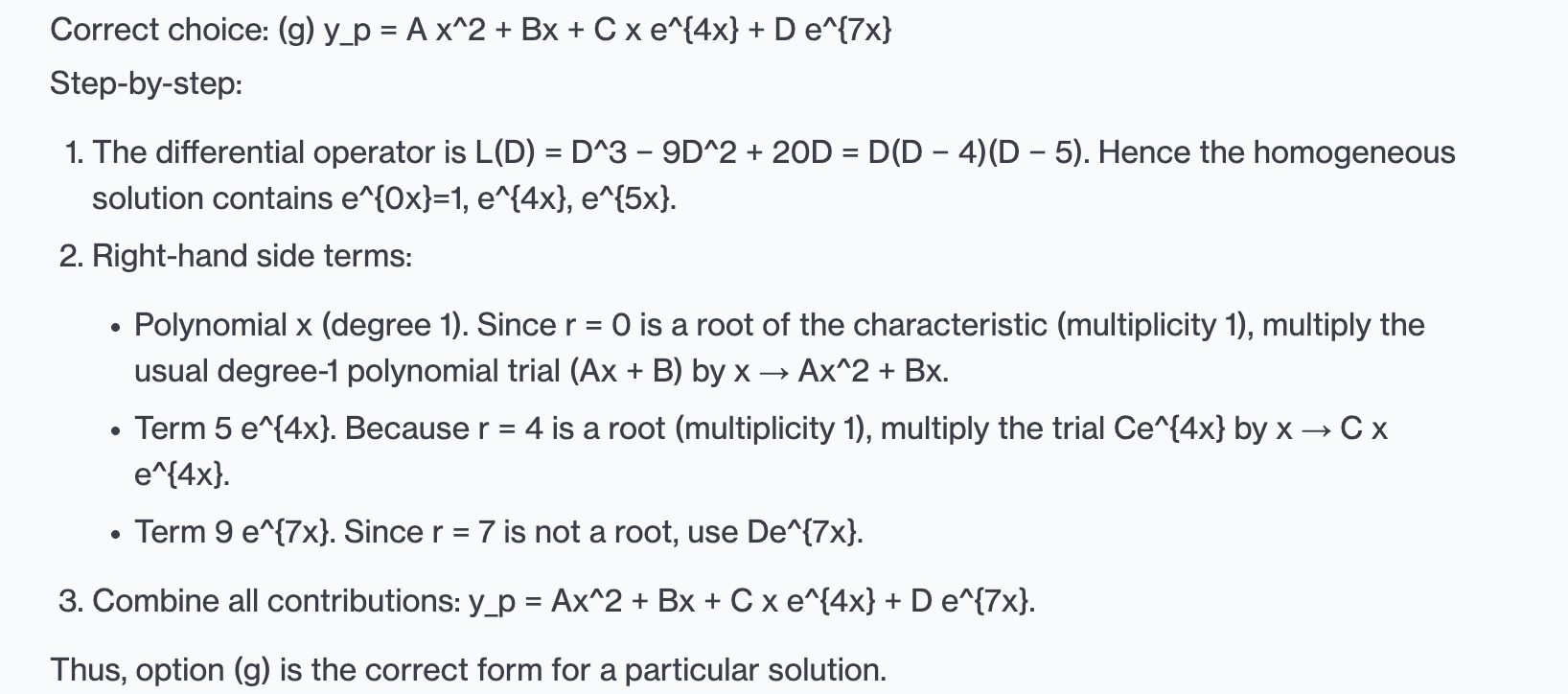 Correct choice: (g) y_p = A x*2 + Bx + C x e\"{4x} + D e\"{7x} Step-by-step: 1. The differential operator is L(D) = D*3 - 9D*2 + 20D = D(D - 4)(D - 5). Hence the homogeneous solution contains e\"{Ox}=1, e\"{4x}, e\"{5x}. 2. Right-hand side terms: Polynomial x (degree 1). Since r = O is a root of the characteristic (multiplicity 1), multiply the usual degree-1 polynomial trial (Ax + B) by x
 Step by Step Solution
There are 3 Steps involved in it
1 Expert Approved Answer
Step: 1 Unlock

Question Has Been Solved by an Expert!
Get step-by-step solutions from verified subject matter experts
Step: 2 Unlock
Step: 3 Unlock
 Study Help