



Question: How do evolutionary theories explain the innate tendencies for humans to engage in helping behaviors, and how do kin selection and reciprocal altruism differ in
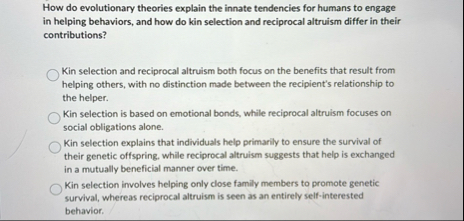
How do evolutionary theories explain the innate tendencies for humans to engage in helping behaviors, and how do kin selection and reciprocal altruism differ in their contributions?
Kin selection and reciprocal altruism both focus on the benefits that result from helping others, with no distinction made between the recipient's relationship to the helper.
Kin selection is based on emotional bonds, while reciprocal altruism focuses on social obligations alone.
Kin selection explains that individuals help primarily to ensure the survival of their genetic offspring, while reciprocal altruism suggests that help is exchanged in a mutually beneficial manner over time.
Kin selection involves helping only close family members to promote genetic survival, whereas reciprocal altruism is seen as an entirely selfinterested behavior.
Step by Step Solution
There are 3 Steps involved in it
1 Expert Approved Answer
Step: 1 Unlock

Question Has Been Solved by an Expert!
Get step-by-step solutions from verified subject matter experts
Step: 2 Unlock
Step: 3 Unlock