







Question: how do I find the upper and lower limits with no mean or standard deviation? or the margin of error For this problem, carry at
how do I find the upper and lower limits with no mean or standard deviation? or the margin of error
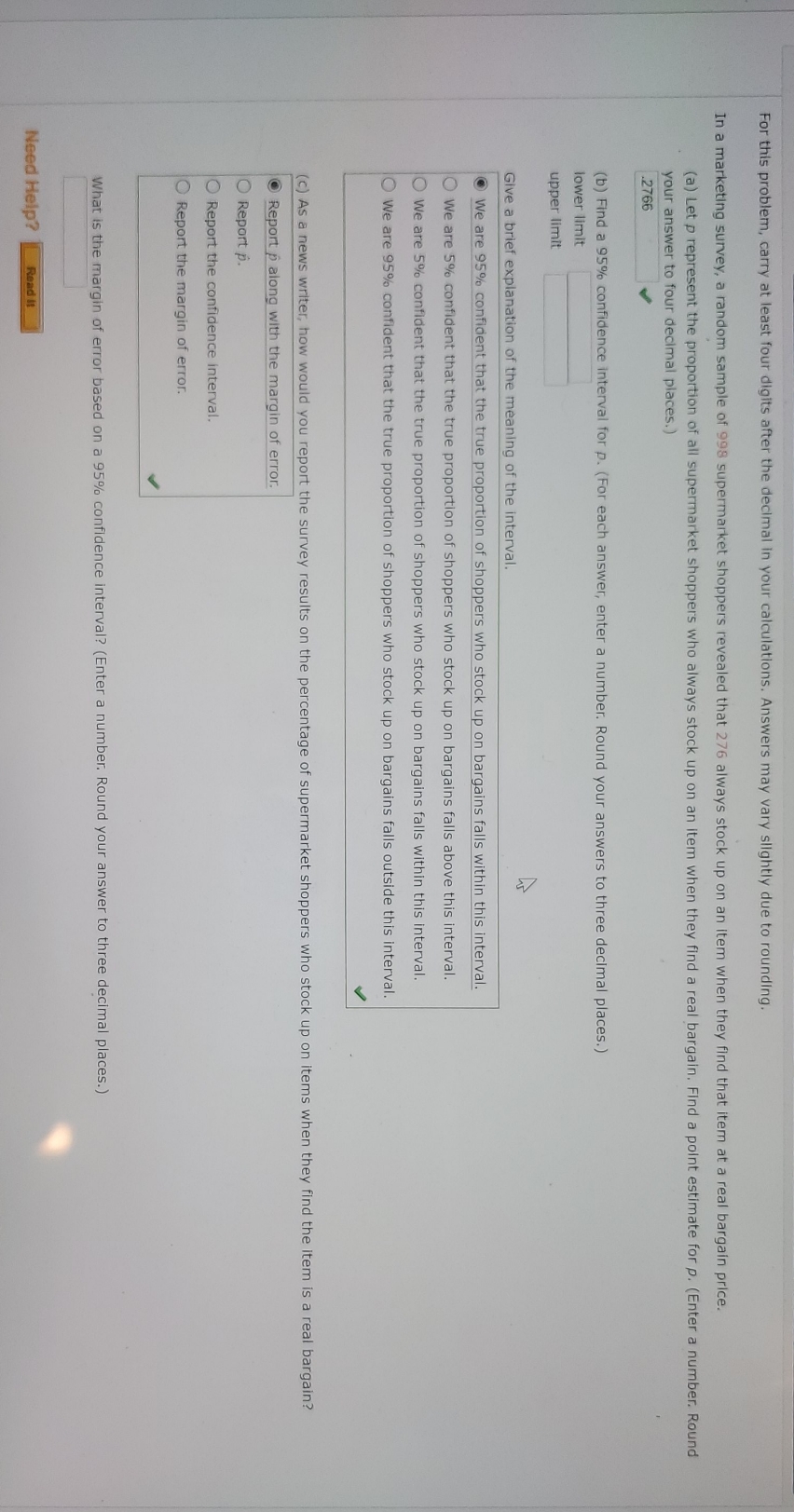
For this problem, carry at least four digits after the decimal in your calculations. Answers may vary slightly due to rounding. In a marketing survey, a random sample of 998 supermarket shoppers revealed that 276 always stock up on an item when they find that item at a real bargain price. (a) Let p represent the proportion of all supermarket shoppers who always stock up on an item when they find a real bargain. Find a point estimate for p. (Enter a number. Round your answer to four decimal places.) .2766 (b) Find a 95% confidence interval for p. (For each answer, enter a number. Round your answers to three decimal places.) lower limit upper limit Give a brief explanation of the meaning of the interval. We are 95% confident that the true proportion of shoppers who stock up on bargains falls within this interval. We are 5% confident that the true proportion of shoppers who stock up on bargains falls above this interval. O We are 5% confident that the true proportion of shoppers who stock up on bargains falls within this interval. We are 95% confident that the true proportion of shoppers who stock up on bargains falls outside this interval. c) As a news writer, how would you report the survey results on the percentage of supermarket shoppers who stock up on items when they find the item is a real bargain? Report p along with the margin of error. O Report p. O Report the confidence interval. Report the margin of error. What is the margin of error based on a 95% confidence interval? (Enter a number. Round your answer to three decimal places.) Need Help? Read It
Step by Step Solution
There are 3 Steps involved in it

Get step-by-step solutions from verified subject matter experts
 Study Help