





Question: how do i graph a composite wave of a square wave and a sawtooth wave? 6. The waveforms below are examples of standard square and

how do i graph a composite wave of a square wave and a sawtooth wave?
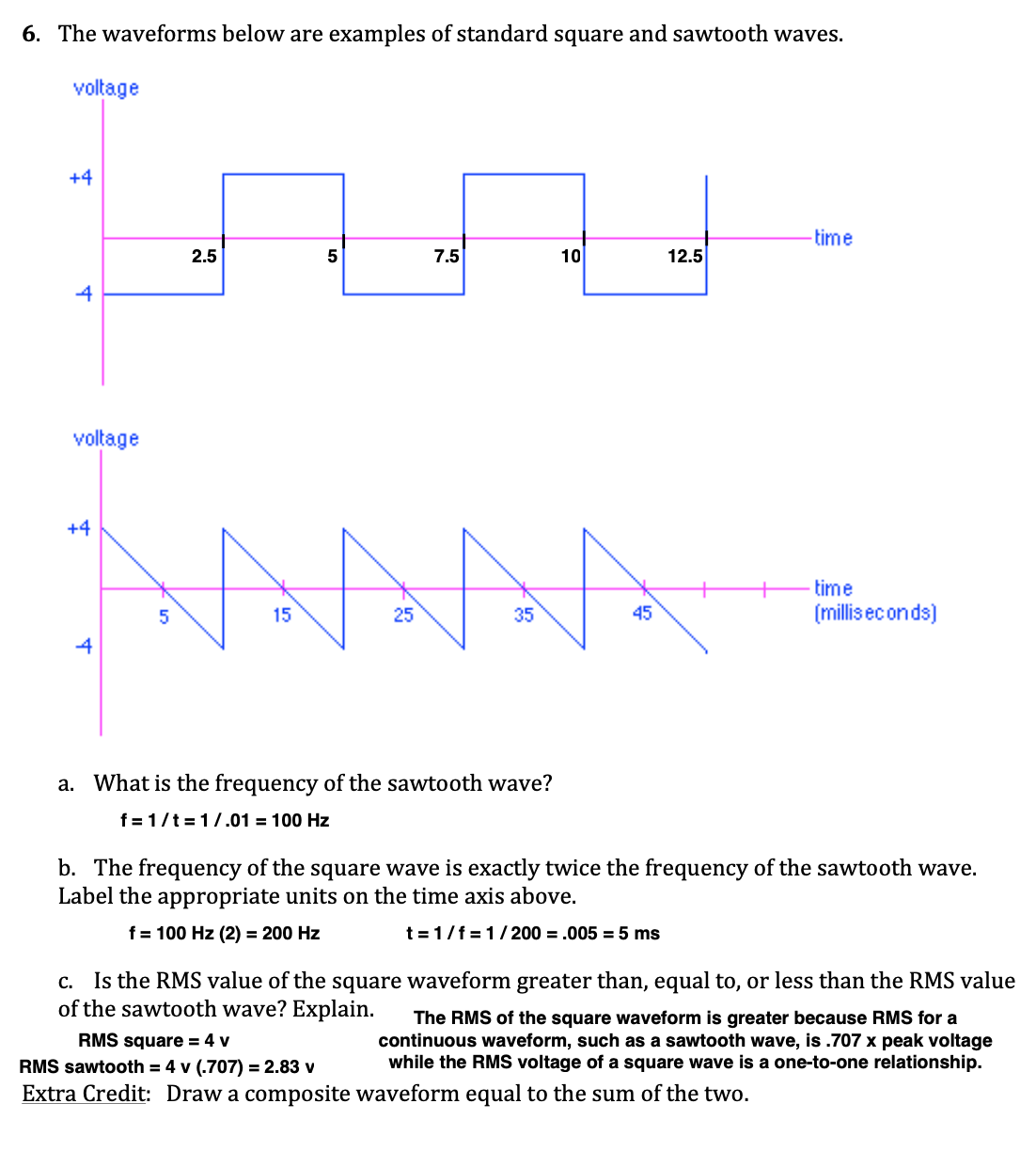
how do i graph a composite wave of a square wave
6. The waveforms below are examples of standard square and sawtooth waves. voltage +4 time 2.5 5 7.5 10 12.5 4 voltage +4 . time 5 15 25 35 45 (milliseconds] 4 a. What is the frequency of the sawtooth wave? f= 1/t=1/.01 = 100 Hz b. The frequency of the square wave is exactly twice the frequency of the sawtooth wave. Label the appropriate units on the time axis above. f = 100 Hz (2) = 200 Hz t= 1/f= 1 / 200 = .005 = 5 ms c. Is the RMS value of the square waveform greater than, equal to, or less than the RMS value of the sawtooth wave? Explain. The RMS of the square waveform is greater because RMS for a RMS square = 4 v continuous waveform, such as a sawtooth wave, is .707 x peak voltage RMS sawtooth = 4 v (.707) = 2.83 v while the RMS voltage of a square wave is a one-to-one relationship. Extra Credit: Draw a composite waveform equal to the sum of the two

Step by Step Solution

There are 3 Steps involved in it

1 Expert Approved Answer
Step: 1 Unlock blur-text-image

Question Has Been Solved by an Expert!

Get step-by-step solutions from verified subject matter experts

Step: 2 Unlock
Step: 3 Unlock

Students Have Also Explored These Related Mathematics Questions!