







Question: How do I identify a problem at work that can be solved using the moving-average method that is explained in Section 7.2.1 The Moving-Average Model
How do I identify a problem at work that can be solved using the moving-average method that is explained in Section 7.2.1 The Moving-Average Model in the Powell text. I have to describe how I would apply the model to solve the problem.
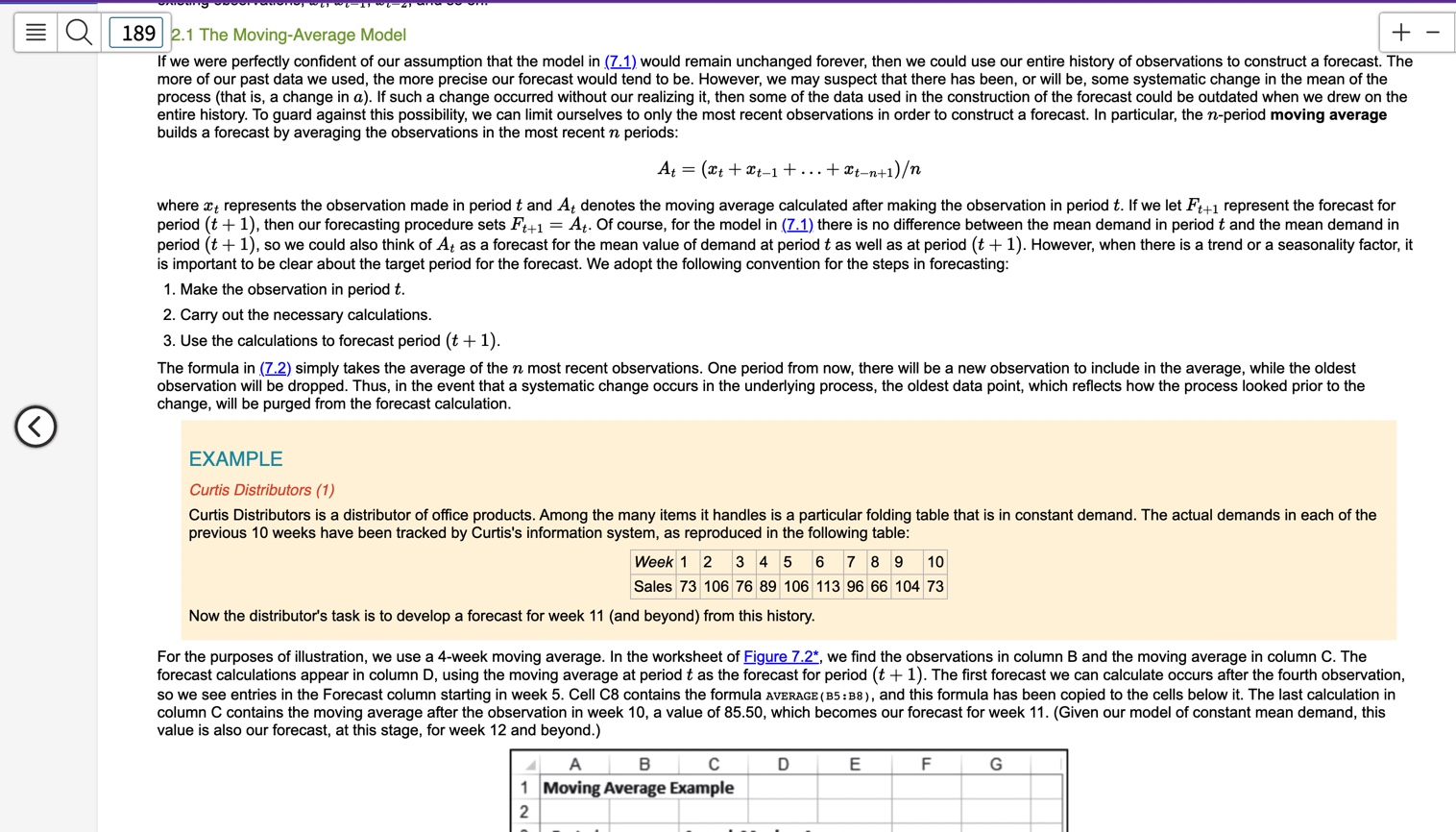
189 2.1 The Moving-Average Model + If we were perfectly confident of our assumption that the model in (7.1) would remain unchanged forever, then we could use our entire history of observations to construct a forecast. The more of our past data we used, the more precise our forecast would tend to be. However, we may suspect that there has been, or will be, some systematic change in the mean of the process (that is, a change in a). If such a change occurred without our realizing it, then some of the data used in the construction of the forecast could be outdated when we drew on the entire history. To guard against this possibility, we can limit ourselves to only the most recent observations in order to construct a forecast. In particular, the n-period moving average builds a forecast by averaging the observations in the most recent n periods: At = (It + "t-1 + ... + "t-n+1) where it represents the observation made in period t and At denotes the moving average calculated after making the observation in period t. If we let Ft+1 represent the forecast for period (t + 1), then our forecasting procedure sets Ft+1 = At. Of course, for the model in (7.1) there is no difference between the mean demand in period t and the mean demand in period (t + 1), so we could also think of At as a forecast for the mean value of demand at period t as well as at period (t + 1). However, when there is a trend or a seasonality factor, it is important to be clear about the target period for the forecast. We adopt the following convention for the steps in forecasting: 1. Make the observation in period t. 2. Carry out the necessary calculations. 3. Use the calculations to forecast period (t + 1). The formula in (7.2) simply takes the average of the n most recent observations. One period from now, there will be a new observation to include in the average, while the oldest observation will be dropped. Thus, in the event that a systematic change occurs in the underlying process, the oldest data point, which reflects how the process looked prior to the change, will be purged from the forecast calculation. EXAMPLE Curtis Distributors (1) Curtis Distributors is a distributor of office products. Among the many items it handles is a particular folding table that is in constant demand. The actual demands in each of the previous 10 weeks have been tracked by Curtis's information system, as reproduced in the following table: Week 1 2 3 4 5 6 7 8 9 10 Sales 73 106 76 89 106 113 96 66 104 73 Now the distributor's task is to develop a forecast for week 11 (and beyond) from this history. For the purposes of illustration, we use a 4-week moving average. In the worksheet of Figure 7.2*, we find the observations in column B and the moving average in column C. The forecast calculations appear in column D, using the moving average at period t as the forecast for period (t + 1). The first forecast we can calculate occurs after the fourth observation, so we see entries in the Forecast column starting in week 5. Cell C8 contains the formula AVERAGE (B5: B8), and this formula has been copied to the cells below it. The last calculation in column C contains the moving average after the observation in week 10, a value of 85.50, which becomes our forecast for week 11. (Given our model of constant mean demand, this value is also our forecast, at this stage, for week 12 and beyond.) A B C D E F G 1 Moving Average Example N
Step by Step Solution
There are 3 Steps involved in it

Get step-by-step solutions from verified subject matter experts
 Study Help