Question: NPP Evaluation Case Study Report - Kaiser Permanente Care Management Institute.pdf Week 4: Case Study Analysis Attached Files: NPP Evaluation Case Study Report - Kaiser
NPP Evaluation Case Study Report - Kaiser Permanente Care Management Institute.pdf
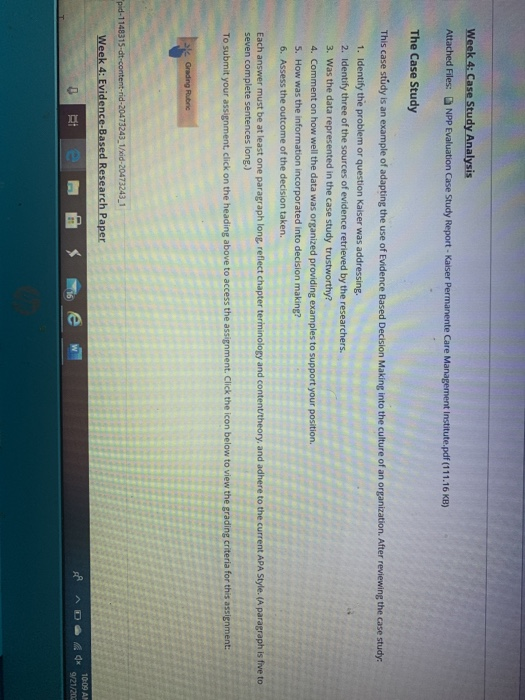
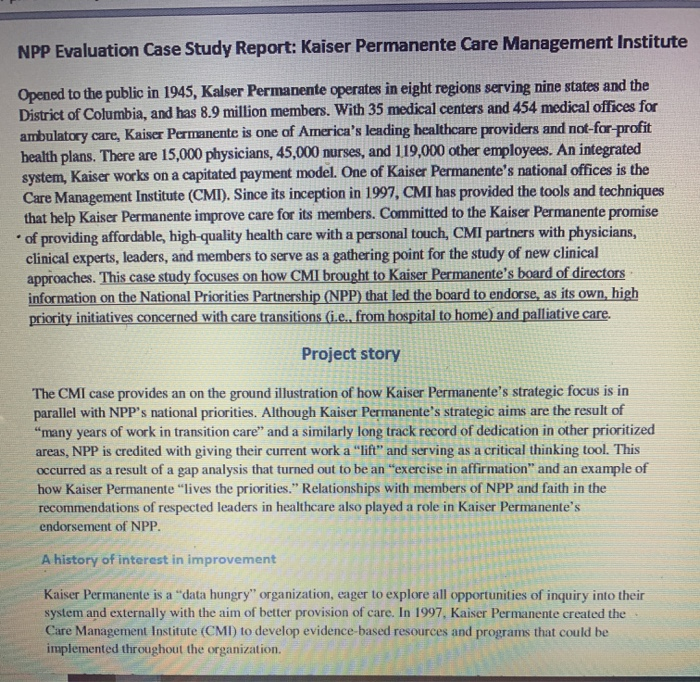
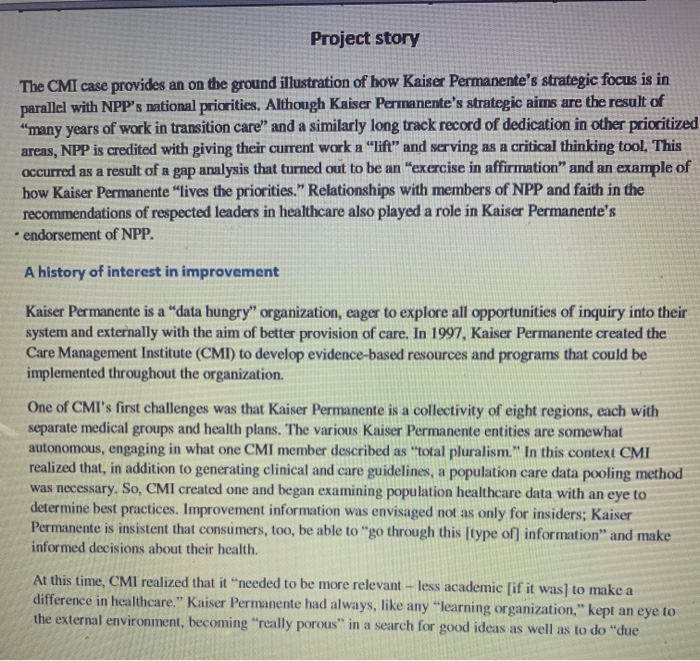
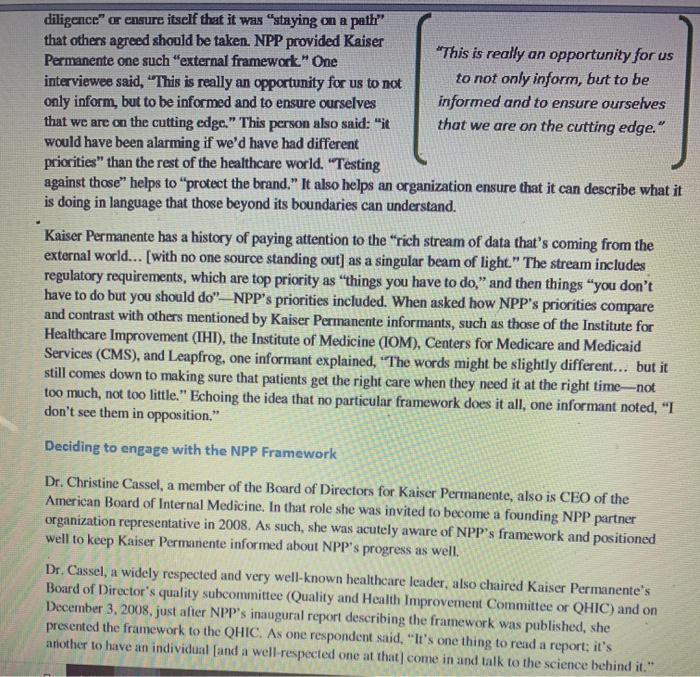
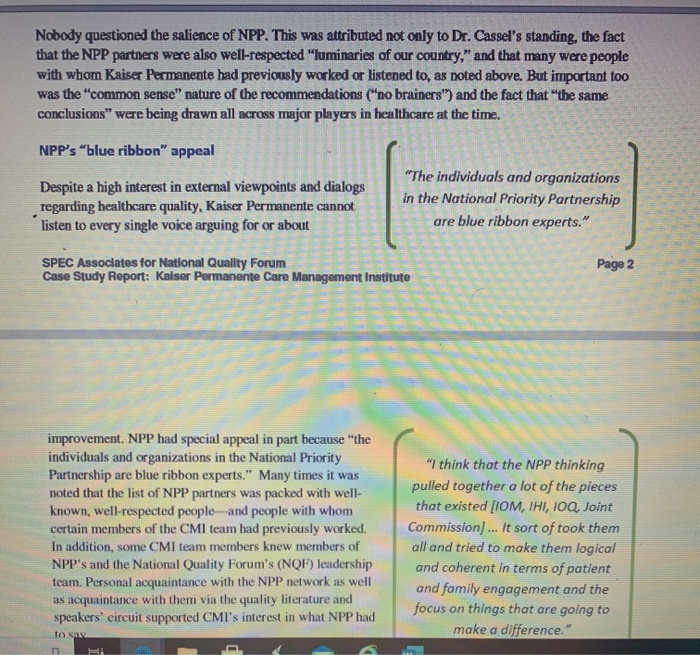
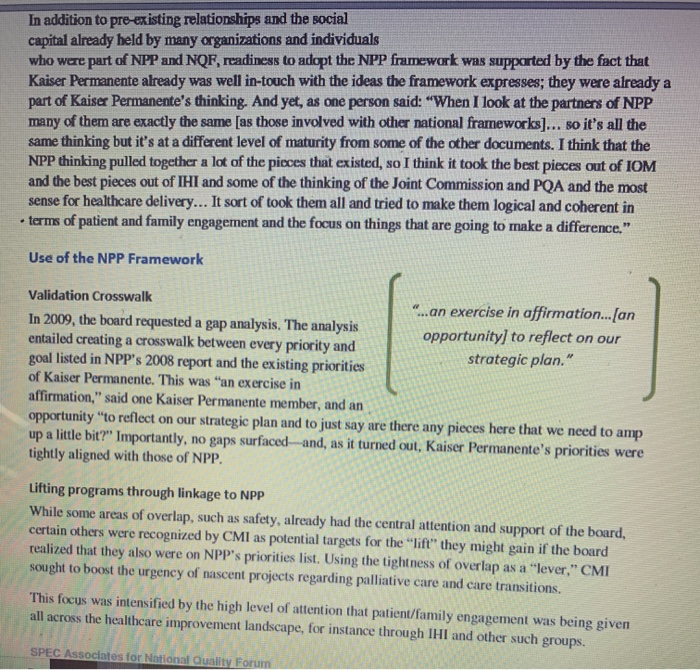
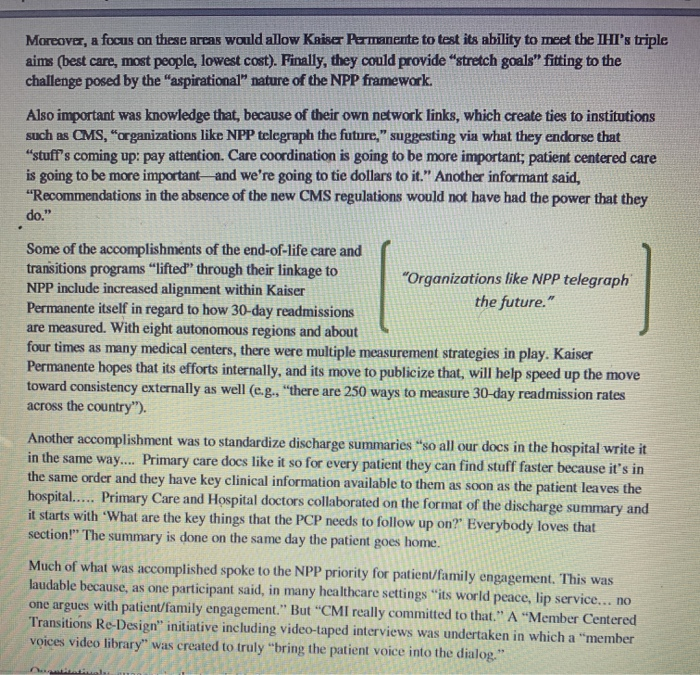
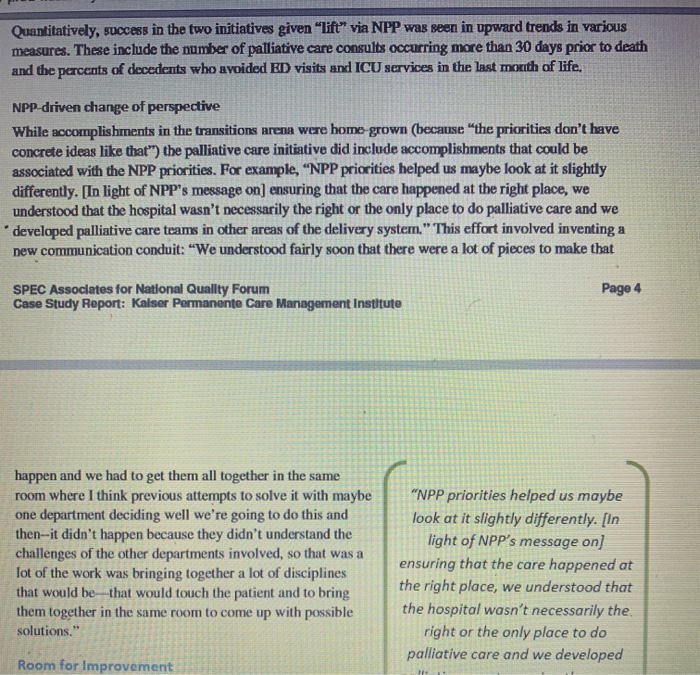
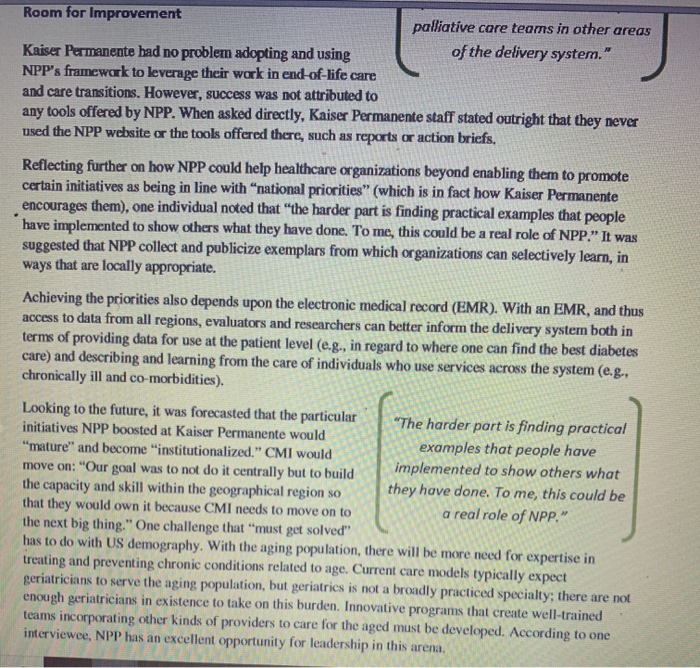
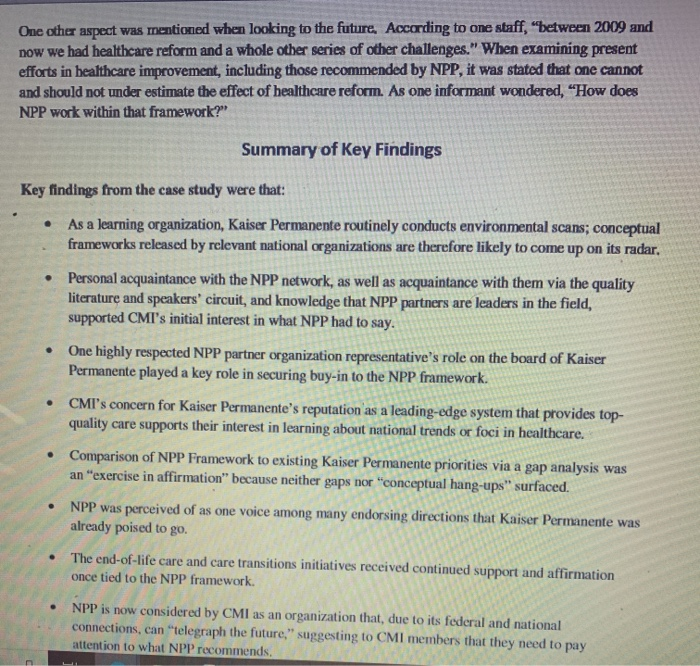
Week 4: Case Study Analysis Attached Files: NPP Evaluation Case Study Report - Kaiser Permanente Care Management Institute.pdf (111.16 KB) The Case Study This case study is an example of adapting the use of Evidence Based Decision Making into the culture of an organization. After reviewing the case study: 1. Identify the problem or question Kaiser was addressing, 2. Identify three of the sources of evidence retrieved by the researchers. 3. Was the data represented in the case study trustworthy? 4. Comment on how well the data was organized providing examples to support your position. 5. How was the information incorporated into decision making? 6. Assess the outcome of the decision taken. Each answer must be at least one paragraph long reflect chapter terminology and content/theory, and adhere to the current APA Style. (A paragraph is five to seven complete sentences long.) To submit your assignment, click on the heading above to access the assignment. Click the icon below to view the grading criteria for this assignment: Grading Rubric pid-1148315-dt-content-rid-20473243 1/xid-20473243_1 Week 4: Evidence-Based Research Paper e e cx 13 10:09 AM 9/21/20 16 NPP Evaluation Case Study Report: Kaiser Permanente Care Management Institute Opened to the public in 1945, Kalser Permanente operates in eight regions serving nine states and the District of Columbia, and has 8.9 million members. With 35 medical centers and 454 medical offices for ambulatory care, Kaiser Permanente is one of America's leading healthcare providers and not-for-profit health plans. There are 15,000 physicians, 45,000 nurses, and 119,000 other employees. An integrated system, Kaiser works on a capitated payment model. One of Kaiser Permanente's national offices is the Care Management Institute (CMI). Since its inception in 1997, CMI has provided the tools and techniques that help Kaiser Permanente improve care for its members. Committed to the Kaiser Permanente promise of providing affordable, high-quality health care with a personal touch, CMI partners with physicians, clinical experts, leaders, and members to serve as a gathering point for the study of new clinical approaches. This case study focuses on how CMI brought to Kaiser Permanente's board of directors information on the National Priorities Partnership (NPP) that led the board to endorse, as its own, high priority initiatives concerned with care transitions (i.e., from hospital to home) and palliative care. Project story The CMI case provides an on the ground illustration of how Kaiser Permanente's strategic focus is in parallel with NPP's national priorities. Although Kaiser Permanente's strategic aims are the result of "many years of work in transition care" and a similarly long track record of dedication in other prioritized areas, NPP is credited with giving their current work a "lift" and serving as a critical thinking tool. This occurred as a result of a gap analysis that turned out to be an exercise in affirmation" and an example of how Kaiser Permanente "lives the priorities." Relationships with members of NPP and faith in the recommendations of respected leaders in healthcare also played a role in Kaiser Permanente's endorsement of NPP. A history of interest in improvement Kaiser Permanente is a "data hungry" organization, eager to explore all opportunities of inquiry into their system and externally with the aim of better provision of care. In 1997. Kaiser Permanente created the Care Management Institute (CMD) to develop evidence-based resources and programs that could be implemented throughout the organization. Project story The CMI case provides an on the ground illustration of how Kaiser Permanente's strategic focus is in parallel with NPP's national priorities. Although Kaiser Permanente's strategic aims are the result of "many years of work in transition care" and a similarly long track record of dedication in other prioritized areas, NPP is credited with giving their current work a "lift" and serving as a critical thinking tool. This occurred as a result of a gap analysis that turned out to be an "exercise in affirmation" and an example of how Kaiser Permanente "lives the priorities." Relationships with members of NPP and faith in the recommendations of respected leaders in healthcare also played a role in Kaiser Permanente's endorsement of NPP. A history of interest in improvement Kaiser Permanente is a data hungry" organization, eager to explore all opportunities of inquiry into their system and externally with the aim of better provision of care. In 1997, Kaiser Permanente created the Care Management Institute (CMI) to develop evidence-based resources and programs that could be implemented throughout the organization. One of CMI's first challenges was that Kaiser Permanente is a collectivity of eight regions, each with separate medical groups and health plans. The various Kaiser Permanente entities are somewhat autonomous, engaging in what one CMI member described as "total pluralism." In this context CMI realized that, in addition to generating clinical and care guidelines, a population care data pooling method was necessary. So, CMI created one and began examining population healthcare data with an eye to determine best practices. Improvement information was envisaged not as only for insiders; Kaiser Permanente is insistent that consumers, too, be able to go through this type of information" and make informed decisions about their health. At this time, CMI realized that it "needed to be more relevant - less academic [if it was to make a difference in healthcare." Kaiser Permanente had always, like any "learning organization," kept an eye to the external environment, becoming "really porous" in a search for good ideas as well as to do "due diligence" or ensure itself that it was "staying on a path" that others agreed should be taken. NPP provided Kaiser "This is really an opportunity for us Permanente one such "external framework." One interviewee said, "This is really an opportunity for us to not to not only inform, but to be only inform, but to be informed and to ensure ourselves informed and to ensure ourselves that we are on the cutting edge." This person also said: "it that we are on the cutting edge." would have been alarming if we'd have had different priorities" than the rest of the healthcare world. "Testing against those" helps to protect the brand." It also helps an organization ensure that it can describe what it is doing in language that those beyond its boundaries can understand. Kaiser Permanente has a history of paying attention to the "rich stream of data that's coming from the external world... [with no one source standing out as a singular beam of light." The stream includes regulatory requirements, which are top priority as "things you have to do," and then things "you don't have to do but you should do"-NPP's priorities included. When asked how NPP's priorities compare and contrast with others mentioned by Kaiser Permanente informants, such as those of the Institute for Healthcare Improvement (IHI), the Institute of Medicine (IOM), Centers for Medicare and Medicaid Services (CMS), and Leapfrog, one informant explained, "The words might be slightly different... but it still comes down to making sure that patients get the right care when they need it at the right time--not too much, not too little." Echoing the idea that no particular framework does it all, one informant noted, I don't see them in opposition." Deciding to engage with the NPP Framework Dr. Christine Cassel, a member of the Board of Directors for Kaiser Permanente, also is CEO of the American Board of Internal Medicine. In that role she was invited to become a founding NPP partner organization representative in 2008. As such, she was acutely aware of NPP's framework and positioned well to keep Kaiser Permanente informed about NPP's progress as well. Dr. Cassel, a widely respected and very well-known healthcare leader, also chaired Kaiser Permanente's Board of Director's quality subcommittee (Quality and Health Improvement Committee or QHIC) and on December 3, 2008, just after NPP's inaugural report describing the framework was published, she presented the framework to the QHIC. As one respondent said, "It's one thing to read a report; it's another to have an individual (and a well-respected one at that come in and talk to the science behind it." Nobody questioned the salience of NPP. This was attributed not only to Dr. Cassel's standing, the fact that the NPP partners were also well-respected "luminaries of our country," and that many were people with whom Kaiser Permanente had previously worked or listened to, as noted above. But important too was the "common sense" nature of the recommendations ("no brainers") and the fact that the same conclusions" were being drawn all across major players in healthcare at the time. NPP's "blue ribbon" appeal Despite a high interest in external viewpoints and dialogs regarding healthcare quality, Kaiser Permanente cannot listen to every single voice arguing for or about "The individuals and organizations in the National Priority Partnership are blue ribbon experts." SPEC Associates for National Quality Forum Case Study Report: Kaiser Permanente Care Management Institute Page 2 improvement. NPP had special appeal in part because the individuals and organizations in the National Priority Partnership are blue ribbon experts. Many times it was noted that the list of NPP partners was packed with well- known, well-respected people and people with whom certain members of the CMI team had previously worked. In addition, some CMI team members knew members of NPP's and the National Quality Forum's (NQF) leadership team. Personal acquaintance with the NPP network as well as acquaintance with them via the quality literature and speakers' circuit supported CMI's interest in what NPP had "I think that the NPP thinking pulled together a lot of the pieces that existed [IOM, IHI, IOQ, Joint Commission) ... It sort of took them all and tried to make them logical and coherent in terms of patient and family engagement and the focus on things that are going to make a difference." to SIM BI In addition to pre-existing relationships and the social capital already held by many organizations and individuals who were part of NPP and NQF, readiness to adopt the NPP framework was supported by the fact that Kaiser Permanente already was well in touch with the ideas the framework expresses; they were already a part of Kaiser Permanente's thinking. And yet, as one person said: "When I look at the partners of NPP many of them are exactly the same [as those involved with other national frameworks)... so it's all the same thinking but it's at a different level of maturity from some of the other documents. I think that the NPP thinking pulled together a lot of the pieces that existed, so I think it took the best pieces out of IOM and the best pieces out of IHI and some of the thinking of the Joint Commission and PQA and the most sense for healthcare delivery... It sort of took them all and tried to make them logical and coherent in terms of patient and family engagement and the focus on things that are going to make a difference." Use of the NPP Framework Validation Crosswalk "...an exercise in affirmation... [an In 2009, the board requested a gap analysis. The analysis opportunity to reflect on our entailed creating a crosswalk between every priority and goal listed in NPP's 2008 report and the existing priorities strategic plan." of Kaiser Permanente. This was an exercise in affirmation," said one Kaiser Permanente member, and an opportunity to reflect on our strategic plan and to just say are there any pieces here that we need to amp up a little bit?" Importantly, no gaps surfaced and, as it turned out, Kaiser Permanente's priorities were tightly aligned with those of NPP. Lifting programs through linkage to NPP While some areas of overlap, such as safety, already had the central attention and support of the board, certain others were recognized by CMI as potential targets for the "lift" they might gain if the board realized that they also were on NPP's priorities list. Using the tightness of overlap as a "lever," CMI sought to boost the urgency of nascent projects regarding palliative care and care transitions. This focus was intensified by the high level of attention that patient/family engagement was being given all across the healthcare improvement landscape, for instance through IHI and other such groups. SPEC Associates for National Quality Forum Moreover, a focus on these areas would allow Kaiser Permanente to test its ability to meet the IHI's triple aims (best care, most people, lowest cost). Finally, they could provide "stretch goals" fitting to the challenge posed by the "aspirational" nature of the NPP framework. Also important was knowledge that, because of their own network links, which create ties to institutions such as CMS,"organizations like NPP telegraph the future," suggesting via what they endorse that "stuff's coming up: pay attention. Care coordination is going to be more important; patient centered care is going to be more important and we're going to tie dollars to it." Another informant said, "Recommendations in the absence of the new CMS regulations would not have had the power that they do." Some of the accomplishments of the end-of-life care and transitions programs "lifted through their linkage to "Organizations like NPP telegraph NPP include increased alignment within Kaiser the future." Permanente itself in regard to how 30-day readmissions are measured. With eight autonomous regions and about four times as many medical centers, there were multiple measurement strategies in play. Kaiser Permanente hopes that its efforts internally, and its move to publicize that will help speed up the move toward consistency externally as well (e.g., "there are 250 ways to measure 30-day readmission rates across the country'). Another accomplishment was to standardize discharge summaries "so all our docs in the hospital write it in the same way.... Primary care docs like it so for every patient they can find stuff faster because it's in the same order and they have key clinical information available to them as soon as the patient leaves the hospital..... Primary Care and Hospital doctors collaborated on the format of the discharge summary and it starts with 'What are the key things that the PCP needs to follow up on?' Everybody loves that section!" The summary is done on the same day the patient goes home. Much of what was accomplished spoke to the NPP priority for patient/family engagement. This was laudable because, as one participant said, in many healthcare settings its world peace, lip service... no one argues with patient/family engagement." But "CMI really committed to that." A "Member Centered Transitions Re-Design" initiative including video-taped interviews was undertaken in which a "member voices video library" was created to truly bring the patient voice into the dialog." Quantitatively, success in the two initiatives given "lift" via NPP was seen in upward trends in various measures. These include the number of palliative care consults occurring more than 30 days prior to death and the percents of decedents who avoided ED visits and ICU services in the last month of life. NPP driven change of perspective While accomplishments in the transitions arena were bome-grown (because the priorities don't have concrete ideas like that") the palliative care initiative did include accomplishments that could be associated with the NPP priorities. For example, "NPP priorities helped us maybe look at it slightly differently. [In light of NPP's message on) ensuring that the care happened at the right place, we understood that the hospital wasn't necessarily the right or the only place to do palliative care and we developed palliative care teams in other areas of the delivery system." This effort involved inventing a new communication conduit: We understood fairly soon that there were a lot of pieces to make that SPEC Associates for National Quality Forum Case Study Report: Kalser Permanente Care Management Institute Page 4 happen and we had to get them all together in the same room where I think previous attempts to solve it with maybe one department deciding well we're going to do this and then--it didn't happen because they didn't understand the challenges of the other departments involved, so that was a lot of the work was bringing together a lot of disciplines that would be that would touch the patient and to bring them together in the same room to come up with possible solutions." "NPP priorities helped us maybe look at it slightly differently. [In light of NPP's message on) ensuring that the care happened at the right place, we understood that the hospital wasn't necessarily the. right or the only place to do palliative care and we developed Room for Improvement Room for Improvement palliative care teams in other areas Kaiser Permanente bad no problem adopting and using of the delivery system." NPP's framework to leverage their work in end-of-life care and care transitions. However, success was not attributed to any tools offered by NPP. When asked directly, Kaiser Permanente staff stated outright that they never used the NPP website or the tools offered there, such as reports or action briefs, Reflecting further on how NPP could help healthcare organizations beyond enabling them to promote certain initiatives as being in line with "national priorities" (which is in fact how Kaiser Permanente encourages them), one individual noted that the harder part is finding practical examples that people have implemented to show others what they have done. To me, this could be a real role of NPP. It was suggested that NPP collect and publicize exemplars from which organizations can selectively learn, in ways that are locally appropriate. Achieving the priorities also depends upon the electronic medical record (EMR). With an EMR, and thus access to data from all regions, evaluators and researchers can better inform the delivery system both in terms of providing data for use at the patient level (e.g., in regard to where one can find the best diabetes care) and describing and learning from the care of individuals who use services across the system (e.g., chronically ill and co-morbidities). Looking to the future, it was forecasted that the particular "The harder part is finding practical initiatives NPP boosted at Kaiser Permanente would "mature" and become "institutionalized. CMI would examples that people have move on: "Our goal was to not do it centrally but to build implemented to show others what the capacity and skill within the geographical region so they have done. To me, this could be that they would own it because CMI needs to move on to a real role of NPP." the next big thing." One challenge that "must get solved" has to do with US demography. With the aging population, there will be more need for expertise in treating and preventing chronic conditions related to age. Current care models typically expect geriatricians to serve the aging population, but geriatrics is not a broadly practiced specialty; there are not enough geriatricians in existence to take on this burden. Innovative programs that create well-trained teams incorporating other kinds of providers to care for the aged must be developed. According to one interviewee, NPP has an excellent opportunity for leadership in this arena. One other aspect was mentioned when looking to the future. According to one staff, "between 2009 and now we had healthcare reform and a whole other series of other challenges." When examining present efforts in healthcare improvement, including those recommended by NPP, it was stated that one cannot and should not under estimate the effect of healthcare reform. As one informant wondered, How does NPP work within that framework?" Summary of Key Findings Key findings from the case study were that: As a learning organization, Kaiser Permanente routinely conducts environmental scans; conceptual frameworks released by relevant national organizations are therefore likely to come up on its radar. Personal acquaintance with the NPP network, as well as acquaintance with them via the quality literature and speakers' circuit, and knowledge that NPP partners are leaders in the field, supported CMI's initial interest in what NPP had to say. One highly respected NPP partner organization representative's role on the board of Kaiser Permanente played a key role in securing buy-in to the NPP framework. CMI's concern for Kaiser Permanente's reputation as a leading-edge system that provides top- quality care supports their interest in learning about national trends or foci in healthcare. Comparison of NPP Framework to existing Kaiser Permanente priorities via a gap analysis was an "exercise in affirmation" because neither gaps nor "conceptual hang-ups" surfaced. NPP was perceived of as one voice among many endorsing directions that Kaiser Permanente was already poised to go . . . The end-of-life care and care transitions initiatives received continued support and affirmation noe tied to the NPP framework. Once NPP is now considered by CMI as an organization that, due to its federal and national connections, can telegraph the future," suggesting to CMI members that they need to pay attention to what NPP recommends. Week 4: Case Study Analysis Attached Files: NPP Evaluation Case Study Report - Kaiser Permanente Care Management Institute.pdf (111.16 KB) The Case Study This case study is an example of adapting the use of Evidence Based Decision Making into the culture of an organization. After reviewing the case study: 1. Identify the problem or question Kaiser was addressing, 2. Identify three of the sources of evidence retrieved by the researchers. 3. Was the data represented in the case study trustworthy? 4. Comment on how well the data was organized providing examples to support your position. 5. How was the information incorporated into decision making? 6. Assess the outcome of the decision taken. Each answer must be at least one paragraph long reflect chapter terminology and content/theory, and adhere to the current APA Style. (A paragraph is five to seven complete sentences long.) To submit your assignment, click on the heading above to access the assignment. Click the icon below to view the grading criteria for this assignment: Grading Rubric pid-1148315-dt-content-rid-20473243 1/xid-20473243_1 Week 4: Evidence-Based Research Paper e e cx 13 10:09 AM 9/21/20 16 NPP Evaluation Case Study Report: Kaiser Permanente Care Management Institute Opened to the public in 1945, Kalser Permanente operates in eight regions serving nine states and the District of Columbia, and has 8.9 million members. With 35 medical centers and 454 medical offices for ambulatory care, Kaiser Permanente is one of America's leading healthcare providers and not-for-profit health plans. There are 15,000 physicians, 45,000 nurses, and 119,000 other employees. An integrated system, Kaiser works on a capitated payment model. One of Kaiser Permanente's national offices is the Care Management Institute (CMI). Since its inception in 1997, CMI has provided the tools and techniques that help Kaiser Permanente improve care for its members. Committed to the Kaiser Permanente promise of providing affordable, high-quality health care with a personal touch, CMI partners with physicians, clinical experts, leaders, and members to serve as a gathering point for the study of new clinical approaches. This case study focuses on how CMI brought to Kaiser Permanente's board of directors information on the National Priorities Partnership (NPP) that led the board to endorse, as its own, high priority initiatives concerned with care transitions (i.e., from hospital to home) and palliative care. Project story The CMI case provides an on the ground illustration of how Kaiser Permanente's strategic focus is in parallel with NPP's national priorities. Although Kaiser Permanente's strategic aims are the result of "many years of work in transition care" and a similarly long track record of dedication in other prioritized areas, NPP is credited with giving their current work a "lift" and serving as a critical thinking tool. This occurred as a result of a gap analysis that turned out to be an exercise in affirmation" and an example of how Kaiser Permanente "lives the priorities." Relationships with members of NPP and faith in the recommendations of respected leaders in healthcare also played a role in Kaiser Permanente's endorsement of NPP. A history of interest in improvement Kaiser Permanente is a "data hungry" organization, eager to explore all opportunities of inquiry into their system and externally with the aim of better provision of care. In 1997. Kaiser Permanente created the Care Management Institute (CMD) to develop evidence-based resources and programs that could be implemented throughout the organization. Project story The CMI case provides an on the ground illustration of how Kaiser Permanente's strategic focus is in parallel with NPP's national priorities. Although Kaiser Permanente's strategic aims are the result of "many years of work in transition care" and a similarly long track record of dedication in other prioritized areas, NPP is credited with giving their current work a "lift" and serving as a critical thinking tool. This occurred as a result of a gap analysis that turned out to be an "exercise in affirmation" and an example of how Kaiser Permanente "lives the priorities." Relationships with members of NPP and faith in the recommendations of respected leaders in healthcare also played a role in Kaiser Permanente's endorsement of NPP. A history of interest in improvement Kaiser Permanente is a data hungry" organization, eager to explore all opportunities of inquiry into their system and externally with the aim of better provision of care. In 1997, Kaiser Permanente created the Care Management Institute (CMI) to develop evidence-based resources and programs that could be implemented throughout the organization. One of CMI's first challenges was that Kaiser Permanente is a collectivity of eight regions, each with separate medical groups and health plans. The various Kaiser Permanente entities are somewhat autonomous, engaging in what one CMI member described as "total pluralism." In this context CMI realized that, in addition to generating clinical and care guidelines, a population care data pooling method was necessary. So, CMI created one and began examining population healthcare data with an eye to determine best practices. Improvement information was envisaged not as only for insiders; Kaiser Permanente is insistent that consumers, too, be able to go through this type of information" and make informed decisions about their health. At this time, CMI realized that it "needed to be more relevant - less academic [if it was to make a difference in healthcare." Kaiser Permanente had always, like any "learning organization," kept an eye to the external environment, becoming "really porous" in a search for good ideas as well as to do "due diligence" or ensure itself that it was "staying on a path" that others agreed should be taken. NPP provided Kaiser "This is really an opportunity for us Permanente one such "external framework." One interviewee said, "This is really an opportunity for us to not to not only inform, but to be only inform, but to be informed and to ensure ourselves informed and to ensure ourselves that we are on the cutting edge." This person also said: "it that we are on the cutting edge." would have been alarming if we'd have had different priorities" than the rest of the healthcare world. "Testing against those" helps to protect the brand." It also helps an organization ensure that it can describe what it is doing in language that those beyond its boundaries can understand. Kaiser Permanente has a history of paying attention to the "rich stream of data that's coming from the external world... [with no one source standing out as a singular beam of light." The stream includes regulatory requirements, which are top priority as "things you have to do," and then things "you don't have to do but you should do"-NPP's priorities included. When asked how NPP's priorities compare and contrast with others mentioned by Kaiser Permanente informants, such as those of the Institute for Healthcare Improvement (IHI), the Institute of Medicine (IOM), Centers for Medicare and Medicaid Services (CMS), and Leapfrog, one informant explained, "The words might be slightly different... but it still comes down to making sure that patients get the right care when they need it at the right time--not too much, not too little." Echoing the idea that no particular framework does it all, one informant noted, I don't see them in opposition." Deciding to engage with the NPP Framework Dr. Christine Cassel, a member of the Board of Directors for Kaiser Permanente, also is CEO of the American Board of Internal Medicine. In that role she was invited to become a founding NPP partner organization representative in 2008. As such, she was acutely aware of NPP's framework and positioned well to keep Kaiser Permanente informed about NPP's progress as well. Dr. Cassel, a widely respected and very well-known healthcare leader, also chaired Kaiser Permanente's Board of Director's quality subcommittee (Quality and Health Improvement Committee or QHIC) and on December 3, 2008, just after NPP's inaugural report describing the framework was published, she presented the framework to the QHIC. As one respondent said, "It's one thing to read a report; it's another to have an individual (and a well-respected one at that come in and talk to the science behind it." Nobody questioned the salience of NPP. This was attributed not only to Dr. Cassel's standing, the fact that the NPP partners were also well-respected "luminaries of our country," and that many were people with whom Kaiser Permanente had previously worked or listened to, as noted above. But important too was the "common sense" nature of the recommendations ("no brainers") and the fact that the same conclusions" were being drawn all across major players in healthcare at the time. NPP's "blue ribbon" appeal Despite a high interest in external viewpoints and dialogs regarding healthcare quality, Kaiser Permanente cannot listen to every single voice arguing for or about "The individuals and organizations in the National Priority Partnership are blue ribbon experts." SPEC Associates for National Quality Forum Case Study Report: Kaiser Permanente Care Management Institute Page 2 improvement. NPP had special appeal in part because the individuals and organizations in the National Priority Partnership are blue ribbon experts. Many times it was noted that the list of NPP partners was packed with well- known, well-respected people and people with whom certain members of the CMI team had previously worked. In addition, some CMI team members knew members of NPP's and the National Quality Forum's (NQF) leadership team. Personal acquaintance with the NPP network as well as acquaintance with them via the quality literature and speakers' circuit supported CMI's interest in what NPP had "I think that the NPP thinking pulled together a lot of the pieces that existed [IOM, IHI, IOQ, Joint Commission) ... It sort of took them all and tried to make them logical and coherent in terms of patient and family engagement and the focus on things that are going to make a difference." to SIM BI In addition to pre-existing relationships and the social capital already held by many organizations and individuals who were part of NPP and NQF, readiness to adopt the NPP framework was supported by the fact that Kaiser Permanente already was well in touch with the ideas the framework expresses; they were already a part of Kaiser Permanente's thinking. And yet, as one person said: "When I look at the partners of NPP many of them are exactly the same [as those involved with other national frameworks)... so it's all the same thinking but it's at a different level of maturity from some of the other documents. I think that the NPP thinking pulled together a lot of the pieces that existed, so I think it took the best pieces out of IOM and the best pieces out of IHI and some of the thinking of the Joint Commission and PQA and the most sense for healthcare delivery... It sort of took them all and tried to make them logical and coherent in terms of patient and family engagement and the focus on things that are going to make a difference." Use of the NPP Framework Validation Crosswalk "...an exercise in affirmation... [an In 2009, the board requested a gap analysis. The analysis opportunity to reflect on our entailed creating a crosswalk between every priority and goal listed in NPP's 2008 report and the existing priorities strategic plan." of Kaiser Permanente. This was an exercise in affirmation," said one Kaiser Permanente member, and an opportunity to reflect on our strategic plan and to just say are there any pieces here that we need to amp up a little bit?" Importantly, no gaps surfaced and, as it turned out, Kaiser Permanente's priorities were tightly aligned with those of NPP. Lifting programs through linkage to NPP While some areas of overlap, such as safety, already had the central attention and support of the board, certain others were recognized by CMI as potential targets for the "lift" they might gain if the board realized that they also were on NPP's priorities list. Using the tightness of overlap as a "lever," CMI sought to boost the urgency of nascent projects regarding palliative care and care transitions. This focus was intensified by the high level of attention that patient/family engagement was being given all across the healthcare improvement landscape, for instance through IHI and other such groups. SPEC Associates for National Quality Forum Moreover, a focus on these areas would allow Kaiser Permanente to test its ability to meet the IHI's triple aims (best care, most people, lowest cost). Finally, they could provide "stretch goals" fitting to the challenge posed by the "aspirational" nature of the NPP framework. Also important was knowledge that, because of their own network links, which create ties to institutions such as CMS,"organizations like NPP telegraph the future," suggesting via what they endorse that "stuff's coming up: pay attention. Care coordination is going to be more important; patient centered care is going to be more important and we're going to tie dollars to it." Another informant said, "Recommendations in the absence of the new CMS regulations would not have had the power that they do." Some of the accomplishments of the end-of-life care and transitions programs "lifted through their linkage to "Organizations like NPP telegraph NPP include increased alignment within Kaiser the future." Permanente itself in regard to how 30-day readmissions are measured. With eight autonomous regions and about four times as many medical centers, there were multiple measurement strategies in play. Kaiser Permanente hopes that its efforts internally, and its move to publicize that will help speed up the move toward consistency externally as well (e.g., "there are 250 ways to measure 30-day readmission rates across the country'). Another accomplishment was to standardize discharge summaries "so all our docs in the hospital write it in the same way.... Primary care docs like it so for every patient they can find stuff faster because it's in the same order and they have key clinical information available to them as soon as the patient leaves the hospital..... Primary Care and Hospital doctors collaborated on the format of the discharge summary and it starts with 'What are the key things that the PCP needs to follow up on?' Everybody loves that section!" The summary is done on the same day the patient goes home. Much of what was accomplished spoke to the NPP priority for patient/family engagement. This was laudable because, as one participant said, in many healthcare settings its world peace, lip service... no one argues with patient/family engagement." But "CMI really committed to that." A "Member Centered Transitions Re-Design" initiative including video-taped interviews was undertaken in which a "member voices video library" was created to truly bring the patient voice into the dialog." Quantitatively, success in the two initiatives given "lift" via NPP was seen in upward trends in various measures. These include the number of palliative care consults occurring more than 30 days prior to death and the percents of decedents who avoided ED visits and ICU services in the last month of life. NPP driven change of perspective While accomplishments in the transitions arena were bome-grown (because the priorities don't have concrete ideas like that") the palliative care initiative did include accomplishments that could be associated with the NPP priorities. For example, "NPP priorities helped us maybe look at it slightly differently. [In light of NPP's message on) ensuring that the care happened at the right place, we understood that the hospital wasn't necessarily the right or the only place to do palliative care and we developed palliative care teams in other areas of the delivery system." This effort involved inventing a new communication conduit: We understood fairly soon that there were a lot of pieces to make that SPEC Associates for National Quality Forum Case Study Report: Kalser Permanente Care Management Institute Page 4 happen and we had to get them all together in the same room where I think previous attempts to solve it with maybe one department deciding well we're going to do this and then--it didn't happen because they didn't understand the challenges of the other departments involved, so that was a lot of the work was bringing together a lot of disciplines that would be that would touch the patient and to bring them together in the same room to come up with possible solutions." "NPP priorities helped us maybe look at it slightly differently. [In light of NPP's message on) ensuring that the care happened at the right place, we understood that the hospital wasn't necessarily the. right or the only place to do palliative care and we developed Room for Improvement Room for Improvement palliative care teams in other areas Kaiser Permanente bad no problem adopting and using of the delivery system." NPP's framework to leverage their work in end-of-life care and care transitions. However, success was not attributed to any tools offered by NPP. When asked directly, Kaiser Permanente staff stated outright that they never used the NPP website or the tools offered there, such as reports or action briefs, Reflecting further on how NPP could help healthcare organizations beyond enabling them to promote certain initiatives as being in line with "national priorities" (which is in fact how Kaiser Permanente encourages them), one individual noted that the harder part is finding practical examples that people have implemented to show others what they have done. To me, this could be a real role of NPP. It was suggested that NPP collect and publicize exemplars from which organizations can selectively learn, in ways that are locally appropriate. Achieving the priorities also depends upon the electronic medical record (EMR). With an EMR, and thus access to data from all regions, evaluators and researchers can better inform the delivery system both in terms of providing data for use at the patient level (e.g., in regard to where one can find the best diabetes care) and describing and learning from the care of individuals who use services across the system (e.g., chronically ill and co-morbidities). Looking to the future, it was forecasted that the particular "The harder part is finding practical initiatives NPP boosted at Kaiser Permanente would "mature" and become "institutionalized. CMI would examples that people have move on: "Our goal was to not do it centrally but to build implemented to show others what the capacity and skill within the geographical region so they have done. To me, this could be that they would own it because CMI needs to move on to a real role of NPP." the next big thing." One challenge that "must get solved" has to do with US demography. With the aging population, there will be more need for expertise in treating and preventing chronic conditions related to age. Current care models typically expect geriatricians to serve the aging population, but geriatrics is not a broadly practiced specialty; there are not enough geriatricians in existence to take on this burden. Innovative programs that create well-trained teams incorporating other kinds of providers to care for the aged must be developed. According to one interviewee, NPP has an excellent opportunity for leadership in this arena. One other aspect was mentioned when looking to the future. According to one staff, "between 2009 and now we had healthcare reform and a whole other series of other challenges." When examining present efforts in healthcare improvement, including those recommended by NPP, it was stated that one cannot and should not under estimate the effect of healthcare reform. As one informant wondered, How does NPP work within that framework?" Summary of Key Findings Key findings from the case study were that: As a learning organization, Kaiser Permanente routinely conducts environmental scans; conceptual frameworks released by relevant national organizations are therefore likely to come up on its radar. Personal acquaintance with the NPP network, as well as acquaintance with them via the quality literature and speakers' circuit, and knowledge that NPP partners are leaders in the field, supported CMI's initial interest in what NPP had to say. One highly respected NPP partner organization representative's role on the board of Kaiser Permanente played a key role in securing buy-in to the NPP framework. CMI's concern for Kaiser Permanente's reputation as a leading-edge system that provides top- quality care supports their interest in learning about national trends or foci in healthcare. Comparison of NPP Framework to existing Kaiser Permanente priorities via a gap analysis was an "exercise in affirmation" because neither gaps nor "conceptual hang-ups" surfaced. NPP was perceived of as one voice among many endorsing directions that Kaiser Permanente was already poised to go . . . The end-of-life care and care transitions initiatives received continued support and affirmation noe tied to the NPP framework. Once NPP is now considered by CMI as an organization that, due to its federal and national connections, can telegraph the future," suggesting to CMI members that they need to pay attention to what NPP recommends









 Study Help