Question: How do I solve for this problem? I appreciate good handwriting. I will rate your answer as helpful. Thanks! 2. Let T be a linear

How do I solve for this problem?

I appreciate good handwriting. I will rate your answer as "helpful". Thanks!
How do I solve for this problem? I appreciateHow do I solve for this problem? I appreciate
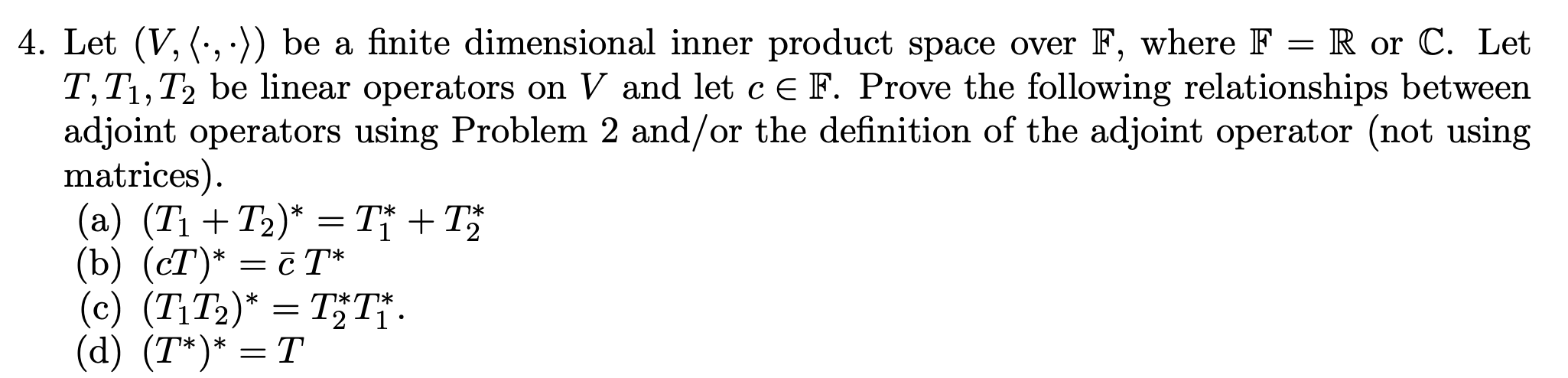
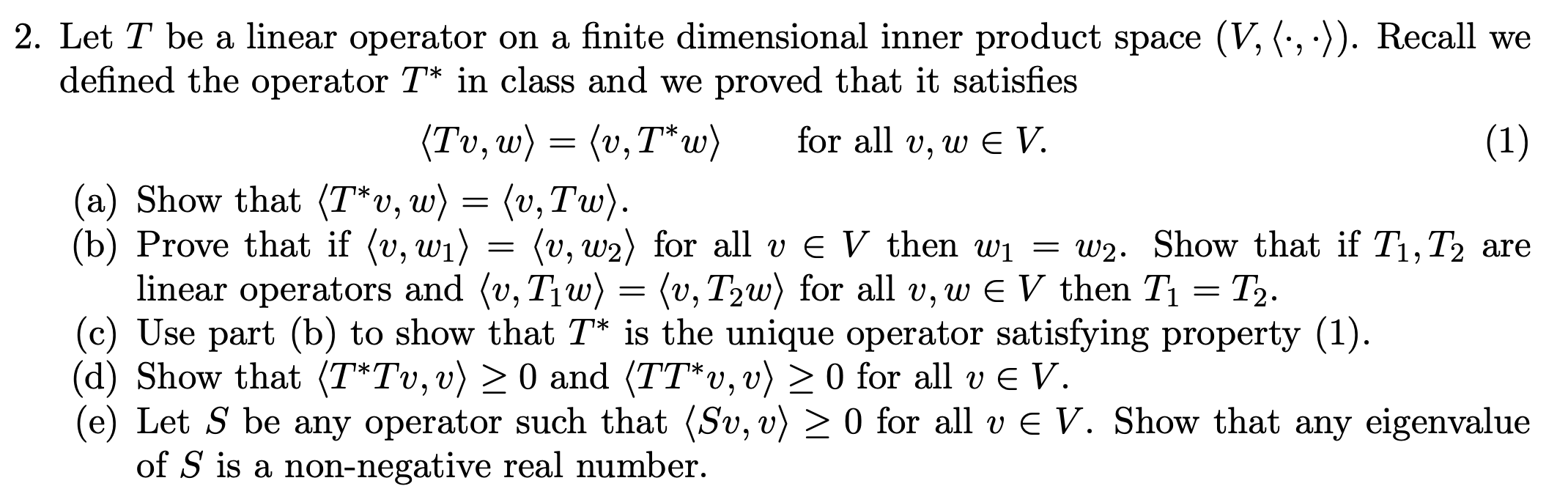
2. Let T be a linear operator on a finite dimensional inner product space (V, (., .)). Recall we defined the operator T* in class and we proved that it satisfies ( Tv, w) = (v, I* w ) for all v, w E V. (1) (a Show that (T*v, w) = (v, Tw). (b) Prove that if (v, w1) = (v, w2) for all v E V then w1 = w2. Show that if Ti, T2 are linear operators and (v, Tiw) = (v, Tow) for all v, w E V then Ti = T2. (c) Use part (b) to show that T* is the unique operator satisfying property (1). (d) Show that (T*Tv, v) 2 0 and (TT*v, v) 2 0 for all v E V. (e) Let S be any operator such that (Sv, v) 2 0 for all v E V. Show that any eigenvalue of S is a non-negative real number.. Let (V, (-, -)) be a nite dimensional inner product space over F, Where IF = R or (C. Let T, T1, T2 be linear operators on V and let 0 6 ]F. Prove the following relationships between adjoint operators using Problem 2 and / or the denition of the adjoint operator (not using matrices). (a) (T1 + T2)* 2 Ti + T; (b) (cT)* = E T* (C) (T1T2)* = T2*Ti"- (d) (T*)* = T

Step by Step Solution

There are 3 Steps involved in it

1 Expert Approved Answer
Step: 1 Unlock blur-text-image

Question Has Been Solved by an Expert!

Get step-by-step solutions from verified subject matter experts

Step: 2 Unlock
Step: 3 Unlock

Students Have Also Explored These Related Mathematics Questions!