







Question: How do I solve this problem using Python programming? The core problem to be solved in the implementation of the Game of Life is how
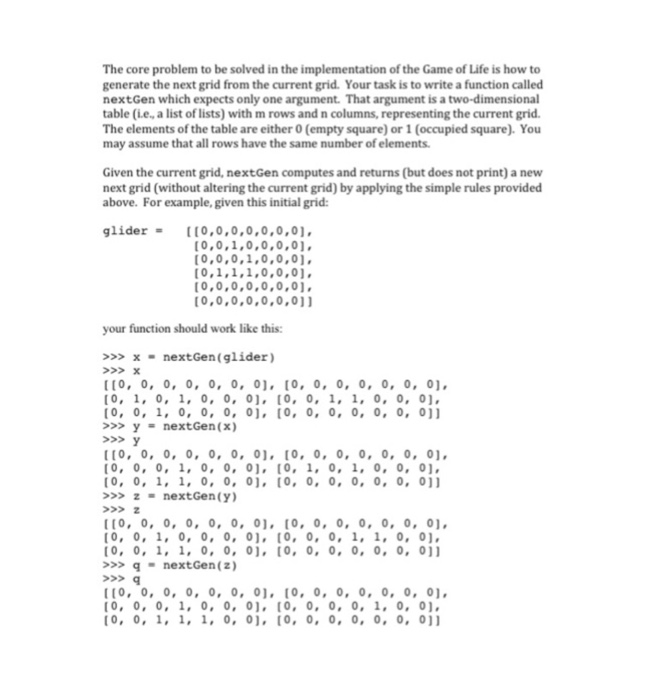
The core problem to be solved in the implementation of the Game of Life is how to generate the next grid from the current grid. Your task is to write a function called nextGen which expects only one argument. That argument is a two-dimensional table (i.e., a list of lists) with m rows and n columns, representing the current grid. The elements of the table are either 0 (empty square) or 1 (occupied square). You may assume that all rows have the same number of elements. Given the current grid, nextGen computes and returns (but does not print) a new next grid (without altering the current grid) by applying the simple rules provided above. For example, given this initial grid: glider = [[0, 0, 0, 0, 0, 0, 0], [0, 0, 1, 0, 0, 0. 0], [0, 0, 0, 1, 0, 0, 0], [0, 1, 1, 1, 0, 0, 0], [0, 0, 0, 0, 0, 0, 0], [0, 0, 0, 0, 0, 0, 0]] your function should work like this: > > > x = nextGen (glider) > > > x [[0, 0, 0, 0, 0, 0, 0], [0, 0, 0, 0, 0,0, 0], [0, 1, 0, 1,0, 0, 0], [0, 0, 1, 1, 0. 0. 0], [0, 0, 1, 0, 0, 0, 0], [0, 0, 0, 0, 0, 0, 0]] > > > y = nextGen (x) > > > y [[0, 0, 0, 0, 0, 0, 0], [0, 0, 0, 0, 0, 0, 0], [0, 0, 0, 1, 0, 0, 0], [0,1, 0, 1, 0. 0, 0], [0, 0, 1, 1, 0, 0, 0], [0, 0, 0, 0, 0, 0, 0]] > > > z nextGen (y) > > > z[[0, 0, 0, 0, 0, 0, 0], [0, 0, 0, 0, 0, 0, 0], [0, 0, 1, 0, 0, 0, 0], [0, 0, 0, 1, 1, 0,0], [0, 0, 1, 1, 0, 0, 0], [0, 0, 0, 0, 0, 0, 0]] > > > q = nextGen (z) > > > q [[0, 0, 0, 0, 0, 0, 0], [0, 0, 0, 0, 0, 0, 0], [0, 0, 0, 1, 0, 0, 0], [0, 0, 0, 0, 1, 0, 0], [0, 0, 1, 1, 1, 0, 0], [0, 0, 0, 0, 0. 0. 0]]
Step by Step Solution
There are 3 Steps involved in it

Get step-by-step solutions from verified subject matter experts
 Study Help