







Question: How do these models reflect potential career growth paths? Reflect on the realism of each model in today's job market. Which model do you think
How do these models reflect potential career growth paths?
Reflect on the realism of each model in today's job market. Which
model do you think more accurately predicts salary growth, and why?
Consider any external factors that could influence salary growth over time and
how they might fit into these models.
Phase : Presentation
Prepare a presentation of your findings, including graphs, equations, and your
analysis.
Share your conclusions on the implications of linear vs quadratic salary growth,
supported by your data analysis.
Assessment Criteria:
Accuracy in plotting data and deriving equations.
Depth of analysis in comparing the models.
Critical thinking in discussing the implications of each model.
Clarity and thoroughness in the presentation of findings.
Submission Requirements:
A written report including all calculations, graphs, and analysis.
A PPT file for sharing your findings with the family.
This project aims to not only enhance students' understanding of linear and quadratic
functions but also to apply mathematical reasoning to realworld economic issues,
preparing them for complex problemsolving in their future academic and professional
endeavors. Inquiry Learning Project: Analyzing Salary Growth Models
Overview:
In this project, students will explore the concepts of linear and quadratic growth as they
apply to salary progression over time. By analyzing given datasets and applying
mathematical models, students will gain insights into how salaries can change and
what factors might influence these changes. This project encourages the application of
mathematical concepts to realworld scenarios, fostering a deeper understanding of
both mathematics and economics.
Objective:
To understand and apply linear and quadratic models to salary data.
To analyze and compare the implications of each model on longterm salary
progression.
To develop critical thinking and data analysis skills through mathematical
modeling.
Materials Needed:
Spreadsheet software eg Microsoft Excel, Google Sheets
Desmos Calculator optional
Project Phases:
Phase : Define and Understand the Salary Growth Models
Linear Growth Model: Salaries increase by a fixed amount each year.
Quadratic Growth Model: Salaries increase at an accelerating rate, represented by
a quadratic equation.Phase : Define and Understand the Salary Growth Models
Linear Growth Model: Salaries increase by a fixed amount each year.
Quadratic Growth Model: Salaries increase at an accelerating rate, represented by
a quadratic equation.
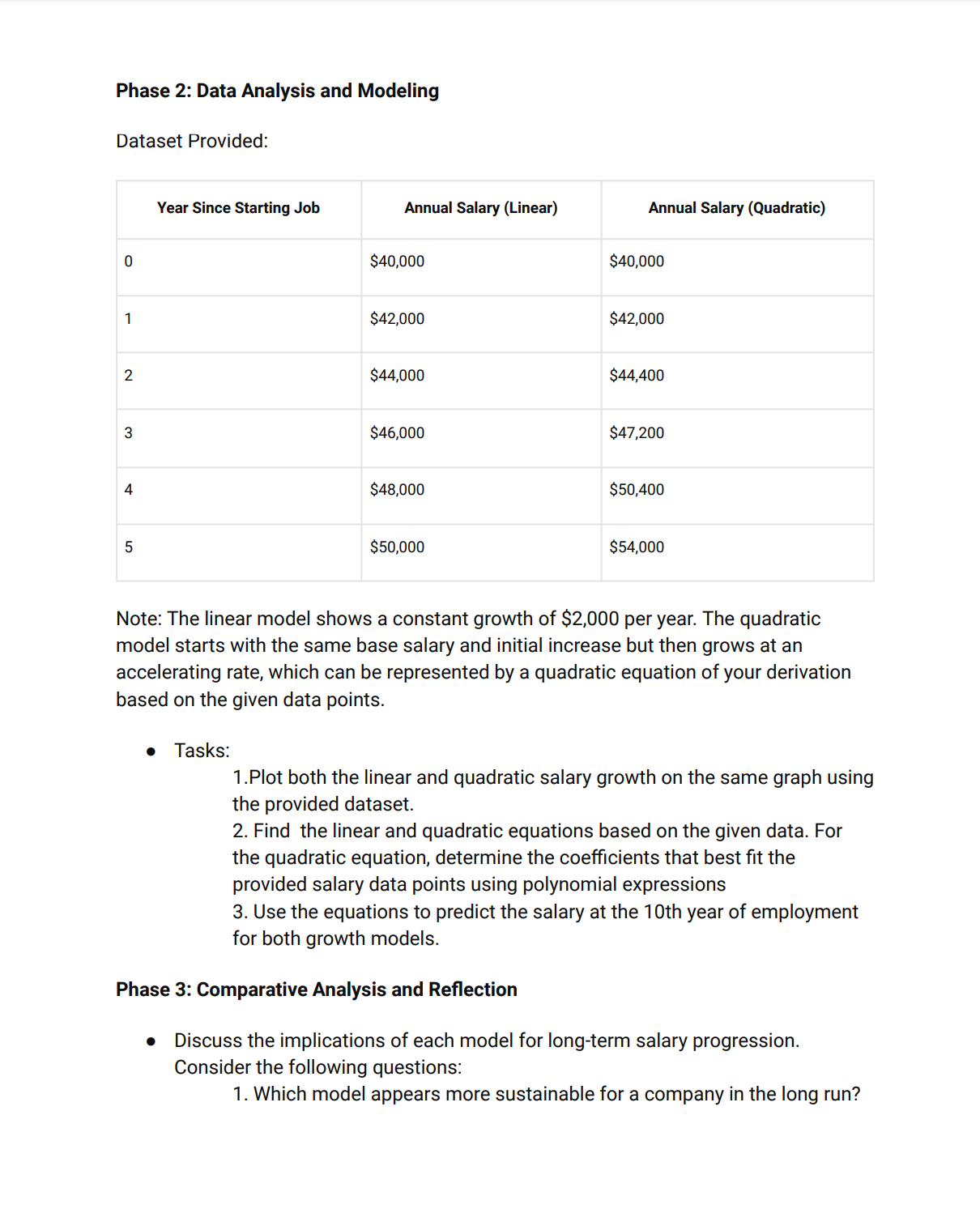
Phase : Data Analysis and Modeling
Dataset Provided:
tableYear Since Starting Job,Annual Salary LinearAnnual Salary Quadratic$$$$$$$$$$$$
Note: The linear model shows a constant growth of $ per year. The quadratic model starts with the same base salary and initial increase but then grows at an accelerating rate, which can be represented by a quadratic equation of your derivation based on the given data points.
Tasks:
Plot both the linear and quadratic salary growth on the same graph using the provided dataset.
Find the linear and quadratic equations based on the given data. For the quadratic equation, determine the coefficients that best fit the provided salary data points using polynomial expressions
Use the equations to predict the salary at the th year of employment for both growth models.
Phase : Comparative Analysis and Reflection
Discuss the implications of each model for longterm salary progression.
Consider the following questions:
Which model appears more sustainable for a company in the long run?
How do these models reflect potential career growth paths?
Reflect on the realism of each model in todays job market. Which
model do you think more accurately predicts salary growth, and why?
Consider any external factors that could influence salary growth over time and
how they might fit into these models.
Phase : Presentation
Prepare a presentation of your findings, including graphs, equations, and your
analysis.
Share your conclusions on the implications of linear vs quadratic salary growth,
supported by your data analysis.
Step by Step Solution
There are 3 Steps involved in it
1 Expert Approved Answer
Step: 1 Unlock

Question Has Been Solved by an Expert!
Get step-by-step solutions from verified subject matter experts
Step: 2 Unlock
Step: 3 Unlock
 Study Help