





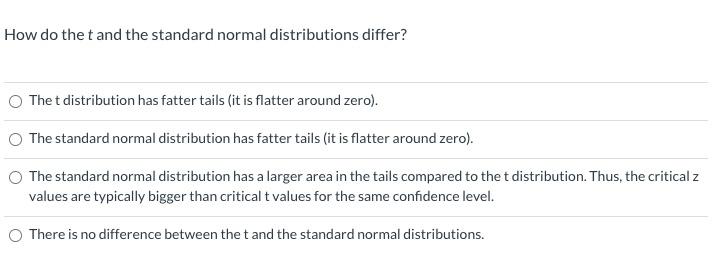
Question: How do thet and the standard normal distributions differ? The t distribution has fatter tails (it is flatter around zero). The standard normal distribution has
How do thet and the standard normal distributionsHow do thet and the standard normal distributionsHow do thet and the standard normal distributions

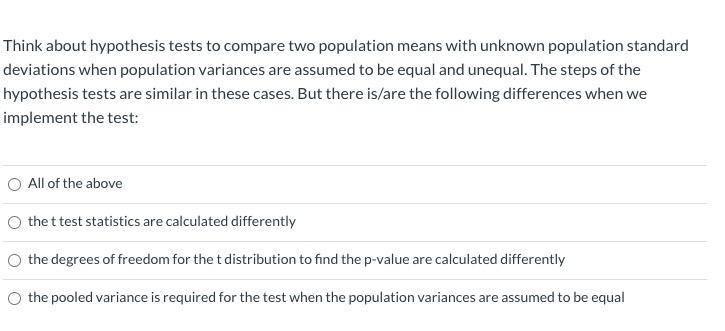
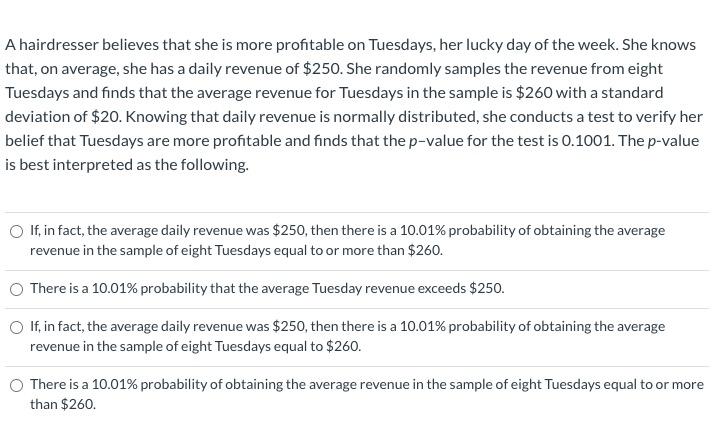
How do thet and the standard normal distributions differ? The t distribution has fatter tails (it is flatter around zero). The standard normal distribution has fatter tails (it is flatter around zero). The standard normal distribution has a larger area in the tails compared to the t distribution. Thus, the critical z values are typically bigger than critical t values for the same confidence level. There is no difference between the t and the standard normal distributions. Think about hypothesis tests to compare two population means with unknown population standard deviations when population variances are assumed to be equal and unequal. The steps of the hypothesis tests are similar in these cases. But there is/are the following differences when we implement the test: All of the above the t test statistics are calculated differently the degrees of freedom for the t distribution to find the p-value are calculated differently the pooled variance is required for the test when the population variances are assumed to be equal A hairdresser believes that she is more profitable on Tuesdays, her lucky day of the week. She knows that, on average, she has a daily revenue of $250. She randomly samples the revenue from eight Tuesdays and finds that the average revenue for Tuesdays in the sample is $260 with a standard deviation of $20. Knowing that daily revenue is normally distributed, she conducts a test to verify her belief that Tuesdays are more profitable and finds that the p-value for the test is 0.1001. The p-value is best interpreted as the following. If, in fact, the average daily revenue was $250, then there is a 10.01% probability of obtaining the average revenue in the sample of eight Tuesdays equal to or more than $260. There is a 10.01% probability that the average Tuesday revenue exceeds $250. If, in fact, the average daily revenue was $250, then there is a 10.01% probability of obtaining the average revenue in the sample of eight Tuesdays equal to $260. There is a 10.01% probability of obtaining the average revenue in the sample of eight Tuesdays equal to or more than $260
Step by Step Solution

There are 3 Steps involved in it

1 Expert Approved Answer
Step: 1 Unlock blur-text-image

Question Has Been Solved by an Expert!

Get step-by-step solutions from verified subject matter experts

Step: 2 Unlock
Step: 3 Unlock

Students Have Also Explored These Related General Management Questions!