







Question: How do we get the basis point? using a portiono insurance strategy, the performance rankings should differ. 7. Consider the following performance data for two
How do we get the basis point?
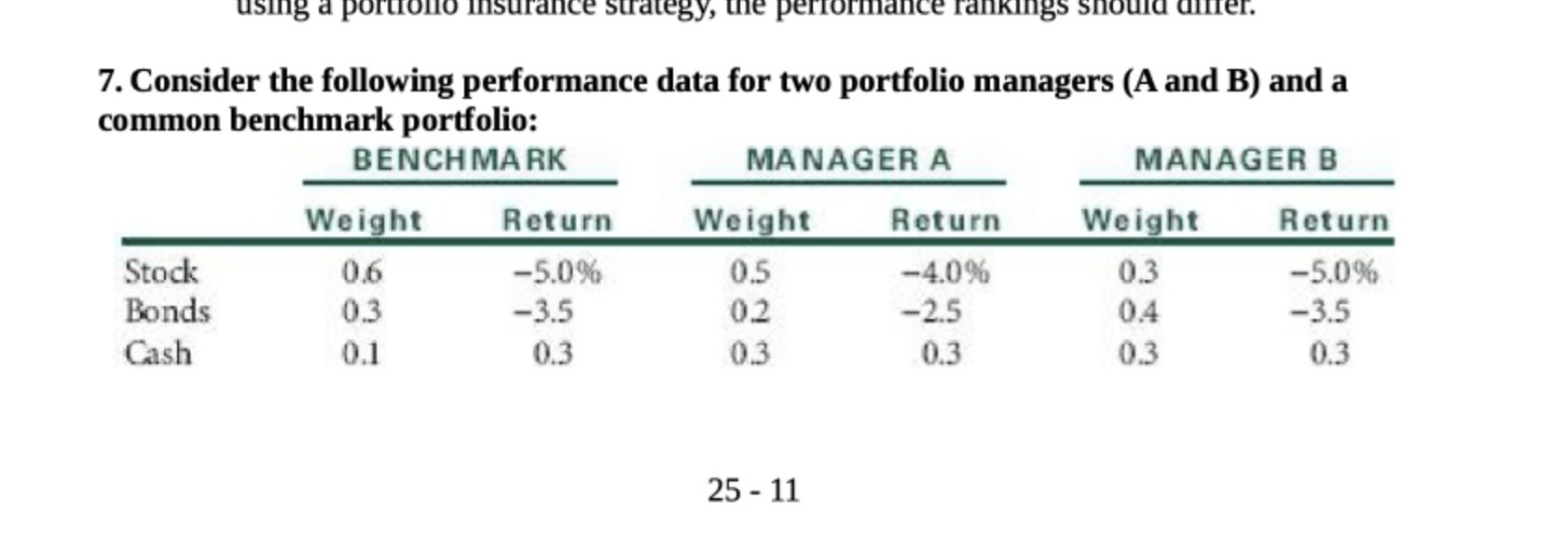
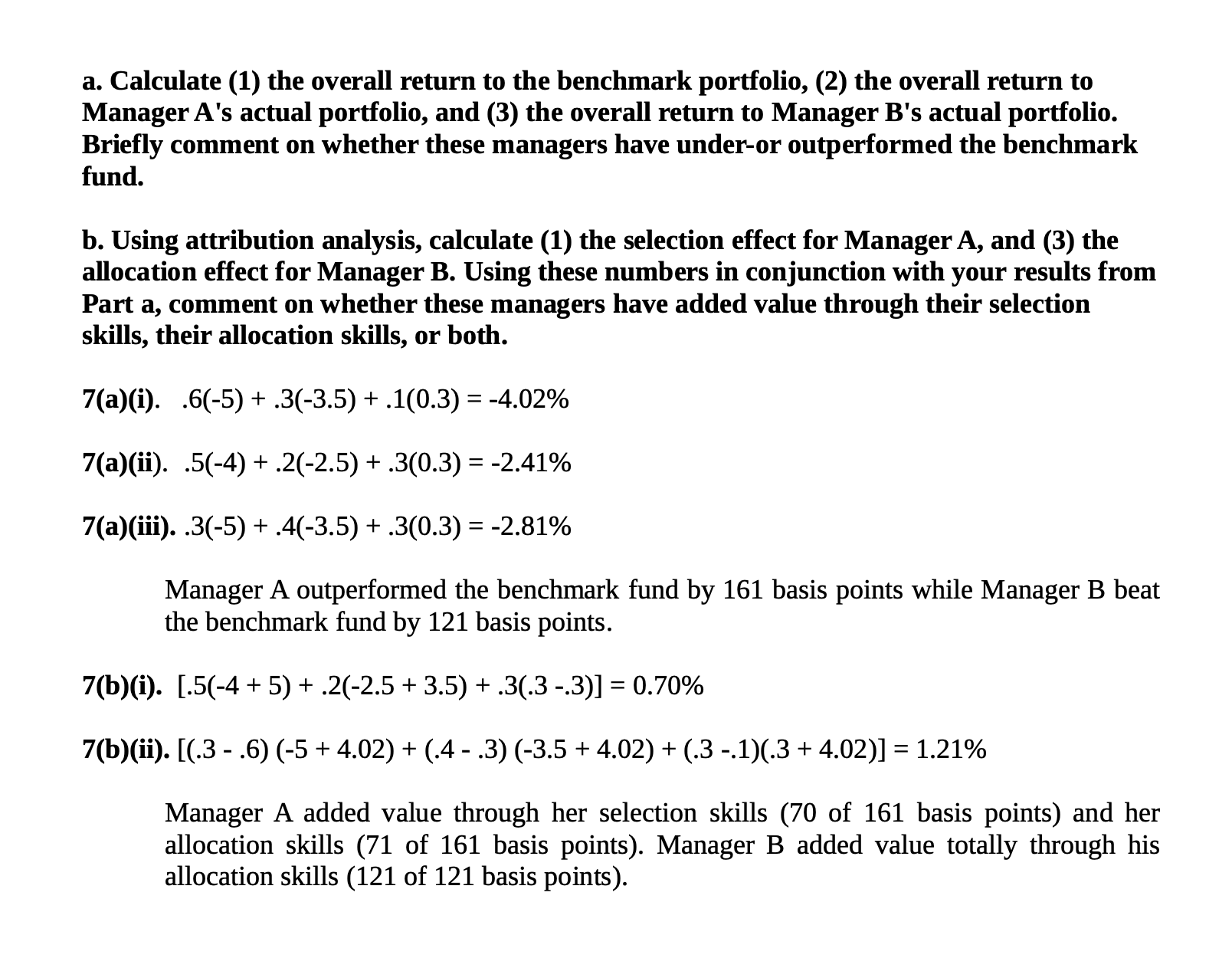
using a portiono insurance strategy, the performance rankings should differ. 7. Consider the following performance data for two portfolio managers (A and B) and a common benchmark portfolio: BENCHMARK MANAGER A MANAGER B Weight Return Weight Return Weight Return Stock 0.6 -5.0% 0.5 -4.0% 0.3 -5.0% Bonds 0.3 -3.5 0.2 -2.5 0.4 -3.5 Cash 0.1 0.3 03 0.3 0.3 0.3 25 - 11a. Calculate (1) the overall return to the benchmark portfolio, (2) the overall return to Manager A's actual portfolio, and (3) the overall return to Manager B's actual portfolio. Briey comment on whether these managers have under-or outperformed the benchmark fund. b. Using attribution analysis, calculate (1) the selection effect for Manager A, and (3) the allocation effect for Manager B. Using these numbers in conjunction with your results from Part a, comment on whether these managers have added value through their selection skills, their allocation skills, or both. 7(a)(i). .6(-5) + .3(-3.5) + .1(0.3) = -4.02% 7(a)(ii). .5(-4) + .2(-2.5) + .3(0.3) = -2.41% 7(a)(iii). .3(-5) + .4(-3.5) + .3(0.3) = -2.81% Manager A outperformed the benchmark fund by 161 basis points while Manager B beat the benchmark fund by 121 basis points. 7(b)(i). [.5(-4 + 5) + .2(-2.5 + 3.5) + .3(.3 -.3)] = 0.70% 7(b)(ii). [(.3 - .6) (-5 + 4.02) + (.4 - .3) (-3.5 + 4.02) + (.3 -.1)(.3 + 4.02)] = 1.21% Manager A added value through her selection skills (70 of 161 basis points) and her allocation skills (71 of 161 basis points). Manager B added value totally through his allocation skills (121 of 121 basis points)
Step by Step Solution
There are 3 Steps involved in it

Get step-by-step solutions from verified subject matter experts
 Study Help