







Question: how do we get this in red solve by hand step by step [A]e=[A]0[P]e then it follows, by the definition of K, that [P]e=k1+k1k1[A]e and,
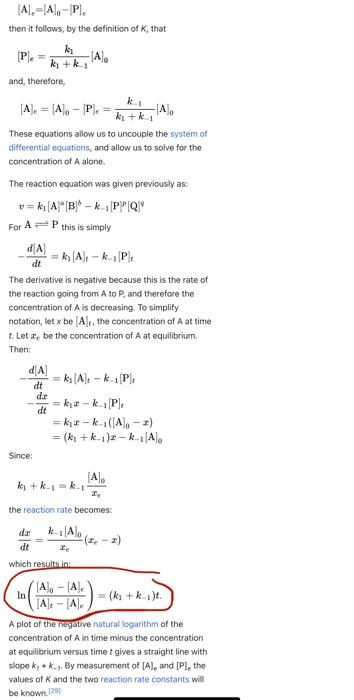
[A]e=[A]0[P]e then it follows, by the definition of K, that [P]e=k1+k1k1[A]e and, therefore, [A]e=[A]0[Pe=k1+k1k1[A]0 These equations allow us to uncouple the system of differential equations, and allow us to solve for the concentration of A alone. The reaction equation was given previcusly as: v=k1[A]a[B]bk1[P]P[Q]p For APthisissimply dtdA]=k1[A]tk1[P]t The derivative is negative because this is the rate of the reaction going from A to P, and therefore the concentration of A is decreasing. To simplify notation, let x be [A]t, the concentration of A at time t. Let xe be the concentration of A at equilibrium. Then: dtd[A]dtdx=k1[A]tk1[P]t=k1xk1[P]t=k1xk1([A]0x)=(k1+k1)xk1[A]e Since: k1+k1=k1xe[A]0 the reaction rate becomes: dtdx=xek1[A]0(xex) which results in: ln([A]t[A]e[A]0[A])=(k1+k1)t A plot of the neggative natural logarithm of the concentration of A in time minus the concentration at equilibrium versus time t gives a straight line with slope k2+k. By measurement of [Ae and [P]e the values of K and the two reaction fate constants will be known. 1291
Step by Step Solution
There are 3 Steps involved in it

Get step-by-step solutions from verified subject matter experts
 Study Help