Question: How does McDonald's create value for its customers? What are its key success factors? What factors in the General Environment have affected the restaurant industry
How does McDonald's create value for its customers? What are its key success factors?
What factors in the General Environment have affected the restaurant industry since McDonald's founding? What impact have they had on competitors and McDonald's in particular?
Analyze the five-forces of the fast food restaurant industry. Do all companies in the industry face the same pressures? How do firms survive the competition?
Based on your response above, make at least two recommendations about changes (e.g., product and marketing strategy, sourcing strategy, personnel strategy) to support its growth.
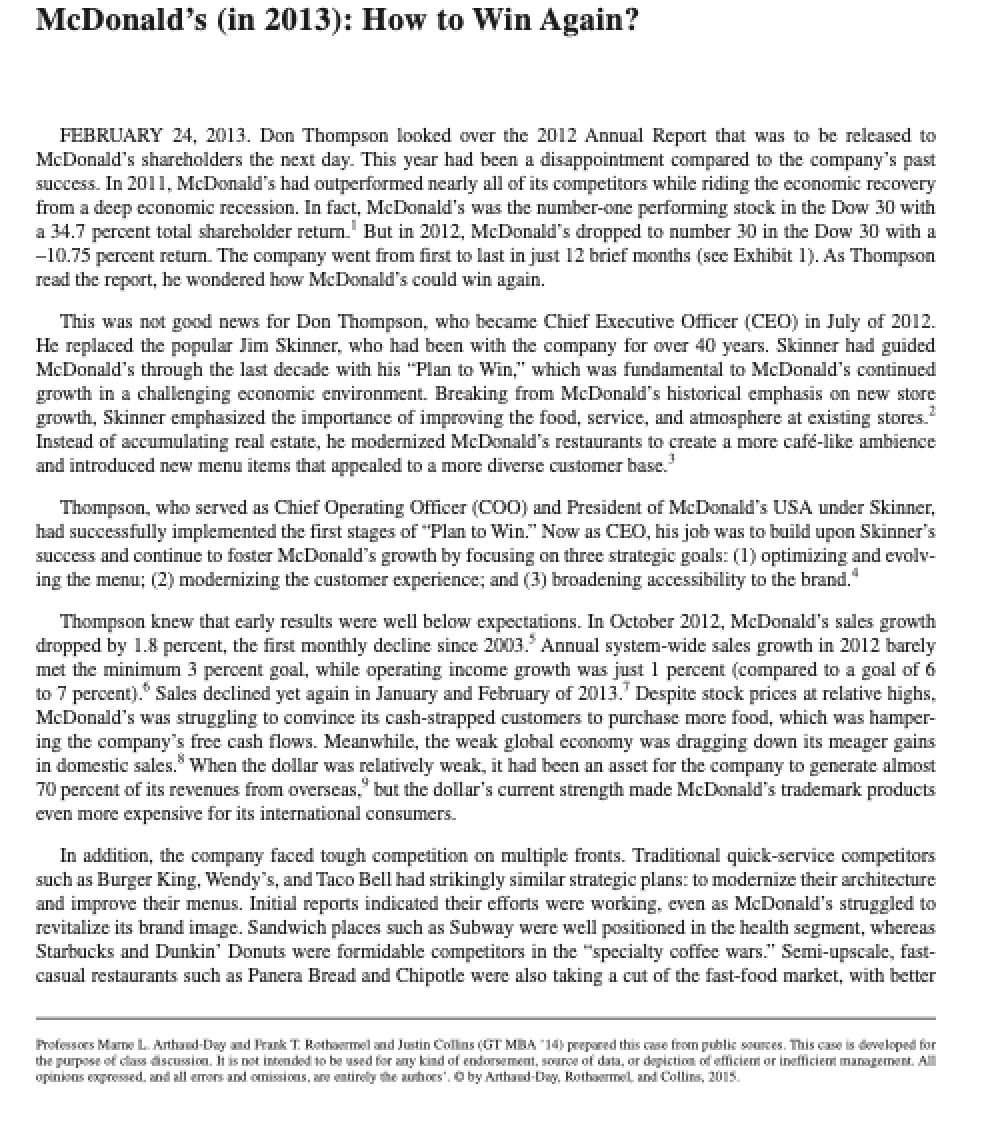
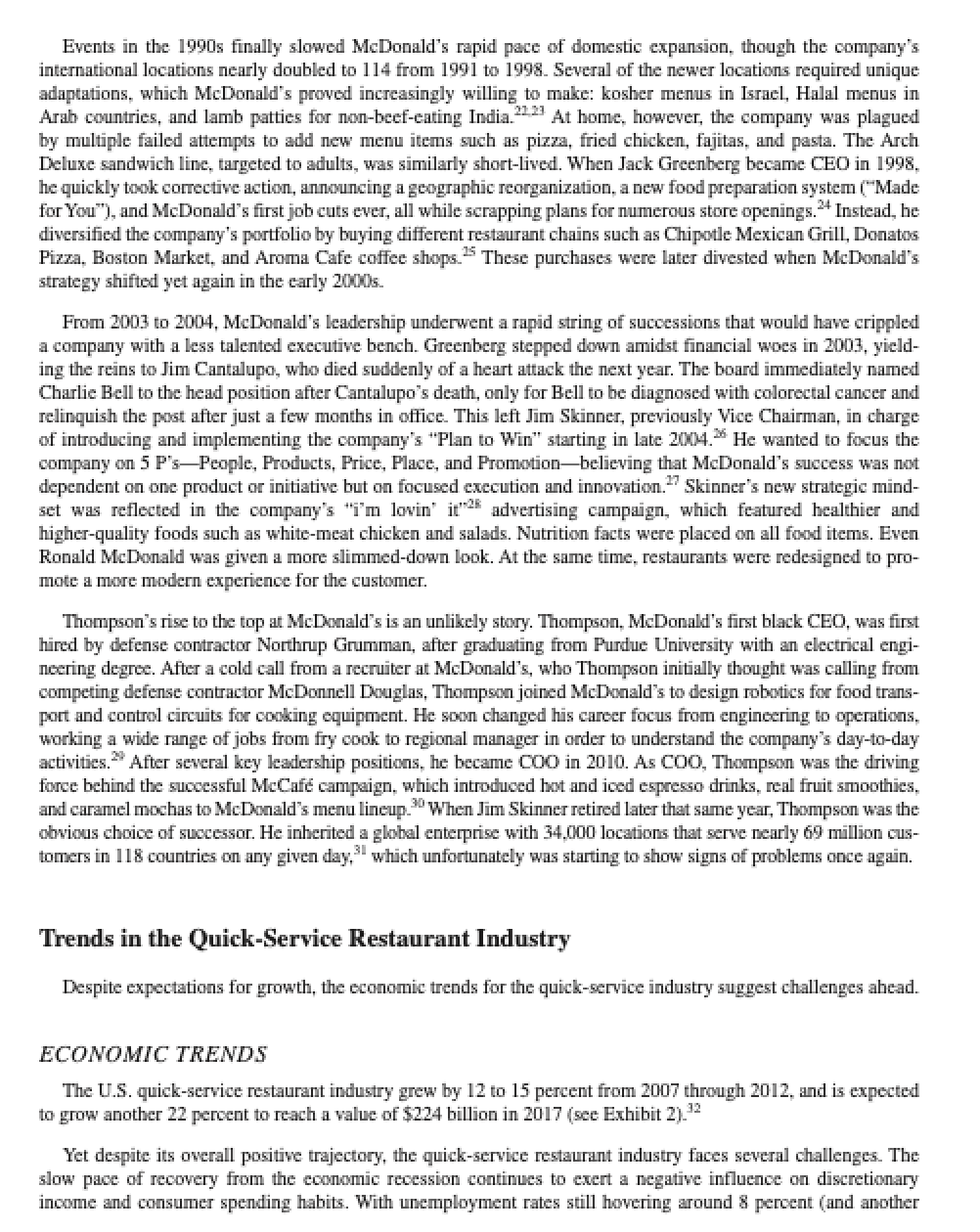
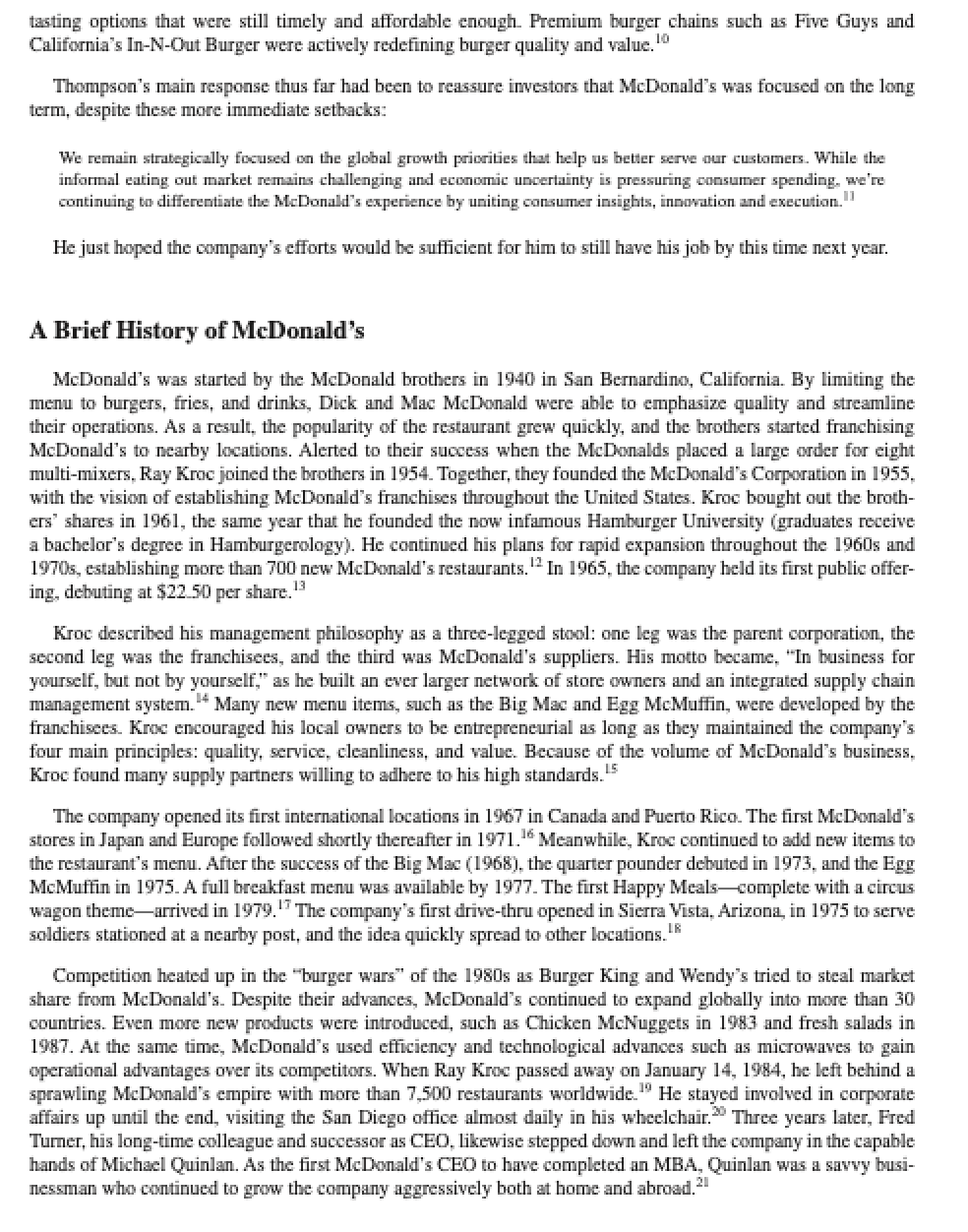
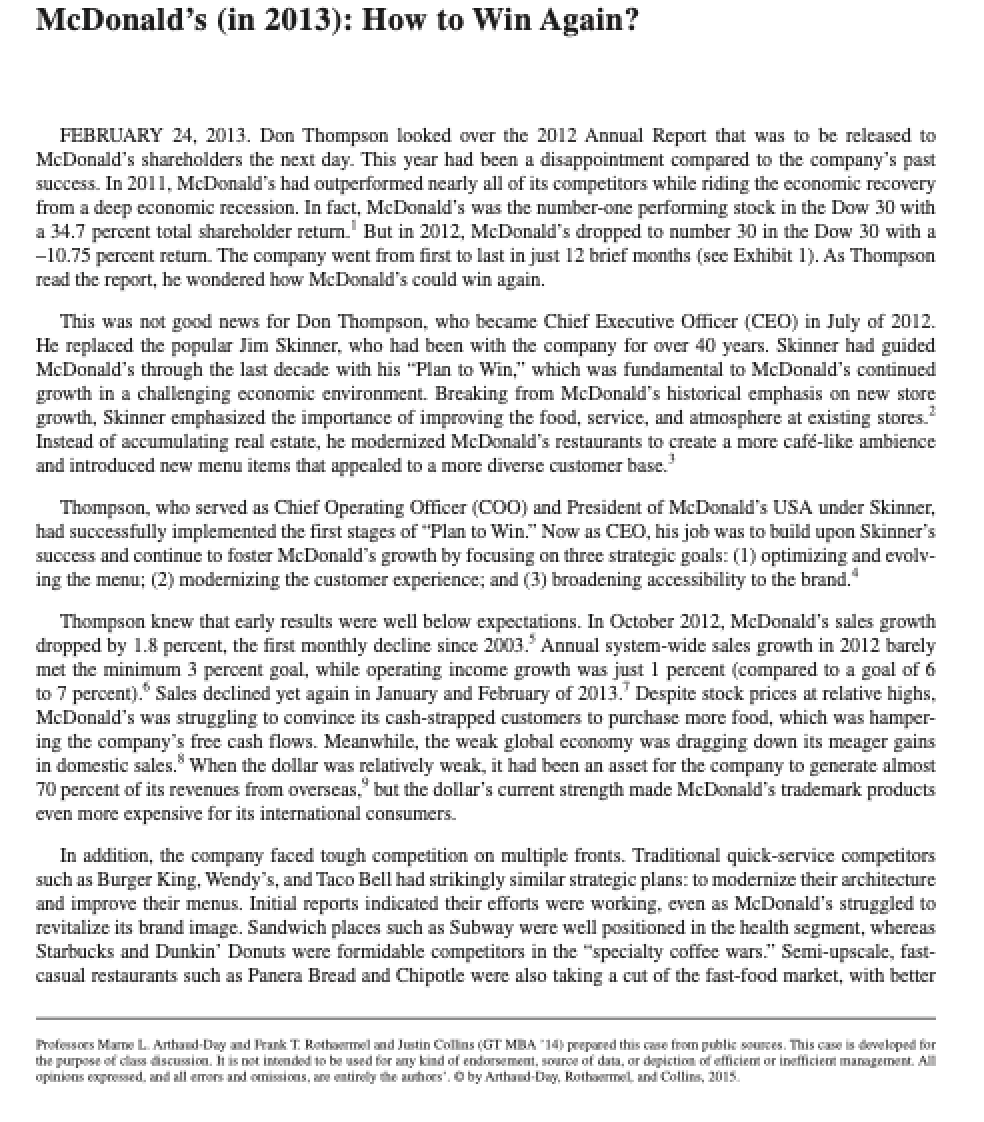
FEBRLARY 24, 2013. Don Thompson looked over the 2012 Annual Report that was to be released to McDonald's shareholders the next day. This year had been a disappointment compared to the company's past success. In 2011, McDonald's had outperformed nearly all of its competitors while riding the economic recovery from a deep economic recession. In fact, MeDonald's was the number-one performing stock in the Dow 30 with a 34.7 peroent total shareholder retumn " But in 2012 , McDonald's dropped to number 30 in the Dow 30 with a 10.75 peroent retum. The company went from first to last in just 12 brief months (see Exhibit 1 ). As Thompson read the report, he wondered how McDonald's could win again. This was not good news for Don Thompson, who became Chief Executive Officer (CEO) in July of 2012. He replaced the popalar Jim Skinner, who had been with the company for over 40 years. Skinner had guided McDonald's through the last decade with his "Plan to Win," which was fundamental to McDonald's continued growth in a challenging economic environment. Breaking from McDonald's historical emphazis on new store growth, Skinner emphasized the importance of impnoving the food, service, and atmosphere at existing stores. 2 Instead of accumulating real estate, he modernized McDonald's restaurants to create a more caf-like ambience and introduced new menu items that appealed to a more diverse customer base. 3 Thompson, who served as Chief Operating Officer (COO) and President of MeDonald's USA under Skinner, had successfully implemented the first stages of "Plan to Win." Now as CEO, his job was to build upon Skinner's success and continue to foster McDonald's growth by focusing on three strategic goals: (1) optimizing and evolving the menu; (2) modernixing the customer experience; and (3) broadening accessibility to the brand." Thompson knew that early results were well below expectations. In October 2012 , McDonald's sales growth dropped by 1.8 percent, the first monthly decline since 2003.5 Annual system-wide sales growth in 2012 barely met the minimum 3 percent goal, while operating income growth waz just 1 percent (compared to a goal of 6 to 7 percent). .6 Sales declined yet again in January and February of 2013 . Despite stock prices at relative highs, McDonald's was struggling to convince its cash-strapped customers to purchase more food, which was hampering the company's free cash flows. Meanwhile, the weak global econony was dragging down its meager gains in domestic sales. . When the dollar was relatively weak, it had been an asset for the company to generate almost 70 percent of its revenues from overseas, 4 bat the dollar's current strength made McDonald's trademark products even more expensive for its international consumers. In addition, the company faced tough competition on multiple fronts. Traditional quick-service competitors such as Burger King, Wendy's, and Taco Bell had strikingly similar strategic plans: to modernize their architecture and improve their menus. Initial reports indicated their efforts were working, even as McDonald's struggled to revitalize its brand image. Sandwich places such as Subway were well positioned in the health segment, whereas Starbucks and Dunkin' Donuts were formidable competitors in the "specialty coffee wars." Semi-upscalc, faztcasual restaurants such as Panera Bread and Chipotle were also taking a cut of the fast-food market, with better Events in the 1990 s finally slowed McDonald's rapid pace of domestic expansion, though the company's international locations nearly doubled to 114 from 1991 to 1998 . Several of the newer locations required unique adaptations, which McDonald's proved increasingly willing to make: kosher menus in Israel, Halal menus in Arab countries, and lamb patties for non-beef-eating India. 22,23 At home, however, the company was plagued by multiple failed attempts to add new menu items such as pizza, fried chicken, fajitas, and pasta. The Arch Deluxe sandwich line, targeted to adults, was similarly short-lived. When Jack Greenberg became CEO in 1998 , he quickly took conective action, announcing a geographic reonganization, a new food preparation system ("Made for You'), and McDonald's first job cuts ever, all while scrapping plans for numerous store openings. 24 Instead, he diversified the company's portfolio by buying different restaurant chains such as Chipotle Mexican Grill, Donatos Pizza, Boston Market, and Aroma Cafe coffee shops- 25 These purchases were later divested when MeDonald's strategy shifted yet again in the early 2000 s. From 2003 to 2004 , McDonald's leadership underwent a rapid string of successions that would have crippled a company with a less talented executive bench. Greenberg stepped down amidst financial woes in 2003 , yielding the reins to Jim Cantalupo, who died suddenly of a heart attack the next year. The board immediately named Charlie Bell to the head position after Cantalupo's death, only for Bell to be diagnosed with colorectal cancer and relinquish the post after just a few months in office. This left Jim Skinner, previously Vice Chairman, in charge of introducing and implementing the company's "Plan to Win" starting in late 2004.26He wanted to focus the company on 5 P's-People, Products, Price, Place, and Promotion-believing that McDonald's success was not dependent on one product or initiative but on focused execution and innovation. 17 Skinner's new strategic mindset was reflected in the company's "i'm lowin' it,"28 advertising campaign, which featured healthier and higher-quality foods such as white-meat chicken and salads. Nutrition facts were placed on all food items. Even Ronald McDonald was given a more slimmed-down look. At the same time, restaurants were redesigned to promote a more modern experience for the customer. Thompson's rise to the top at McDonald's is an unlikely story. Thompson, McDonald's first black CEO, was first hired by defense contractor Northrup Grumman, after graduating from Purdue University with an electrical engineering degree. After a cold call from a recruiter at McDonald's, who Thompson initially thought was calling from competing defense contractor McDonnell Douglas, Thompson joined McDonald's to design roboties for food transport and control circuits for conking equipment. He soon changed his career focus from engineering to operations, working a wide range of jobs from fry cook to regional manager in order to understand the company's day-to-day activities. 2 After several key leadership positions, he became COO in 2010 . As COO, Thompson was the driving force behind the successful McCafe campaign, which introduced bot and ioed espresso drinks, real fruit smoothies, and caramel mochas to McDonald's menu lineup. 30 When Jim Skinner retired later that same year, Thompson was the obvious choice of successor. He inherited a global enterprise with 34,000 locations that serve nearly 69 million customers in 118 countries on any given day, 31 which unfortunately was starting to show signs of problens once again. Trends in the Quick-Service Restaurant Industry Despite expectations for growth, the economic trends for the quick-service industry suggest challenges ahead. ECONOMIC TRENDS The U.S. quick-service restaurant industry grew by 12 to 15 percent from 2007 through 2012 , and is expected to grow another 22 percent to reach a value of $224 billion in 2017 (see Exhibit 2). 32 Yet despite its overall positive trajectory, the quick-service restaurant industry faces several challenges. The slow pace of recovery from the economic recession continues to exert a negative influence on discretionary income and consumer spending habits. With unemployment rates still hovering around 8 percent (and another tasting options that were still timely and affordable caough. Premium burger chains such as Five Guys and California's In-N-Out Burger were actively redefining burger quality and value. 10 Thompson's main response thus far had been to reazsure investors that McDonald's was focused on the long term, despite these more immediate setbacks: We remain strategically focused on the global growth priorities that help as better serve our cuatamers. While the infarmal eating out market remains challenging and economic uncertainty is pressuring consumer spending. ?eve're continuing to differentiate the MeDonald's experience by uniting consumer insights, innovation and execution." He just hoped the company's efforts would be sufficient for him to still have his job by this time next year. A Brief History of McDonald's MeDonald's was started by the McDonald brothers in 1940 in San Bernardino, California. By limiting the menu to burgers, fries, and drinks, Dick and Mac MeDonald were able to cmphazize quality and streamline their operations. As a result, the popularity of the restaurant grew quickly, and the brothers started franchising McDonald's to nearby lecations. Alerted to their suocess when the MeDonalds placed a large order for eight multi-mixers, Ray Kroc joined the brothers in 1954. Together, they founded the MeDonald's Corporation in 1955 , with the vision of establishing McDonald's franchises thoughout the United States. Kroc bought out the brothers" shares in 1961 , the same year that he founded the now infamous Hambarger University (graduates receive a bachelor's degree in Hamburgerology). He continued his plans for rapid expansion throughout the 1960g and 1970 , establishing more than 700 new McDonald's restaurants. 12 In 1965 , the company held its first public offering, debuting at $22.50 per share. 13 Kroc described his management philosophy as a three-legged steol: one leg was the parent corponation, the second leg was the franchisees, and the third was MeDonald's suppliers. His motto became, "In business for yourself, bat not by yourself," as he built an ever larger network of store wwners and an integrated supply chain management system. 14 Many new menu iteme, such as the Big Mac and Egg McMuffin, were developed by the franchisees. Kroc encouraged his local owners to be entrepreneurial az long as they maintained the company's four main principles: quality, service, cleanliness, and value. Because of the volume of McDonald's business, Kroc found many supply partners willing to adhere to his high standards. 15 The company opened its first international locations in 1967 in Canada and Puerto Rico. The first MeDonald's stores in Japan and Europe followed shortly thereafter in 1971.16 Meanwhile, Kroc continued to add new items to the restaurant's menu. After the sucoess of the Big Mac (1968), the quarter pounder debuted in 1973 , and the Egg McMuffin in 1975. A full breakfast menu waz available by 1977. The first Happy Meals-complete with a circus soldiers stationed at a nearby post, and the idea quickly spread to other locations. IR Competition heated up in the "burger wars" of the 1980s as Burger King and Wendy's tried to steal market share from MeDonald's. Despite their advances, McDonald's continued to expand globally into more than 30 countries. Even more new products were introduced, such az Chicken MoNuggets in 1983 and fresh salads in 1987. At the same time. McDonald's wsed efficiency and technological advances sech as microwaves to gain operational advantagoes over its competitors. When Ray Kroc passed away on January 14,1984 , he left behind a sprawling MeDonald's cmpire with more than 7,500 restaurants worldwide 19 He stayed involved in corporate affairs up until the cad, visiting the San Dicgo office almost daily in his wheelchair. 20 Three years later, Fred Tumer, his long-time colleague and successor as CEO, likewise stepped down and left the company in the capable hands of Michael Quinlan. As the first MeDwnald's CEO to have completed an MBA, Quinlan was a savvy busjnessman who continued to grow the company aggressively both at home and abroad.' 2 FEBRLARY 24, 2013. Don Thompson looked over the 2012 Annual Report that was to be released to McDonald's shareholders the next day. This year had been a disappointment compared to the company's past success. In 2011, McDonald's had outperformed nearly all of its competitors while riding the economic recovery from a deep economic recession. In fact, MeDonald's was the number-one performing stock in the Dow 30 with a 34.7 peroent total shareholder retumn " But in 2012 , McDonald's dropped to number 30 in the Dow 30 with a 10.75 peroent retum. The company went from first to last in just 12 brief months (see Exhibit 1 ). As Thompson read the report, he wondered how McDonald's could win again. This was not good news for Don Thompson, who became Chief Executive Officer (CEO) in July of 2012. He replaced the popalar Jim Skinner, who had been with the company for over 40 years. Skinner had guided McDonald's through the last decade with his "Plan to Win," which was fundamental to McDonald's continued growth in a challenging economic environment. Breaking from McDonald's historical emphazis on new store growth, Skinner emphasized the importance of impnoving the food, service, and atmosphere at existing stores. 2 Instead of accumulating real estate, he modernized McDonald's restaurants to create a more caf-like ambience and introduced new menu items that appealed to a more diverse customer base. 3 Thompson, who served as Chief Operating Officer (COO) and President of MeDonald's USA under Skinner, had successfully implemented the first stages of "Plan to Win." Now as CEO, his job was to build upon Skinner's success and continue to foster McDonald's growth by focusing on three strategic goals: (1) optimizing and evolving the menu; (2) modernixing the customer experience; and (3) broadening accessibility to the brand." Thompson knew that early results were well below expectations. In October 2012 , McDonald's sales growth dropped by 1.8 percent, the first monthly decline since 2003.5 Annual system-wide sales growth in 2012 barely met the minimum 3 percent goal, while operating income growth waz just 1 percent (compared to a goal of 6 to 7 percent). .6 Sales declined yet again in January and February of 2013 . Despite stock prices at relative highs, McDonald's was struggling to convince its cash-strapped customers to purchase more food, which was hampering the company's free cash flows. Meanwhile, the weak global econony was dragging down its meager gains in domestic sales. . When the dollar was relatively weak, it had been an asset for the company to generate almost 70 percent of its revenues from overseas, 4 bat the dollar's current strength made McDonald's trademark products even more expensive for its international consumers. In addition, the company faced tough competition on multiple fronts. Traditional quick-service competitors such as Burger King, Wendy's, and Taco Bell had strikingly similar strategic plans: to modernize their architecture and improve their menus. Initial reports indicated their efforts were working, even as McDonald's struggled to revitalize its brand image. Sandwich places such as Subway were well positioned in the health segment, whereas Starbucks and Dunkin' Donuts were formidable competitors in the "specialty coffee wars." Semi-upscalc, faztcasual restaurants such as Panera Bread and Chipotle were also taking a cut of the fast-food market, with better









 Study Help