







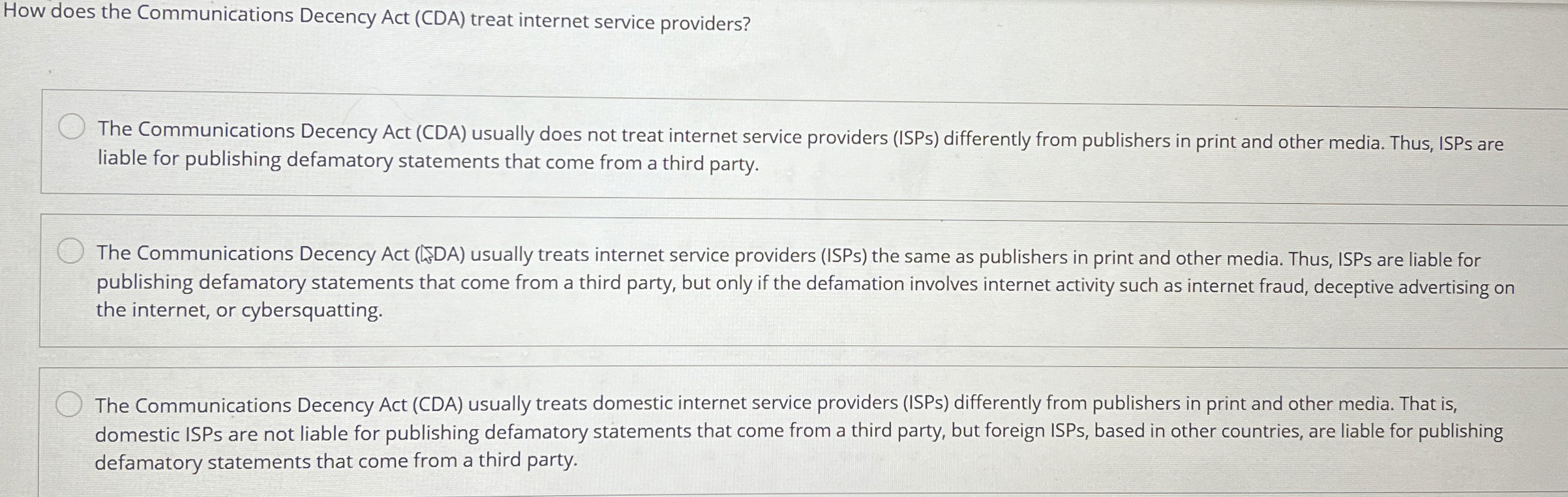
Question: How does the Communications Decency Act ( CDA ) treat internet service providers? The Communications Decency Act ( CDA ) usually does not treat internet
How does the Communications Decency Act CDA treat internet service providers?
The Communications Decency Act CDA usually does not treat internet service providers ISPs differently from publishers in print and other media. Thus, ISPs are
liable for publishing defamatory statements that come from a third party.
The Communications Decency Act SDA usually treats internet service providers ISPs the same as publishers in print and other media. Thus, ISPs are liable for
publishing defamatory statements that come from a third party, but only if the defamation involves internet activity such as internet fraud, deceptive advertising on
the internet, or cybersquatting.
The Communications Decency Act CDA usually treats domestic internet service providers ISPs differently from publishers in print and other media. That is
domestic ISPs are not liable for publishing defamatory statements that come from a third party, but foreign ISPs, based in other countries, are liable for publishing
defamatory statements that come from a third party.
Step by Step Solution
There are 3 Steps involved in it
1 Expert Approved Answer
Step: 1 Unlock

Question Has Been Solved by an Expert!
Get step-by-step solutions from verified subject matter experts
Step: 2 Unlock
Step: 3 Unlock
 Study Help