







Question: How does the zero net force and smaller negative charge indicate the third charge must be to the right of the negative? Why couldn't it
How does the zero net force and smaller negative charge indicate the third charge must be to the right of the negative? Why couldn't it be to the left of the positive? Also, how do I know to apply the quadratic
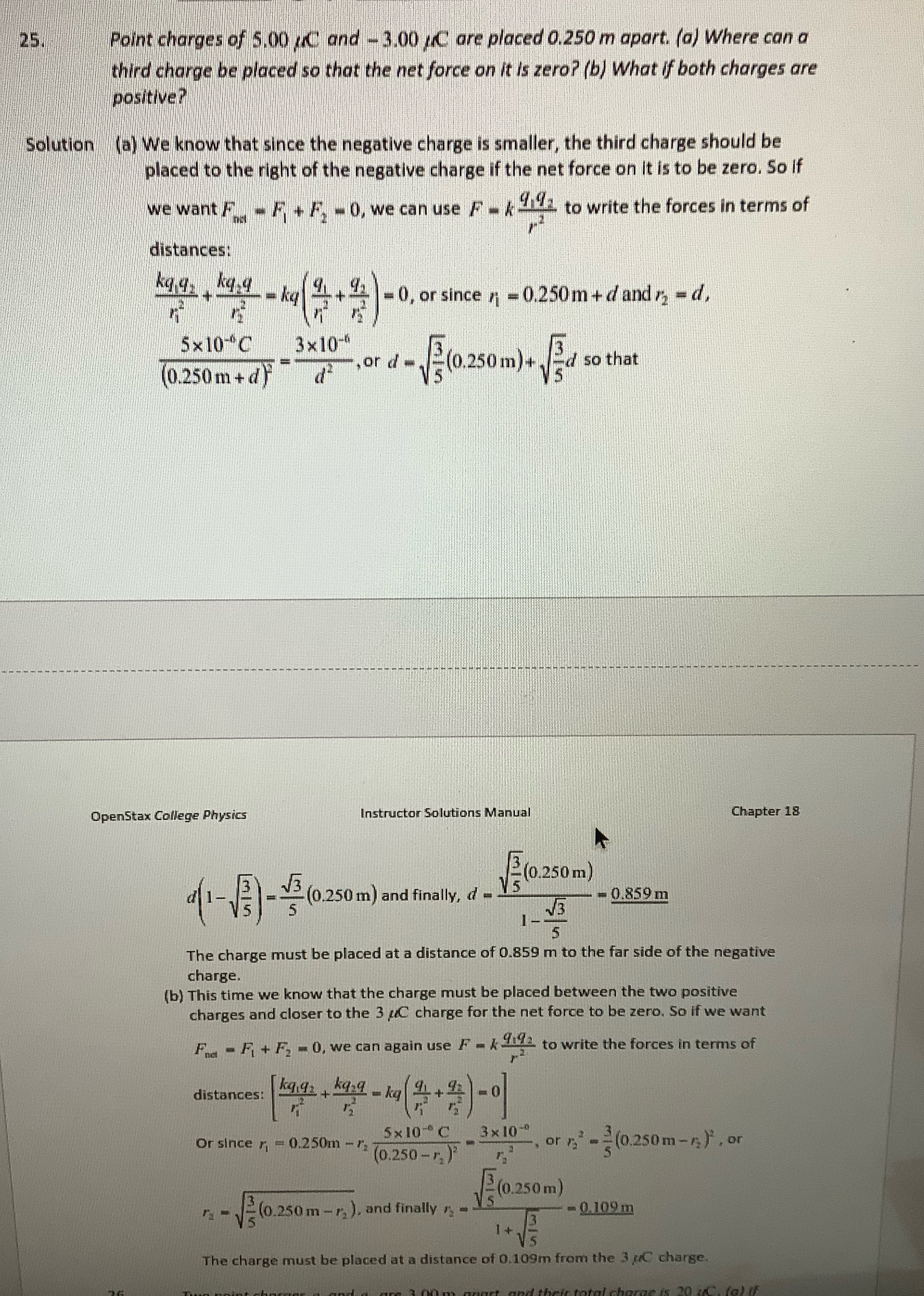
25 Point charges of 5.00 /C and - 3.00 JIC are placed 0.250 m apart. (a) Where can a third charge be placed so that the net force on it is zero? (b) What If both charges are positive? Solution (a) We know that since the negative charge is smaller, the third charge should be placed to the right of the negative charge if the net force on it is to be zero. So If we want F. - F + F - 0, we can use F - # 412 to write the forces in terms of distances: kage , ke:4 _ kq 41+ 94 - 0, or since n - 0.250m + d and /2 -d, 5x10 C 3x10- (0.250 medFavor d - (0.250m)+ 3d so that OpenStax College Physics Instructor Solutions Manual Chapter 18 a(1-V3)-45 (0250 m) and finaly, d = $ (0. 250 m) - 0.859 m 1- 13 5 The charge must be placed at a distance of 0.859 m to the far side of the negative charge. (b) This time we know that the charge must be placed between the two positive charges and closer to the 3 /C charge for the net force to be zero. So if we want Fod - Fi + F2 - 0, we can again use F - & 1042 to write the forces in terms of distances: 19192 + 4929 - kq ( 91 +94-0 5x 10- C 3x 10- Or since r, = 0.250m - 7; 7 (0.250 -r) -, or 12 - (0.250m -m)' . or (0.250m) ra - (0.250m -ra), and finally n =- - 0.109 m 1+ 13 The charge must be placed at a distance of 0.109m from the 3 /C charge
Step by Step Solution
There are 3 Steps involved in it

Get step-by-step solutions from verified subject matter experts
 Study Help