Question: how is my response to the question for this assignment Topic: The Gambler's Fallacy: U X Chat Thread X y! In their study, Tversky and
how is my response to the question for this assignment
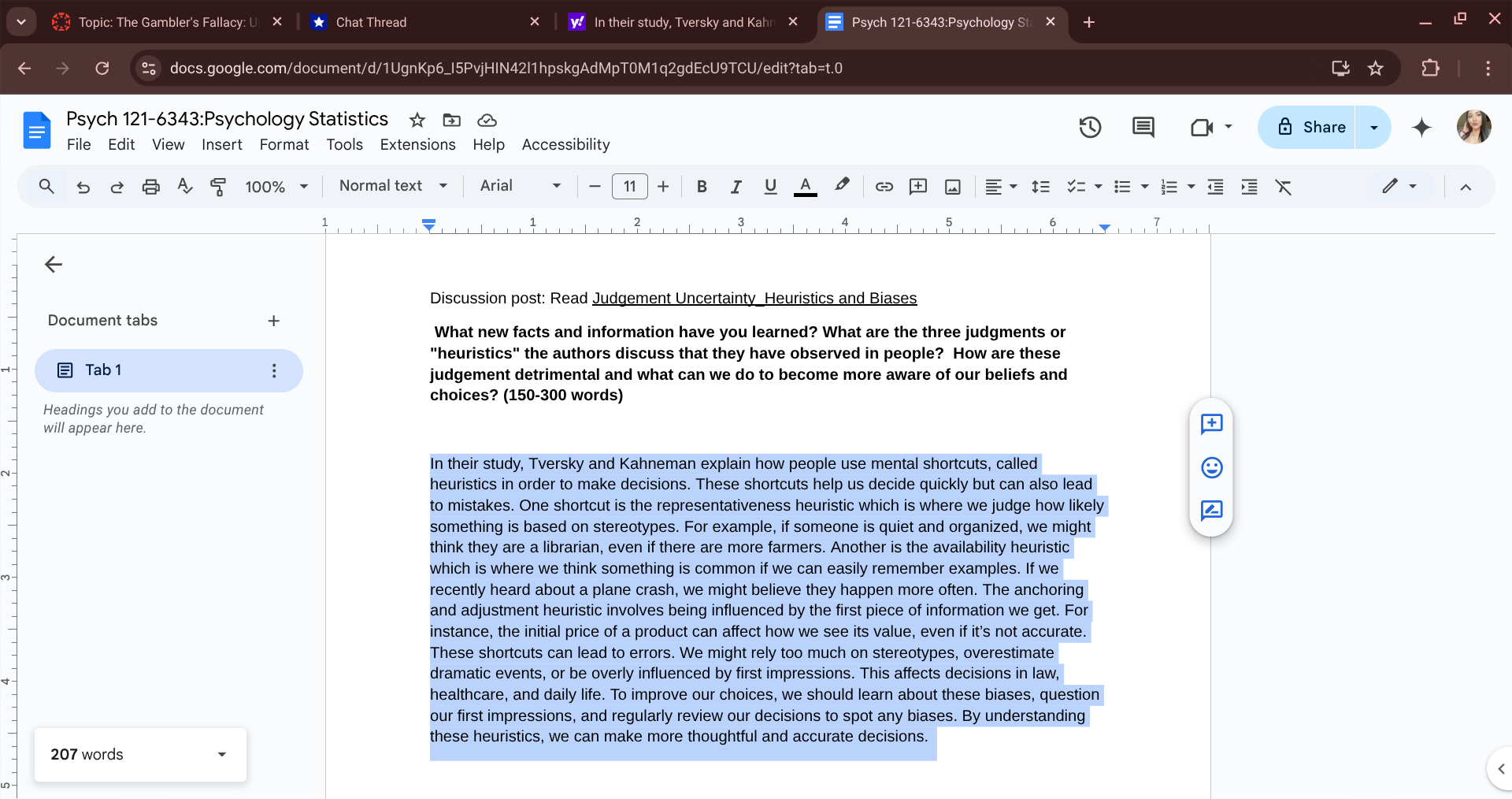
Topic: The Gambler's Fallacy: U X Chat Thread X y! In their study, Tversky and Kahn Psych 121-6343:Psychology Sto + X C 2% docs.google.com/document/d/1UgnKp6_15PvjHIN4211hpskgAdMpTOM1q2gdEcU9TCU/edit?tab=t.0 Psych 121-6343:Psychology Statistics * & Share File Edit View Insert Format Tools Extensions Help Accessibility Q 5 2 5 4 5 100% Normal text Arial 11 + B 5 Discussion post: Read Judgement Uncertainty_Heuristics and Biases Document tabs + What new facts and information have you learned? What are the three judgments or "heuristics" the authors discuss that they have observed in people? How are these Tab 1 . .. judgement detrimental and what can we do to become more aware of our beliefs and choices? (150-300 words) Headings you add to the document will appear here. + In their study, Tversky and Kahneman explain how people use mental shortcuts, called heuristics in order to make decisions. These shortcuts help us decide quickly but can also lead to mistakes. One shortcut is the representativeness heuristic which is where we judge how likely something is based on stereotypes. For example, if someone is quiet and organized, we might think they are a librarian, even if there are more farmers. Another is the availability heuristic which is where we think something is common if we can easily remember examples. If we recently heard about a plane crash, we might believe they happen more often. The anchoring and adjustment heuristic involves being influenced by the first piece of information we get. For instance, the initial price of a product can affect how we see its value, even if it's not accurate. These shortcuts can lead to errors. We might rely too much on stereotypes, overestimate dramatic events, or be overly influenced by first impressions. This affects decisions in law, healthcare, and daily life. To improve our choices, we should learn about these biases, question our first impressions, and regularly review our decisions to spot any biases. By understanding these heuristics, we can make more thoughtful and accurate decisions. 207 words









 Study Help