







Question: How often do you go out dancing? This question was asked by a professional survey group on behalf of the National Arts Survey. A random
How often do you go out dancing? This question was asked by a professional survey group on behalf of the National Arts Survey. A random sample ofn1=97
single men showed thatr1=24
went out dancing occasionally. Another random sample ofn2=93
single women showed thatr2=18
went out dancing occasionally.Note: For degrees of freedom d.f. not in the Student'sttable,use the closest d.f. that is smaller. In some situations, this choice of d.f. may increase theP-valuea small amount and thereby produce a slightly more "conservative" answer.
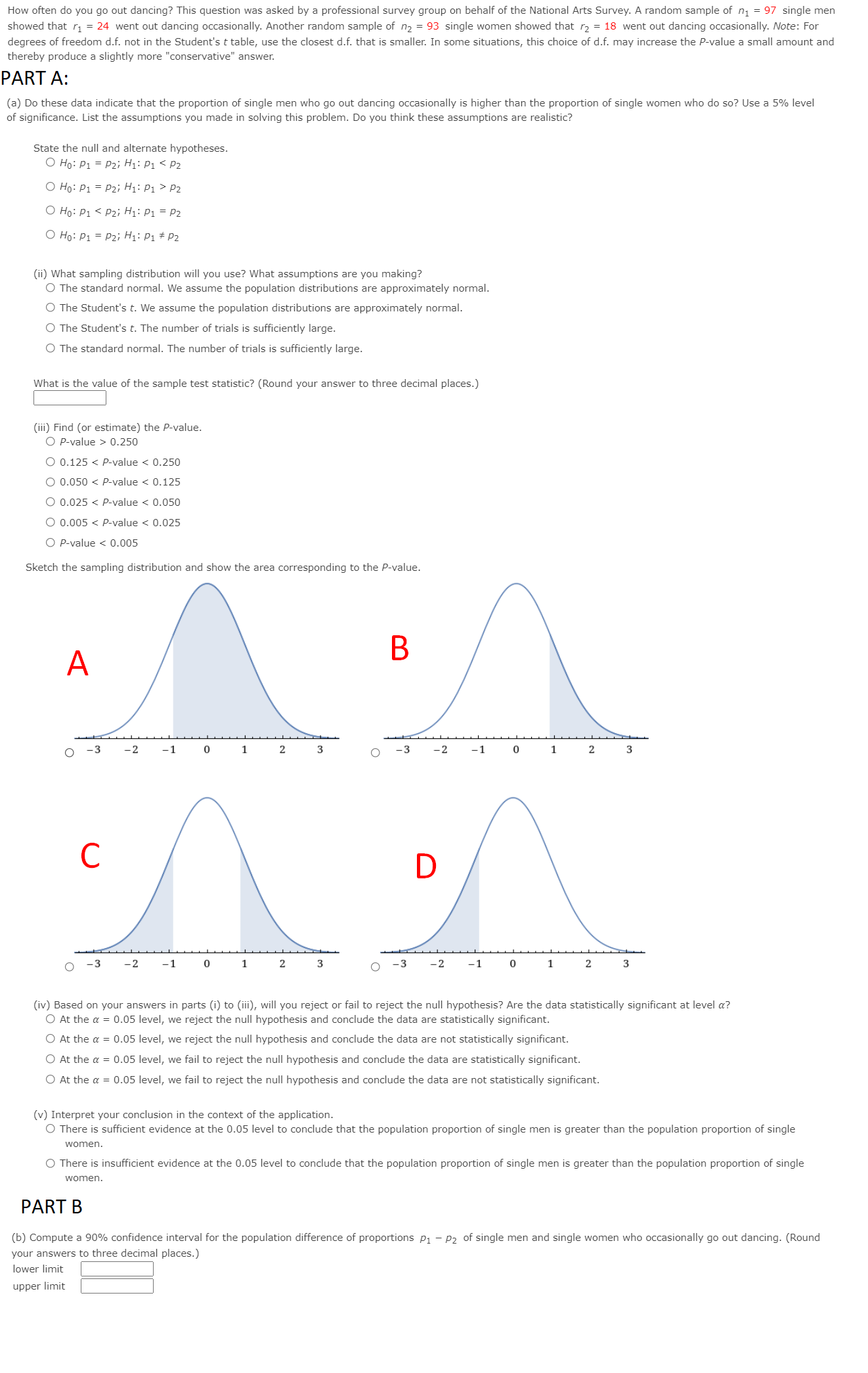
How often do you go out dancing? This question was asked by a professional survey group on behalf of the National Arts Survey. A random sample of n1 = 97 single men showed that 1 = 24 went out dancing occasionally. Another random sample of n2 = 93 single women showed that 2 = 18 went out dancing occasionally. Note: For degrees of freedom d.f. not in the Student's t table, use the closest d.f. that is smaller. In some situations, this choice of d.f. may increase the P-value a small amount and thereby produce a slightly more "conservative" answer. PART A: (a) Do these data indicate that the proportion of single men who go out dancing occasionally is higher than the proportion of single women who do so? Use a 5% level of significance. List the assumptions you made in solving this problem. Do you think these assumptions are realistic? State the null and alternate hypotheses. O Ho: P1 = P2; H1: P1
Step by Step Solution
There are 3 Steps involved in it

Get step-by-step solutions from verified subject matter experts
 Study Help