







Question: how to code these in jupyter notebook? Using a Monte Carlo simulation approach, we will model variability in an industrial system filling containers with a
how to code these in jupyter notebook?
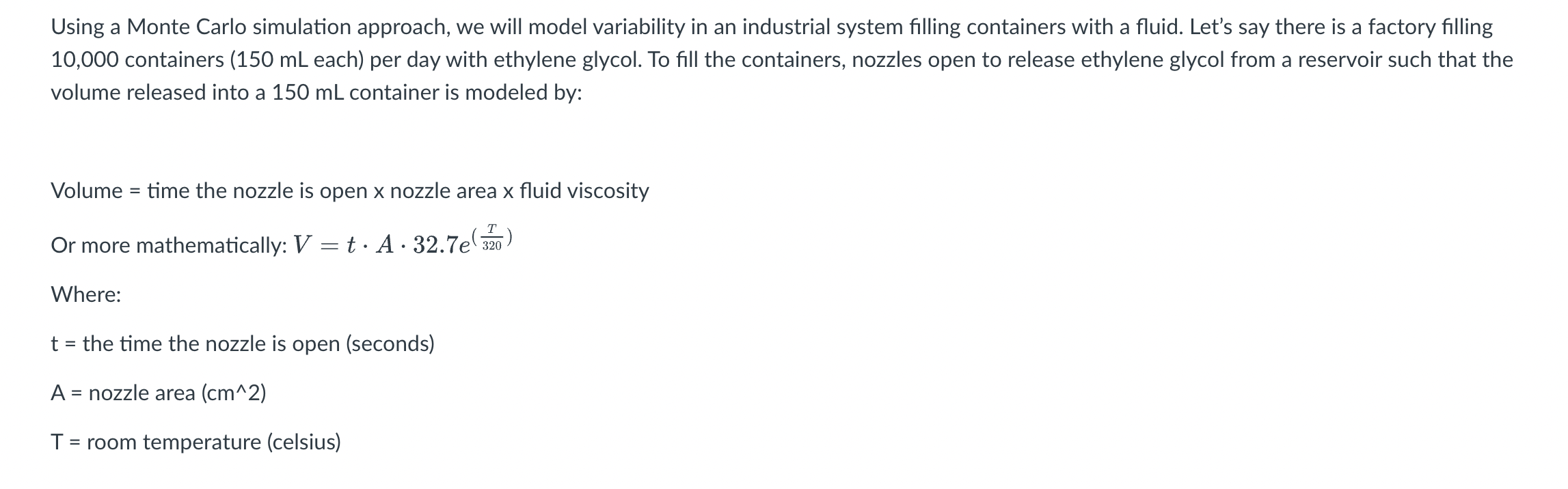
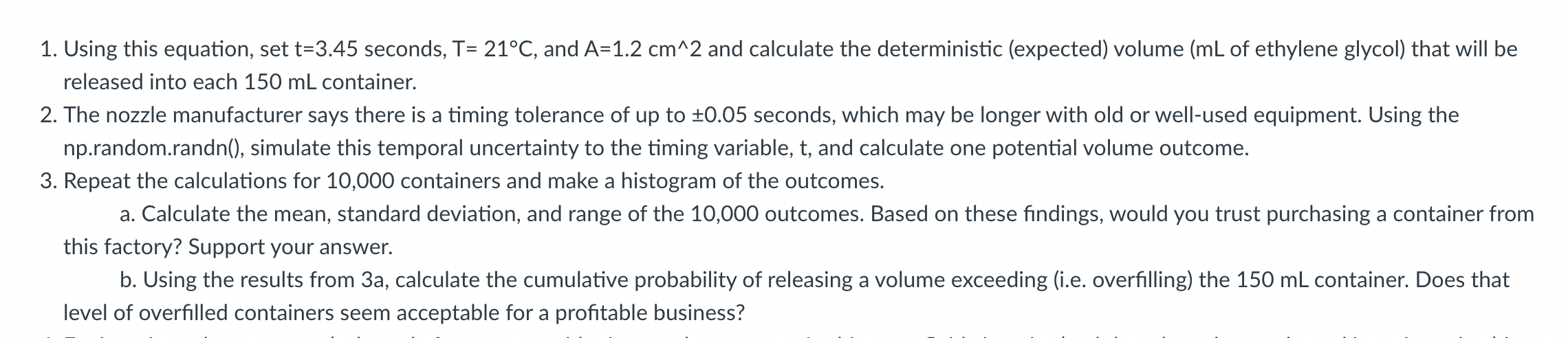
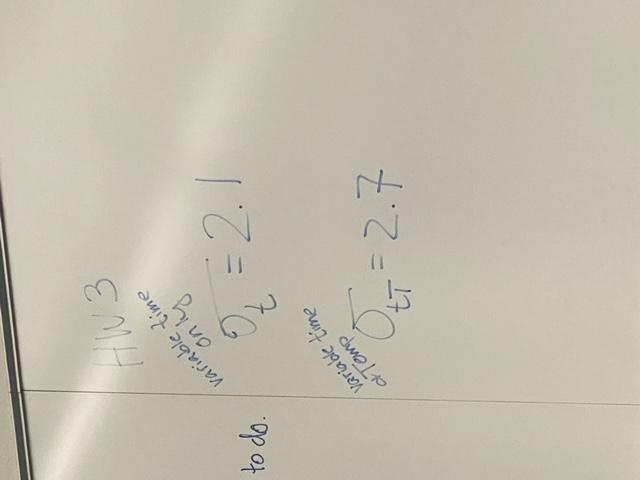
Using a Monte Carlo simulation approach, we will model variability in an industrial system filling containers with a fluid. Let's say there is a factory filling 10,000 containers (150 mL each) per day with ethylene glycol. To fill the containers, nozzles open to release ethylene glycol from a reservoir such that the volume released into a 150 mL container is modeled by: a Volume = time the nozzle is open x nozzle area x fluid viscosity T Or more mathematically: V = t A 32.7e(370) Where: t = the time the nozzle is open (seconds) A = nozzle area (cm^2) = T = room temperature (celsius) = 1. Using this equation, set t=3.45 seconds, T= 21C, and A=1.2 cm^2 and calculate the deterministic (expected) volume (mL of ethylene glycol) that will be released into each 150 mL container. 2. The nozzle manufacturer says there is a timing tolerance of up to 0.05 seconds, which may be longer with old or well-used equipment. Using the np.random.randn(), simulate this temporal uncertainty to the timing variable, t, and calculate one potential volume outcome. 3. Repeat the calculations for 10,000 containers and make a histogram of the outcomes. a. Calculate the mean, standard deviation, and range of the 10,000 outcomes. Based on these findings, would you trust purchasing a container from this factory? Support your answer. b. Using the results from 3a, calculate the cumulative probability of releasing a volume exceeding (i.e. overfilling) the 150 mL container. Does that level of overfilled containers seem acceptable for a profitable business? 3 variable time only 0 = 2.1 to do. 76 variable time duelo O = 2.7 Using a Monte Carlo simulation approach, we will model variability in an industrial system filling containers with a fluid. Let's say there is a factory filling 10,000 containers (150 mL each) per day with ethylene glycol. To fill the containers, nozzles open to release ethylene glycol from a reservoir such that the volume released into a 150 mL container is modeled by: a Volume = time the nozzle is open x nozzle area x fluid viscosity T Or more mathematically: V = t A 32.7e(370) Where: t = the time the nozzle is open (seconds) A = nozzle area (cm^2) = T = room temperature (celsius) = 1. Using this equation, set t=3.45 seconds, T= 21C, and A=1.2 cm^2 and calculate the deterministic (expected) volume (mL of ethylene glycol) that will be released into each 150 mL container. 2. The nozzle manufacturer says there is a timing tolerance of up to 0.05 seconds, which may be longer with old or well-used equipment. Using the np.random.randn(), simulate this temporal uncertainty to the timing variable, t, and calculate one potential volume outcome. 3. Repeat the calculations for 10,000 containers and make a histogram of the outcomes. a. Calculate the mean, standard deviation, and range of the 10,000 outcomes. Based on these findings, would you trust purchasing a container from this factory? Support your answer. b. Using the results from 3a, calculate the cumulative probability of releasing a volume exceeding (i.e. overfilling) the 150 mL container. Does that level of overfilled containers seem acceptable for a profitable business? 3 variable time only 0 = 2.1 to do. 76 variable time duelo O = 2.7
Step by Step Solution
There are 3 Steps involved in it

Get step-by-step solutions from verified subject matter experts
 Study Help