







Question: how to code this in jupyter notebook? Using a Monte Carlo simulation approach, we will model variability in an industrial system filling containers with a
how to code this in jupyter notebook?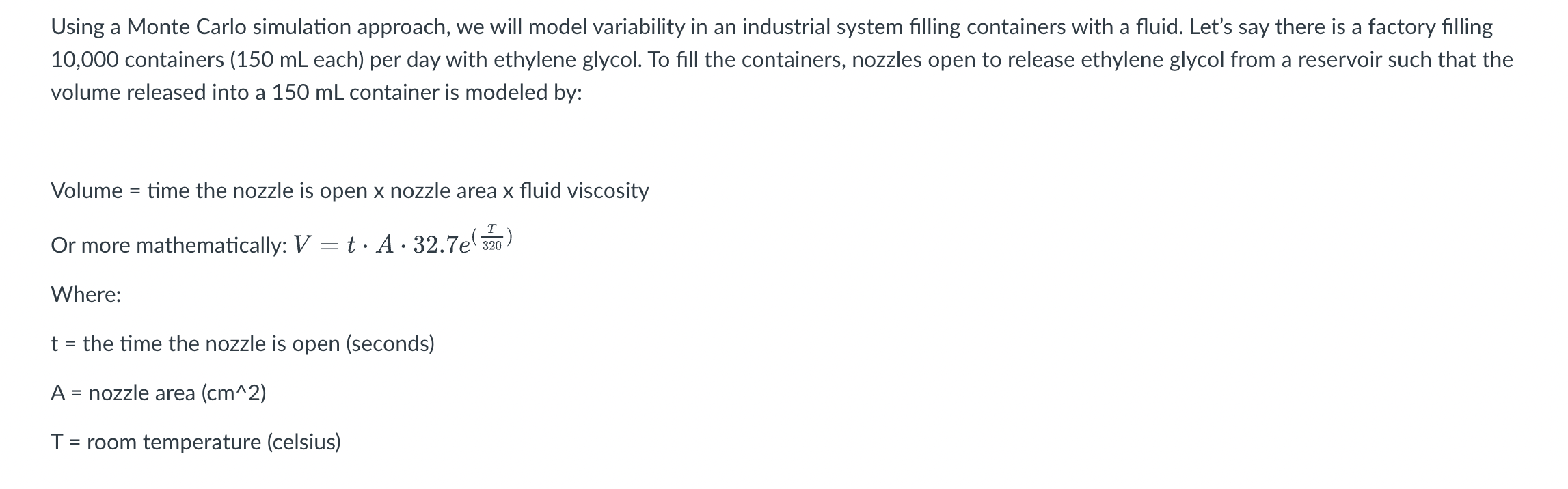
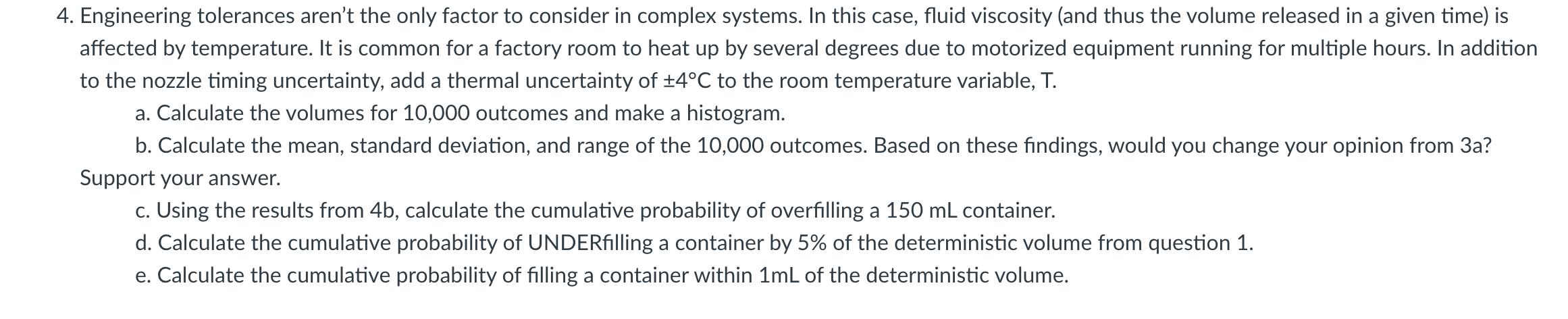
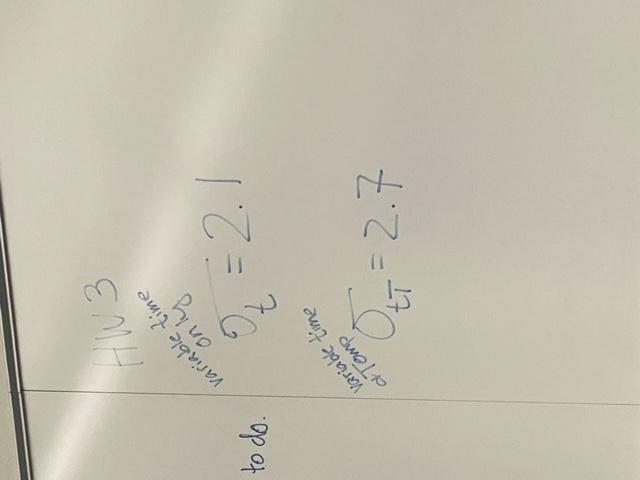
Using a Monte Carlo simulation approach, we will model variability in an industrial system filling containers with a fluid. Let's say there is a factory filling 10,000 containers (150 mL each) per day with ethylene glycol. To fill the containers, nozzles open to release ethylene glycol from a reservoir such that the volume released into a 150 mL container is modeled by: a Volume = time the nozzle is open x nozzle area x fluid viscosity T Or more mathematically: V = t A 32.7e(370) Where: t = the time the nozzle is open (seconds) A = nozzle area (cm^2) = T = room temperature (celsius) = a 4. Engineering tolerances aren't the only factor to consider in complex systems. In this case, fluid viscosity (and thus the volume released in a given time) is affected by temperature. It is common for a factory room to heat up by several degrees due to motorized equipment running for multiple hours. In addition to the nozzle timing uncertainty, add a thermal uncertainty of +4C to the room temperature variable, T. a. Calculate the volumes for 10,000 outcomes and make a histogram. b. Calculate the mean, standard deviation, and range of the 10,000 outcomes. Based on these findings, would you change your opinion from 3a? Support your answer. c. Using the results from 4b, calculate the cumulative probability of overfilling a 150 mL container. d. Calculate the cumulative probability of UNDERfilling a container by 5% of the deterministic volume from question 1. e. Calculate the cumulative probability of filling a container within 1mL of the deterministic volume. 3 variable time only 0 = 2.1 to do. 76 variable time duelo O = 2.7 Using a Monte Carlo simulation approach, we will model variability in an industrial system filling containers with a fluid. Let's say there is a factory filling 10,000 containers (150 mL each) per day with ethylene glycol. To fill the containers, nozzles open to release ethylene glycol from a reservoir such that the volume released into a 150 mL container is modeled by: a Volume = time the nozzle is open x nozzle area x fluid viscosity T Or more mathematically: V = t A 32.7e(370) Where: t = the time the nozzle is open (seconds) A = nozzle area (cm^2) = T = room temperature (celsius) = a 4. Engineering tolerances aren't the only factor to consider in complex systems. In this case, fluid viscosity (and thus the volume released in a given time) is affected by temperature. It is common for a factory room to heat up by several degrees due to motorized equipment running for multiple hours. In addition to the nozzle timing uncertainty, add a thermal uncertainty of +4C to the room temperature variable, T. a. Calculate the volumes for 10,000 outcomes and make a histogram. b. Calculate the mean, standard deviation, and range of the 10,000 outcomes. Based on these findings, would you change your opinion from 3a? Support your answer. c. Using the results from 4b, calculate the cumulative probability of overfilling a 150 mL container. d. Calculate the cumulative probability of UNDERfilling a container by 5% of the deterministic volume from question 1. e. Calculate the cumulative probability of filling a container within 1mL of the deterministic volume. 3 variable time only 0 = 2.1 to do. 76 variable time duelo O = 2.7
Step by Step Solution
There are 3 Steps involved in it

Get step-by-step solutions from verified subject matter experts
 Study Help