







Question: How to code this unit conversion in Visual Basic .Net (Framework) Problem Statement: Mr. Giant pushes a 1000-lbm stationary box with a constant linear acceleration
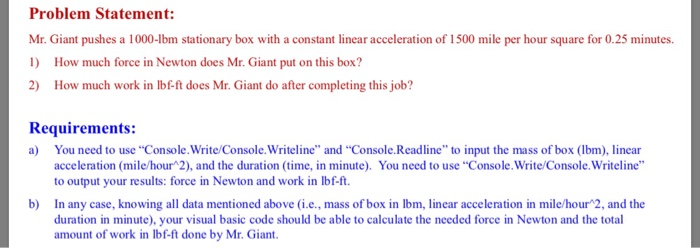
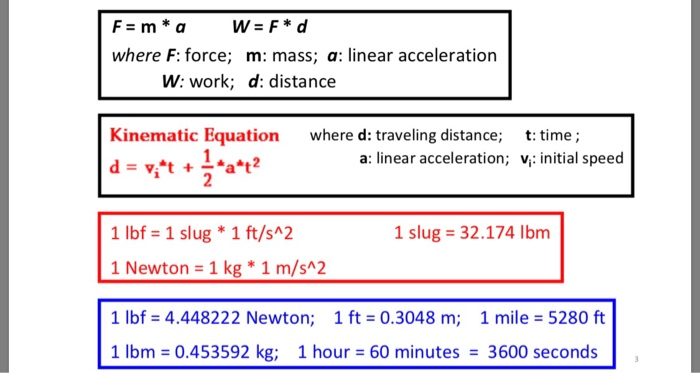
Problem Statement: Mr. Giant pushes a 1000-lbm stationary box with a constant linear acceleration of 1500 mile per hour square for 0.25 minutes 1) How much force in Newton does Mr. Giant put on this box? 2) How much work in lbf-ft does Mr. Giant do after completing this job? Requirements: a) You need to use "Console.Write/Console.Writeline" and "Console.Readline" to input the mass of box (lbm), inear acceleration (mile/hour 2), and the duration (time, in minute) You need to use "Console. Write/Console. Writeline to output your results: force in Newton and work in Ibfft. In any case, knowing all data mentioned above (i.e., mass of box in Ibm, linear acceleration in mile hour 2, and the duration in minute), your visual basic code should be able to calculate the needed force in Newton and the total amount of work in lbf-ft done by Mr. Giant b) F-m* a where F: force; m: mass; a: linear acceleration W: work; d: distance Kinematic Equation where d: traveling distance; t: time; a: linear acceleration; v; initial speed 1 lbf 1 slug 1 ft/s 2 1 Newton-1 kg * 1 m/sA2 1 lbf 4.448222 Newton; 1 ft 0.3048 m; 1 mile 5280 ft 1 lbm 0.453592 kg; 1 hour -60 minutes 3600 seconds 1 slug 32.174 lbm
Step by Step Solution
There are 3 Steps involved in it

Get step-by-step solutions from verified subject matter experts
 Study Help