



Question: How to do parts a b c and d 1. Suppose Laura allocates her income between two goods, chocolate and ice'cream, to maximize her utility.
How to do parts a b c and d
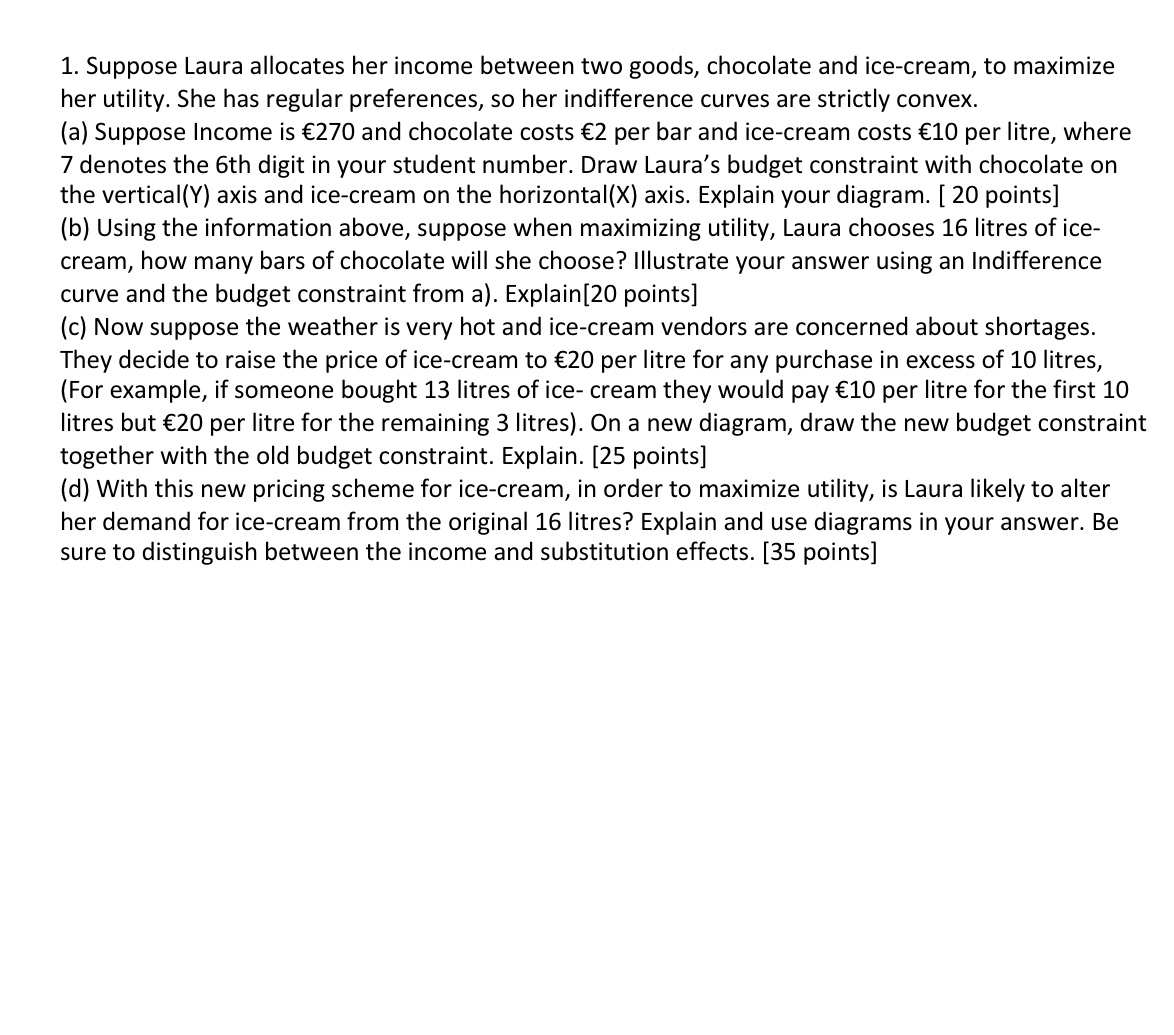
1. Suppose Laura allocates her income between two goods, chocolate and ice'cream, to maximize her utility. She has regular preferences, so her indifference curves are strictly convex. (a) Suppose Income is 270 and chocolate costs 2 per bar and ice-cream costs 10 per litre, where 7 denotes the 6th digit in your student number. Draw Laura's budget constraint with chocolate on the vertical(Y) axis and ice~cream on the horizontal(X) axis. Explain your diagram. [ 20 points] (b) Using the information above, suppose when maximizing utility, Laura chooses 16 litres of ice- cream, how many bars of chocolate will she choose? Illustrate your answer using an Indifference curve and the budget constraint from a). Explain[20 points] (c) Now suppose the weather is very hot and ice-cream vendors are concerned about shortages. They decide to raise the price of ice-cream to 20 per litre for any purchase in excess of 10 litres, (For example, if someone bought 13 litres of ice- cream they would pay 10 per litre for the first 10 litres but 20 per litre for the remaining 3 litres). On a new diagram, draw the new budget constraint together with the old budget constraint. Explain. [25 points] (d) With this new pricing scheme for ice-cream, in order to maximize utility, is Laura likely to alter her demand for ice-cream from the original 16 litres? Explain and use diagrams in your answer. Be sure to distinguish between the income and substitution effects. [35 points]
Step by Step Solution
There are 3 Steps involved in it

Get step-by-step solutions from verified subject matter experts