







Question: How to get the answer from those data?? Q4 Fewer young people are driving. In 1983, 37% of 19yearolds had a driver's license. Twentyve years
How to get the answer from those data??
Q4
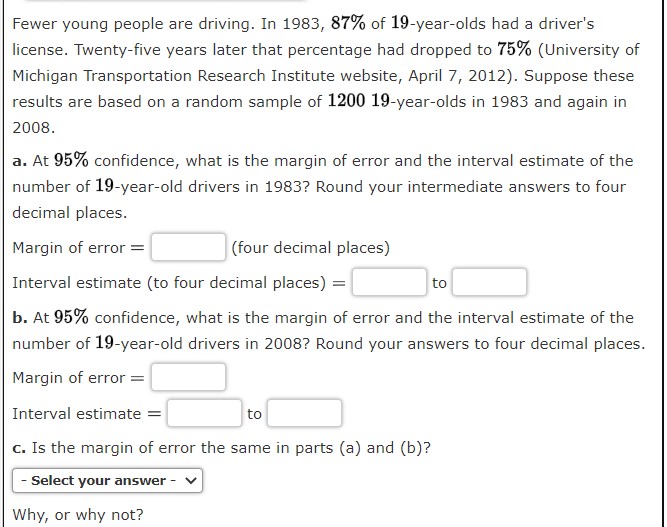
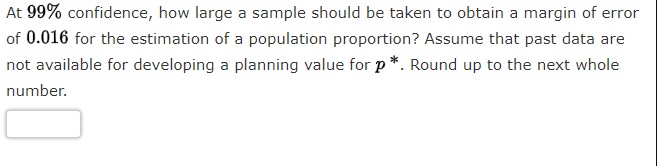
Fewer young people are driving. In 1983, 37% of 19yearolds had a driver's license. Twentyve years later that percentage had dropped to 75% (University of Michigan Transportation Research Institute website, April 7, 2012). Suppose these results are based on a random sample of 1200 19yearolds in 1983 and again in 2(108. a. At 95% confidence, what is the margin of error and the interval estimate of the number of 19year-old drivers in 1933? Round your intermediate answers to four decimal places. Margin of error = _(four decimal places) Interval estimate [to four decimal places] = _ Ito. b. At 95% confidence, what is the margin of error and the interval estimate of the number of 19yearold drivers in 2008? Round your answers to four decimal places. Margin of error = Interval estimate =' to: c. Is the margin of error the same in parts (a) and (b)? Select your answer v Why, or why not? At 99% condence, how large a sample should be taken to obtain a margin of error of 0.016 for the estimation of a population proportion? Assume that past data are not available for developing a planning value for]? *. Round up to the next whole number
Step by Step Solution
There are 3 Steps involved in it

Get step-by-step solutions from verified subject matter experts
 Study Help