







Question: How to implement this equation in matlab? what is xo exactly? explain me the equation. I want an explanation how to do it (how to
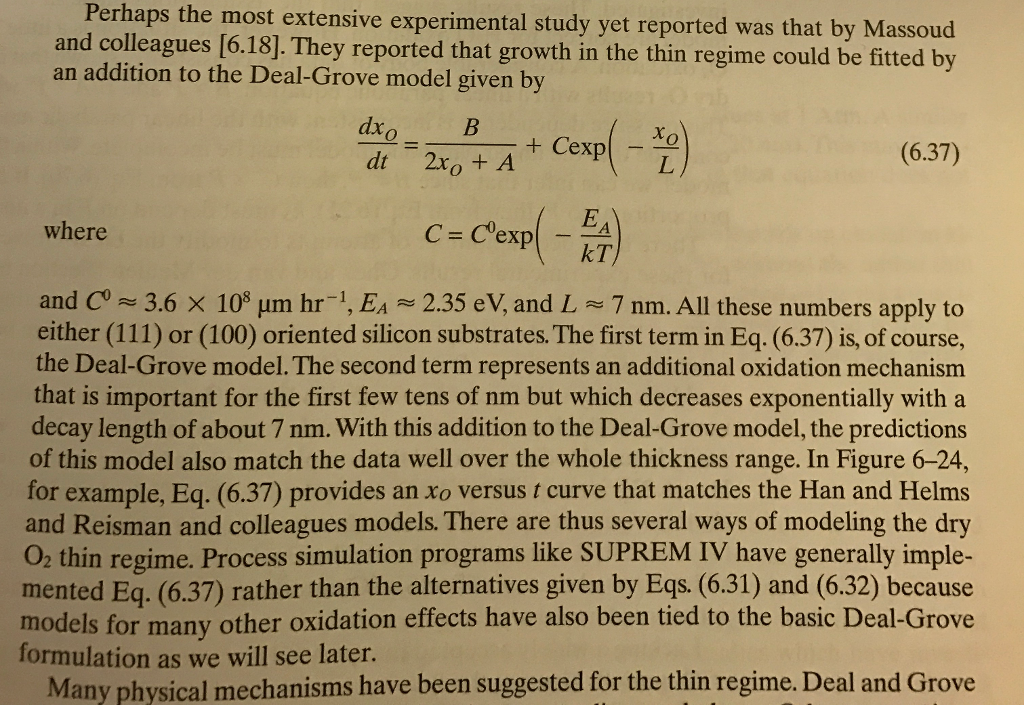
How to implement this equation in matlab? what is "xo" exactly? explain me the equation.
I want an explanation how to do it (how to implement it)?
Perhaps the most extensive experimental study yet reported was that by Massoud and colleagues [6.18]. They reported that growth in the thin regime could be fitted by an addition to the Deal-Grove model given by dx_0/dt = B/2x_0 + A + C exp (-x_0/L) where C = C^0 exp (-E_A/kT) and C^0 = 3.6 times 10^8 mu m hr^-1m, E_A = 2.35 eV, and L = 7nm. All these numbers apply to either (111) or (100) oriented silicon substrates. The first term in Eq. (6.37) is, of course, the Deal-Grove model. The second term represents an additional oxidation mechanism that is important for the first few tens of nm but which decreases exponentially with a decay length of about 7 nm. With this addition to the Deal-Grove model, the predictions of this model also match the data well over the whole thickness range. In Figure 6-24, for example, Eq. (6.37) provides an x_o versus t curve that matches the Han and Helms and Reisman and colleagues models. There are thus several ways of modeling the dry O_2 thin regime. Process simulation programs like SUPREM IV have generally implemented Eq. (6.37) rather than the alternatives given by Eqs. (6.31) and (6.32) because models for many other oxidation effects have also been tied to the basic Deal-Grove formulation as we will see later. Many physical mechanisms have been suggested for the thin regime. Deal and Grove
Step by Step Solution
There are 3 Steps involved in it

Get step-by-step solutions from verified subject matter experts
 Study Help