







Question: how to solve these 3 questions from the article. 2 articles are attached. typing please. really appreciate it. 1. Name 5 of his corollaries to
how to solve these 3 questions from the article. 2 articles are attached. typing please. really appreciate it.
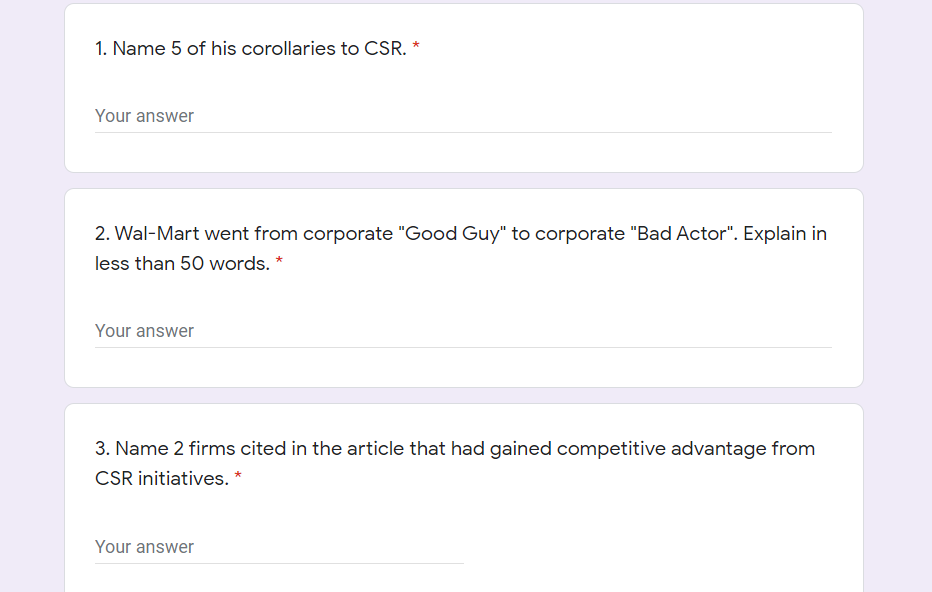
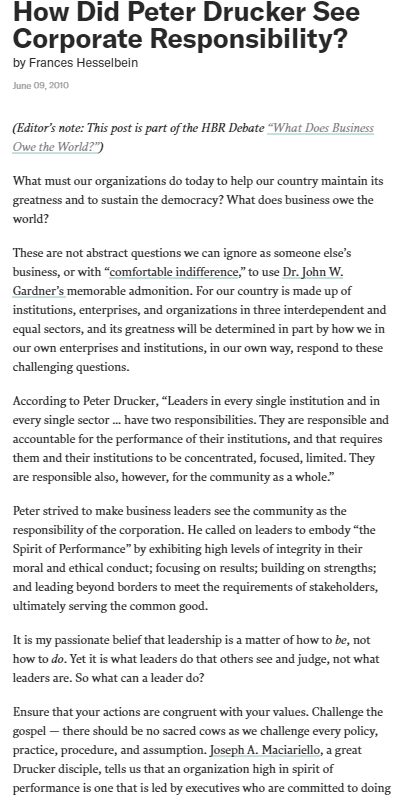
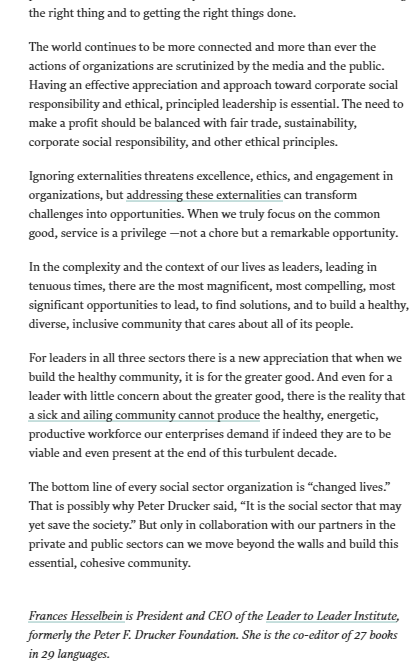
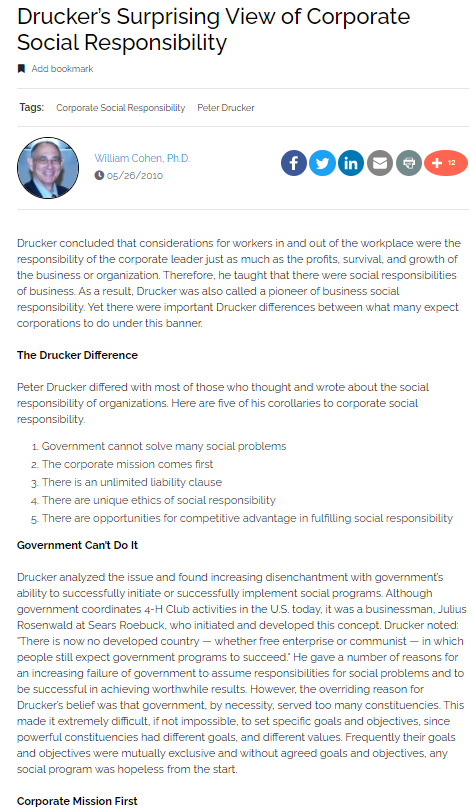
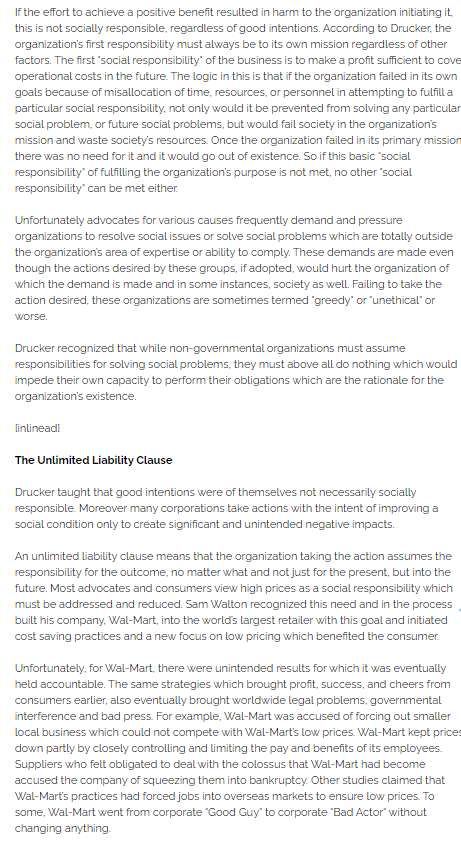
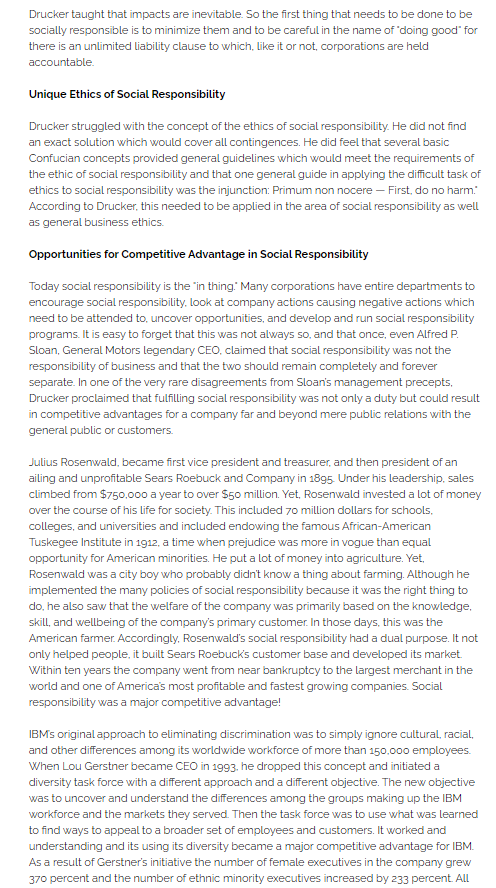
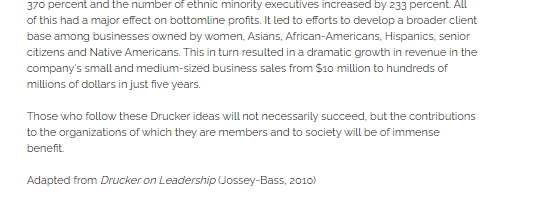
1. Name 5 of his corollaries to CSR. * Your answer 2. Wal-Mart went from corporate "Good Guy" to corporate "Bad Actor". Explain in less than 50 words. * Your answer 3. Name 2 firms cited in the article that had gained competitive advantage from CSR initiatives. * Your answer How Did Peter Drucker See Corporate Responsibility? by Frances Hesselbein June 09.2010 (Editor's note: This post is part of the HBR Debate "What Does Business Owe the World?") What must our organizations do today to help our country maintain its greatness and to sustain the democracy? What does business owe the world? These are not abstract questions we can ignore as someone else's business, or with comfortable indifference," to use Dr. John W. Gardner's memorable admonition. For our country is made up of institutions, enterprises, and organizations in three interdependent and equal sectors, and its greatness will be determined in part by how we in our own enterprises and institutions, in our own way, respond to these challenging questions. According to Peter Drucker, Leaders in every single institution and in every single sector ... have two responsibilities. They are responsible and accountable for the performance of their institutions, and that requires them and their institutions to be concentrated, focused, limited. They are responsible also, however, for the community as a whole." Peter strived to make business leaders see the community as the responsibility of the corporation. He called on leaders to embody "the Spirit of Performance by exhibiting high levels of integrity in their moral and ethical conduct; focusing on results; building on strengths; and leading beyond borders to meet the requirements of stakeholders, ultimately serving the common good. It is my passionate belief that leadership is a matter of how to be, not how to do. Yet it is what leaders do that others see and judge, not what leaders are. So what can a leader do? Ensure that your actions are congruent with your values. Challenge the gospel there should be no sacred cows as we challenge every policy, practice, procedure, and assumption. Joseph A. Maciariello, a great Drucker disciple, tells us that an organization high in spirit of performance is one that is led by executives who are committed to doing the right thing and to getting the right things done. The world continues to be more connected and more than ever the actions of organizations are scrutinized by the media and the public. Having an effective appreciation and approach toward corporate social responsibility and ethical, principled leadership is essential. The need to make a profit should be balanced with fair trade, sustainability, corporate social responsibility, and other ethical principles. Ignoring externalities threatens excellence, ethics, and engagement in organizations, but addressing these externalities can transform challenges into opportunities. When we truly focus on the common good, service is a privilege -not a chore but a remarkable opportunity. In the complexity and the context of our lives as leaders, leading in tenuous times, there are the most magnificent, most compelling, most significant opportunities to lead to find solutions, and to build a healthy, diverse, inclusive community that cares about all of its people. For leaders in all three sectors there is a new appreciation that when we build the healthy community, it is for the greater good. And even for a leader with little concern about the greater good, there is the reality that a sick and ailing community cannot produce the healthy, energetic, productive workforce our enterprises demand if indeed they are to be viable and even present at the end of this turbulent decade. The bottom line of every social sector organization is "changed lives." That is possibly why Peter Drucker said, It is the social sector that may yet save the society. But only in collaboration with our partners in the private and public sectors can we move beyond the walls and build this essential, cohesive community. Frances Hesselbein is President and CEO of the Leader to Leader Institute, formerly the Peter F. Drucker Foundation. She is the co-editor of 27 books in 29 languages. Drucker's Surprising View of Corporate Social Responsibility Add bookmark Tags: Corporate Social Responsibility Peter Drucker William Cohen, Ph.D. 05/26/2010 fin @ + 12 Drucker concluded that considerations for workers in and out of the workplace were the responsibility of the corporate leader just as much as the profits, survival, and growth of the business or organization. Therefore, he taught that there were social responsibilities of business. As a result, Drucker was also called a pioneer of business social responsibility. Yet there were important Drucker differences between what many expect corporations to do under this banner. The Drucker Difference Peter Drucker differed with most of those who thought and wrote about the social responsibility of organizations. Here are five of his corollaries to corporate social responsibility 1. Government cannot solve many social problems 2. The corporate mission comes first 3. There is an unlimited liability clause 4. There are unique ethics of social responsibility 5. There are opportunities for competitive advantage in fulfilling social responsibility Government Can't Do It Drucker analyzed the issue and found increasing disenchantment with government's ability to successfully initiate or successfully implement social programs. Although government coordinates 4-H Club activities in the U.S. today, it was a businessman Julius Rosenwald at Sears Roebuck, who initiated and developed this concept. Drucker noted: There is now no developed country - whether free enterprise or communist - in which people still expect government programs to succeed." He gave a number of reasons for an increasing failure of government to assume responsibilities for social problems and to be successful in achieving worthwhile results. However, the overriding reason for Drucker's belief was that government, by necessity, served too many constituencies. This made it extremely difficult, if not impossible, to set specific goals and objectives, since powerful constituencies had different goals, and different values. Frequently their goals and objectives were mutually exclusive and without agreed goals and objectives, any social program was hopeless from the start. Corporate Mission First If the effort to achieve a positive benet resulted in harm to the organization initiating it. this is not socially responsible, regardless of good intentions. According to Drucker, the organization's first responsibility must always be to its own mission regardless of other factors. The first 'social responsibility of the business is to make a profit sufficient to cove operational costs in the future. The logic in this is that if the organization failed in its own goals because of misallocation of time, resources, or personnel in attempting to fulfill a particular social responsibility, not only would it be prevented from solving any particular social problem, or future social problems, but would fail society in the organization's mission and waste society's resources. Once the organization failed in its primary mission there was no need for it and it would go out of existence. So if this basic social responsibility of fulfilling the organization's purpose is not met, no other social responsibility can be met either. Unfortunately advocates for various causes frequently demand and pressure organizations to resolve social issues or solve social problems which are totally outside the organization's area of expertise or ability to comply. These demands are made even though the actions desired by these groups, if adopted, would hurt the organization of which the demand is made and in some instances, society as well. Failing to take the action desired, these organizations are sometimes termed greedy' or 'unethical' or worse. Drucker recognized that while non-governmental organizations must assume responsibilities for solving social problems, they must above all do nothing which would impede their own capacity to perform their obligations which are the rationale for the organization's existence. linlineadl The Unlimited Liability Clause Drucker taught that good intentions were of themselves not necessarily socially responsible. Moreover many corporations take actions with the intent of improving a social condition only to create significant and unintended negative impacts. An unlimited liability clause means that the organization taking the action assumes the responsibility for the outcome, no matter what and not just for the present, but into the future. Most advocates and consumers view high prices as a social responsibility which must be addressed and reduced. Sam Walton recognized this need and in the process built his company. Wal-Mart, into the world's largest retailer with this goal and initiated cost saving practices and a new focus on low pricing which beneted the consumer. Unfortunately, for Wal- Mart, there were unintended results for which it was eventually held accountable. The same strategies which brought profit, success, and cheers from consumers earlier, also eventually brought worldwide legal problems, governmental interference and bad press. For example, Wal-Mart was accused of forcing out smaller local business which could not compete with Wal-Mart's low prices. Wal-Mart kept prices down partly by closely controlling and limiting the pay and benefits of its employees. Suppliers who felt obligated to deal with the colossus that Wal-Mart had become accused the company of squeezing them into bankruptcy. Other studies claimed that Wal-Mart's practices had forced jobs into overseas markets to ensure low prices. To some, Wal-Mart went from corporate Good Guy" to corporate "Bad Actor without changing anything Drucker taught that impacts are inevitable. So the first thing that needs to be done to be socially responsible is to minimize them and to be careful in the name of doing good" for there is an unlimited liability clause to which, like it or not, corporations are held accountable. Unique Ethics of Social Responsibility Drucker struggled with the concept of the ethics of social responsibility. He did not find an exact solution which would cover all contingences. He did feel that several basic Confucian concepts provided general guidelines which would meet the requirements of the ethic of social responsibility and that one general guide in applying the difficult task of ethics to social responsibility was the injunction: Primum non nocere - First, do no harm: According to Drucker, this needed to be applied in the area of social responsibility as well as general business ethics. Opportunities for Competitive Advantage in Social Responsibility Today social responsibility is the "in thing. Many corporations have entire departments to encourage social responsibility, look at company actions causing negative actions which need to be attended to uncover opportunities, and develop and run social responsibility programs. It is easy to forget that this was not always so, and that once, even Alfred P. Sloan, General Motors legendary CEO. claimed that social responsibility was not the responsibility of business and that the two should remain completely and forever separate. In one of the very rare disagreements from Sloan's management precepts, Drucker proclaimed that fulfilling social responsibility was not only a duty but could result in competitive advantages for a company far and beyond mere public relations with the general public or customers. Julius Rosenwald, became first vice president and treasurer, and then president of an ailing and unprofitable Sears Roebuck and Company in 1895. Under his leadership. sales climbed from $750,000 a year to over $50 million. Yet, Rosenwald invested a lot of money over the course of his life for society. This included 70 million dollars for schools, colleges, and universities and included endowing the famous African-American Tuskegee Institute in 1922, a time when prejudice was more in vogue than equal opportunity for American minorities. He put a lot of money into agriculture. Yet, Rosenwald was a city boy who probably didn't know a thing about farming. Although he implemented the many policies of social responsibility because it was the right thing to do, he also saw that the welfare of the company was primarily based on the knowledge, skill, and wellbeing of the company's primary customer. In those days, this was the American farmer. Accordingly, Rosenwald's social responsibility had a dual purpose. It not only helped people, it built Sears Roebuck's customer base and developed its market. Within ten years the company went from near bankruptcy to the largest merchant in the world and one of America's most profitable and fastest growing companies Social responsibility was a major competitive advantage! IBM's original approach to eliminating discrimination was to simply ignore cultural, racial, and other differences among its worldwide workforce of more than 150.000 employees. When Lou Gerstner became CEO in 1993. he dropped this concept and initiated a diversity task force with a different approach and a different objective. The new objective was to uncover and understand the differences among the groups making up the IBM workforce and the markets they served. Then the task force was to use what was learned to find ways to appeal to a broader set of employees and customers. It worked and understanding and its using its diversity became a major competitive advantage for IBM. As a result of Gerstner's initiative the number of female executives in the company grew 370 percent and the number of ethnic minority executives increased by 233 percent. All 370 percent and the number of ethnic minority executives increased by 233 percent. All of this had a major effect on bottomline profits. It led to efforts to develop a broader client base among businesses owned by women, Asians, African-Americans, Hispanics, senior citizens and Native Americans. This in turn resulted in a dramatic growth in revenue in the company's small and medium-sized business sales from $10 million to hundreds of millions of dollars in just five years. Those who follow these Drucker ideas will not necessarily succeed, but the contributions to the organizations of which they are members and to society will be of immense benefit Adapted from Drucker on Leadership Jossey-Bass, 2010)
Step by Step Solution
There are 3 Steps involved in it

Get step-by-step solutions from verified subject matter experts
 Study Help