







Question: How to solve these schedule? Program (or Project ) Evaluation and Review Technique (PERT) The CPM is well suited to projects that are repetitive in
How to solve these schedule?
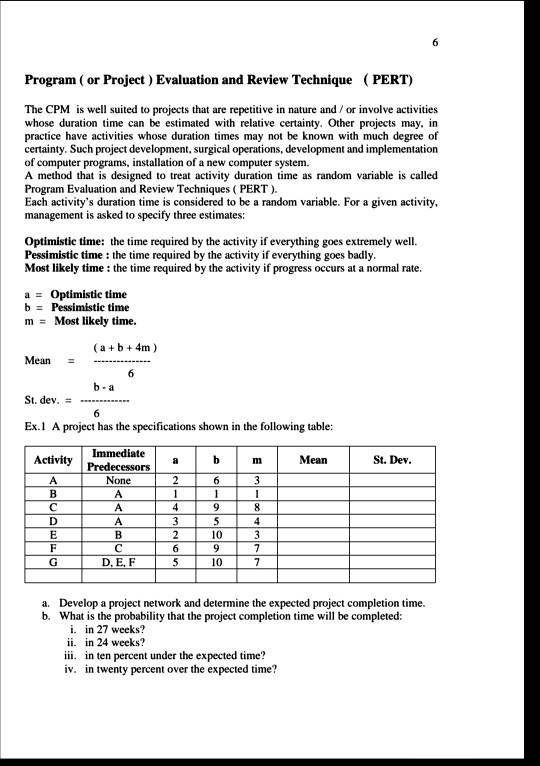
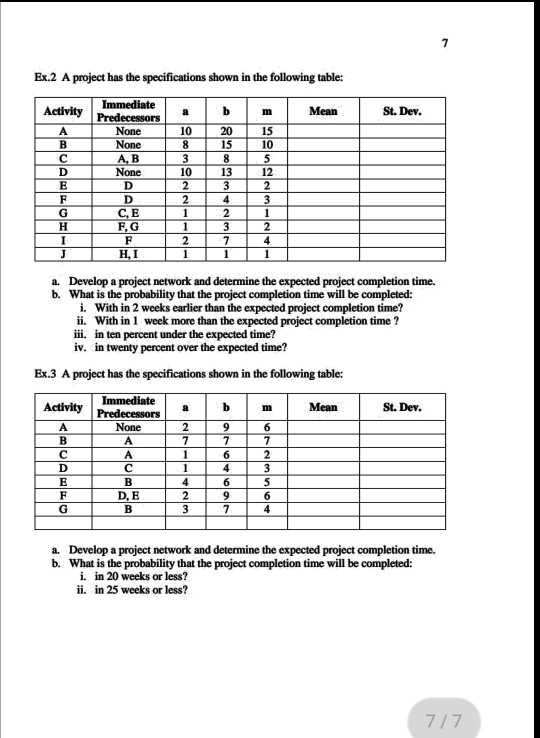
Program (or Project ) Evaluation and Review Technique (PERT) The CPM is well suited to projects that are repetitive in nature and/or involve activities whose duration time can be estimated with relative certainty. Other projects may, in practice have activities whose duration times may not be known with much degree of certainty. Such project development, surgical operations, development and implementation of computer programs, installation of a new computer system. A method that is designed to treat activity duration time as random variable is called Program Evaluation and Review Techniques ( PERT). Each activity's duration time is considered to be a random variable. For a given activity, management is asked to specify three estimates: Optimistic time: the time required by the activity if everything goes extremely well. Pessimistic time: the time required by the activity if everything goes badly. Most likely time: the time required by the activity if progress occurs at a normal rate. a = Optimistic time b = Pessimistic time m = Most likely time. (a + b + 4m) ---------- Mean = ba St. dev, - --- Ex. 1 A project has the specifications shown in the following table: Activity Immediate Predecessors None Mean St. Dev. 16 3 A A 3 54 B 2 10 3 c6 97 D,E,F 7 10 a. Develop a project network and determine the expected project completion time. b. What is the probability that the project completion time will be completed: i. in 27 weeks? ii. in 24 weeks? iii. in ten percent under the expected time? iv. in twenty percent over the expected time? Ex.2 A project has the specifications shown in the following table: Activity Mean | St. Dev. Immediate Predecessors None None None . 10 8 3 b m 2015 00 10 2 Nuo W AO D 2 1 CE 1 G1 2 1274 HI 1 1 a. Develop a project network and determine the expected project completion time. b. What is the probability that the project completion time will be completed: i. With in 2 weeks earlier than the expected project completion time? H. With in 1 week more than the expected project completion time? iii. in ten percent under the expected time? iv. in twenty percent over the expected time? Ex.3 A project has the specifications shown in the following table: Immediate Predecessors Mean Activity St. Dev. 6 None 29 B A 7 A 1 C1 B4 F DE 2 GB 3 alla 5 a. Develop a project network and determine the expected project completion time. b. What is the probability that the project completion time will be completed: i. in 20 weeks or less? ii. in 25 weeks or less? 717 Program (or Project ) Evaluation and Review Technique (PERT) The CPM is well suited to projects that are repetitive in nature and/or involve activities whose duration time can be estimated with relative certainty. Other projects may, in practice have activities whose duration times may not be known with much degree of certainty. Such project development, surgical operations, development and implementation of computer programs, installation of a new computer system. A method that is designed to treat activity duration time as random variable is called Program Evaluation and Review Techniques ( PERT). Each activity's duration time is considered to be a random variable. For a given activity, management is asked to specify three estimates: Optimistic time: the time required by the activity if everything goes extremely well. Pessimistic time: the time required by the activity if everything goes badly. Most likely time: the time required by the activity if progress occurs at a normal rate. a = Optimistic time b = Pessimistic time m = Most likely time. (a + b + 4m) ---------- Mean = ba St. dev, - --- Ex. 1 A project has the specifications shown in the following table: Activity Immediate Predecessors None Mean St. Dev. 16 3 A A 3 54 B 2 10 3 c6 97 D,E,F 7 10 a. Develop a project network and determine the expected project completion time. b. What is the probability that the project completion time will be completed: i. in 27 weeks? ii. in 24 weeks? iii. in ten percent under the expected time? iv. in twenty percent over the expected time? Ex.2 A project has the specifications shown in the following table: Activity Mean | St. Dev. Immediate Predecessors None None None . 10 8 3 b m 2015 00 10 2 Nuo W AO D 2 1 CE 1 G1 2 1274 HI 1 1 a. Develop a project network and determine the expected project completion time. b. What is the probability that the project completion time will be completed: i. With in 2 weeks earlier than the expected project completion time? H. With in 1 week more than the expected project completion time? iii. in ten percent under the expected time? iv. in twenty percent over the expected time? Ex.3 A project has the specifications shown in the following table: Immediate Predecessors Mean Activity St. Dev. 6 None 29 B A 7 A 1 C1 B4 F DE 2 GB 3 alla 5 a. Develop a project network and determine the expected project completion time. b. What is the probability that the project completion time will be completed: i. in 20 weeks or less? ii. in 25 weeks or less? 717Step by Step Solution
There are 3 Steps involved in it
1 Expert Approved Answer
Step: 1 Unlock

Question Has Been Solved by an Expert!
Get step-by-step solutions from verified subject matter experts
Step: 2 Unlock
Step: 3 Unlock
 Study Help