







Question: How to solve this equation A simple random sample of size n is drawn. The sample mean, )2, is found to be 17.6, and the
How to solve this equation
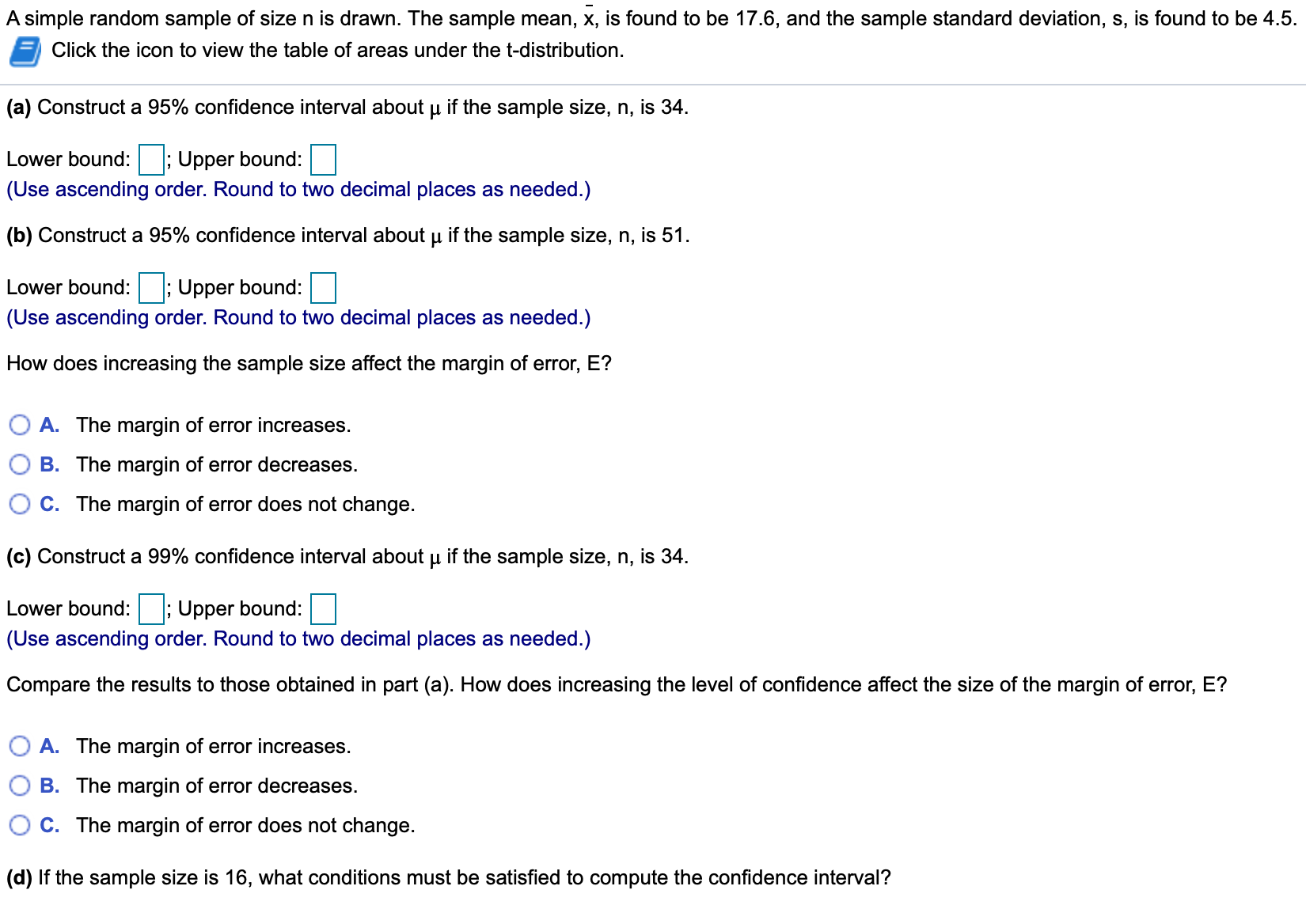
A simple random sample of size n is drawn. The sample mean, )2, is found to be 17.6, and the sample standard deviation, 5, is found to be 4.5. 3 Click the icon to view the table of areas under the t-distribution. (3) Construct a 95% confidence interval about )1 if the sample size, n, is 34. Lower bound: D; Upper bound: |:| (Use ascending order. Round to two decimal places as needed.) (b) Construct a 95% condence interval about )1 if the sample size, n, is 51. Lower bound: D; Upper bound: |:| (Use ascending order. Round to two decimal places as needed.) How does increasing the sample size affect the margin of error, E? O A. The margin of error increases. 0 B. The margin of error decreases. O C. The margin of error does not change. (c) Construct a 99% confidence interval about u if the sample size, n, is 34. Lower bound: D; Upper bound: |:| (Use ascending order. Round to two decimal places as needed.) Compare the results to those obtained in part (a). How does increasing the level of condence affect the size of the margin of error, E? O A. The margin of error increases. 0 B. The margin of error decreases. O C. The margin of error does not change. (cl) If the sample size is 16, what conditions must be satised to compute the condence interval
Step by Step Solution
There are 3 Steps involved in it

Get step-by-step solutions from verified subject matter experts
 Study Help