







Question: I need help figuring out how to complete these homework 2 questions, if anyone could walk me through it that would be great! Thanks! This
I need help figuring out how to complete these homework 2 questions, if anyone could walk me through it that would be great! Thanks!
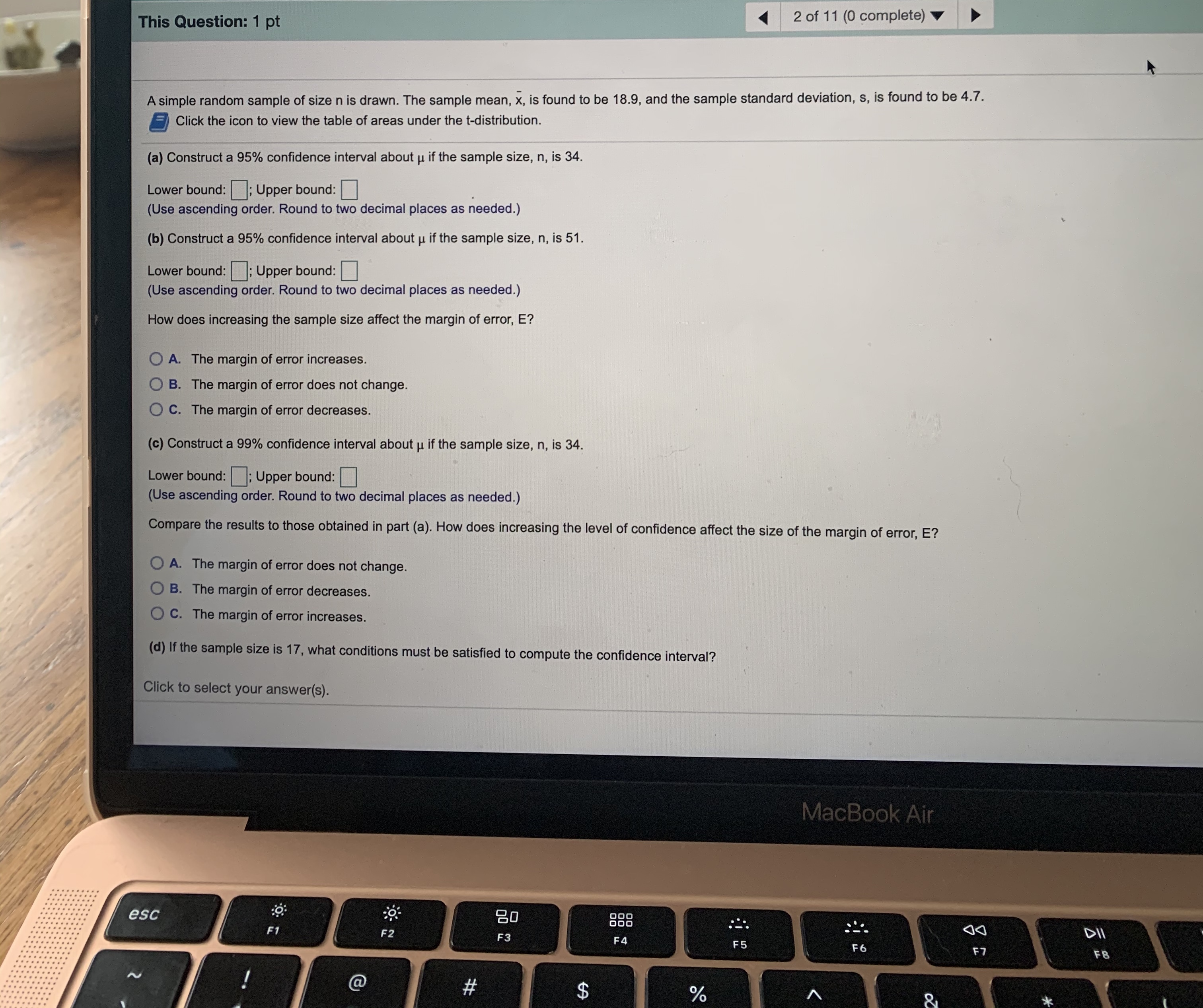
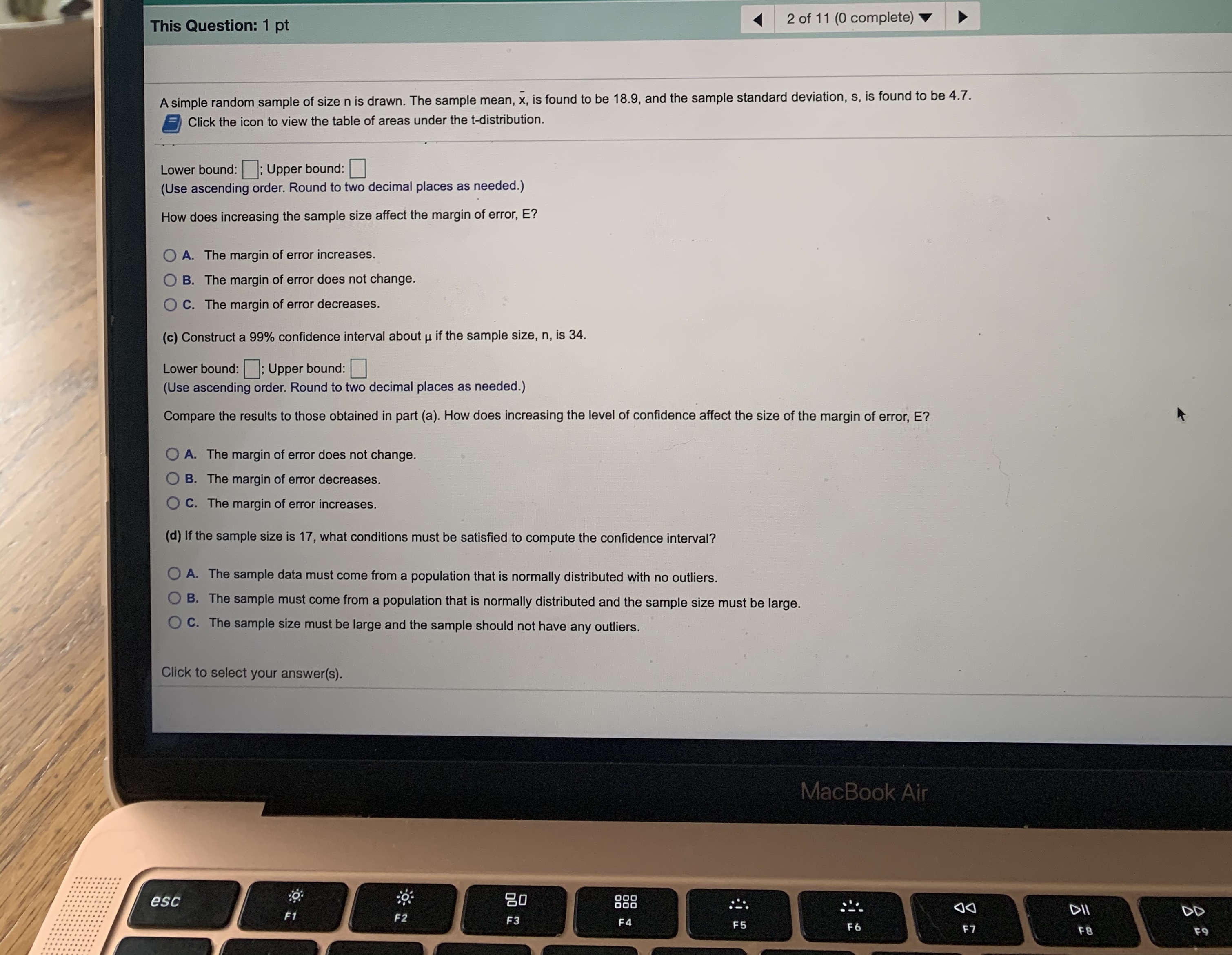
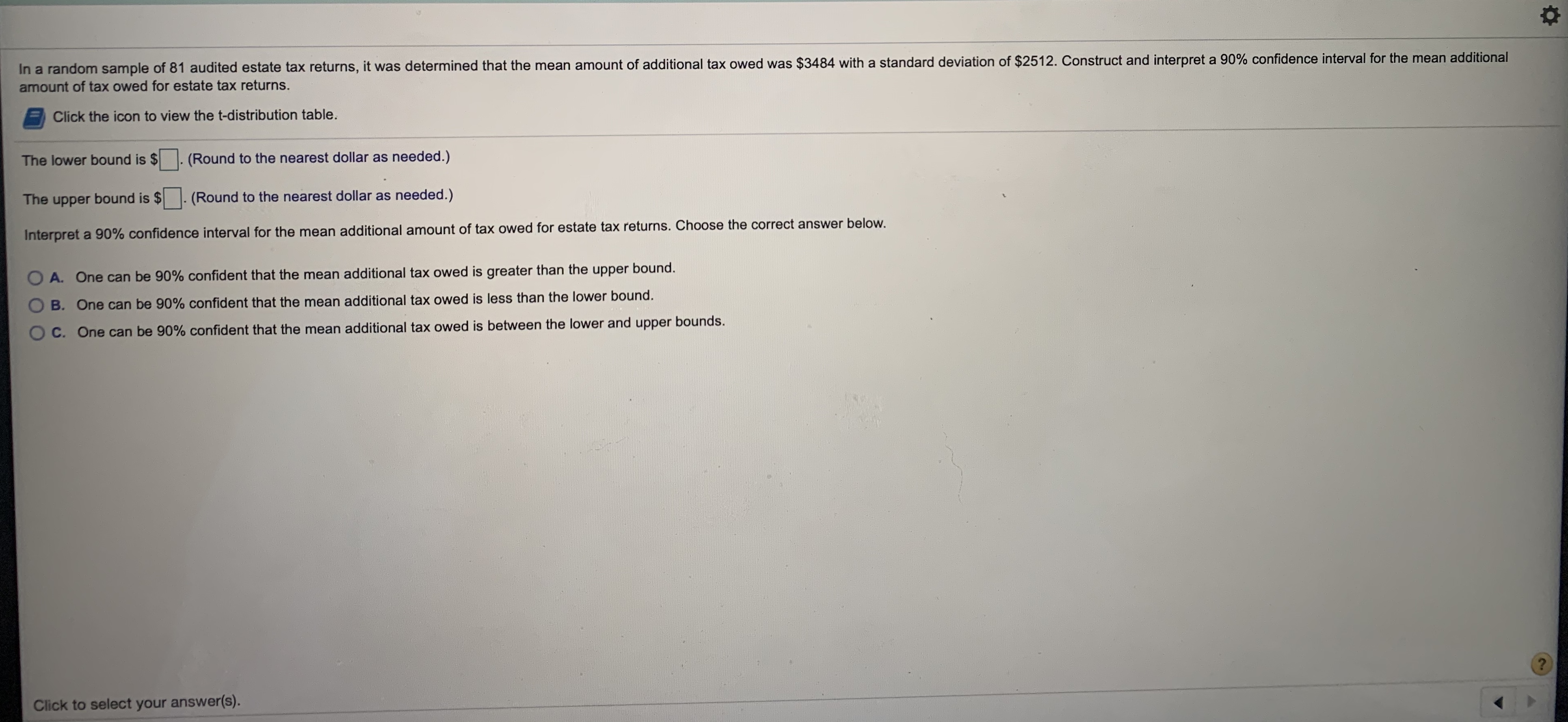
This Question: 1 pt 1 1 2 of 11 (0 complete) A simple random sample of size n is drawn. The sample mean, x, is found to be 18.9, and the sample standard deviation, s, is found to be 4.7. Click the icon to view the table of areas under the t-distribution. (a) Construct a 95% confidence interval about u if the sample size, n, is 34. Lower bound: ; Upper bound: (Use ascending order. Round to two decimal places as needed.) (b) Construct a 95% confidence interval about u if the sample size, n, is 51. Lower bound: ; Upper bound: (Use ascending order. Round to two decimal places as needed.) How does increasing the sample size affect the margin of error, E? O A. The margin of error increases. O B. The margin of error does not change. O C. The margin of error decreases. (c) Construct a 99% confidence interval about u if the sample size, n, is 34. Lower bound: ; Upper bound: (Use ascending order. Round to two decimal places as needed.) Compare the results to those obtained in part (a). How does increasing the level of confidence affect the size of the margin of error, E? O A. The margin of error does not change. O B. The margin of error decreases. O C. The margin of error increases. (d) If the sample size is 17, what conditions must be satisfied to compute the confidence interval? Click to select your answer(s) MacBook Air esc F1 F2 20 F3 F4 F5 F6 DII F7 FB # $This Question: 1 pt 2 of 11 (0 complete) A simple random sample of size n is drawn. The sample mean, x, is found to be 18.9, and the sample standard deviation, s, is found to be 4.7. Click the icon to view the table of areas under the t-distribution. Lower bound: ; Upper bound: (Use ascending order. Round to two decimal places as needed.) How does increasing the sample size affect the margin of error, E? O A. The margin of error increases. O B. The margin of error does not change. O C. The margin of error decreases. (c) Construct a 99% confidence interval about u if the sample size, n, is 34. Lower bound: ; Upper bound: (Use ascending order. Round to two decimal places as needed.) Compare the results to those obtained in part (a). How does increasing the level of confidence affect the size of the margin of error, E? O A. The margin of error does not change. O B. The margin of error decreases. O C. The margin of error increases. (d) If the sample size is 17, what conditions must be satisfied to compute the confidence interval? O A. The sample data must come from a population that is normally distributed with no outliers. O B. The sample must come from a population that is normally distributed and the sample size must be large. O C. The sample size must be large and the sample should not have any outliers. Click to select your answer(s). MacBook Air esc 20 . . .... ....:: F1 888 3 F4 DII DD F 5 F6 F8In a random sample of 81 audited estate tax returns, it was determined that the mean amount of additional tax owed was $3484 with a standard deviation of $2512. Construct and interpret a 90% confidence interval for the mean additional amount of tax owed for estate tax returns. Click the icon to view the t-distribution table. The lower bound is $ . (Round to the nearest dollar as needed.) The upper bound is $ . (Round to the nearest dollar as needed.) Interpret a 90% confidence interval for the mean additional amount of tax owed for estate tax returns. Choose the correct answer below. O A. One can be 90% confident that the mean additional tax owed is greater than the upper bound. O B. One can be 90% confident that the mean additional tax owed is less than the lower bound. O C. One can be 90% confident that the mean additional tax owed is between the lower and upper bounds. ? Click to select your answer(s)
Step by Step Solution
There are 3 Steps involved in it

Get step-by-step solutions from verified subject matter experts
 Study Help