







Question: how to with steps, please Learning Goal: To practice Tactics Box 3.2 Finding the acceleration vector. Suppose an object has an initial velocity v; at
how to with steps, please
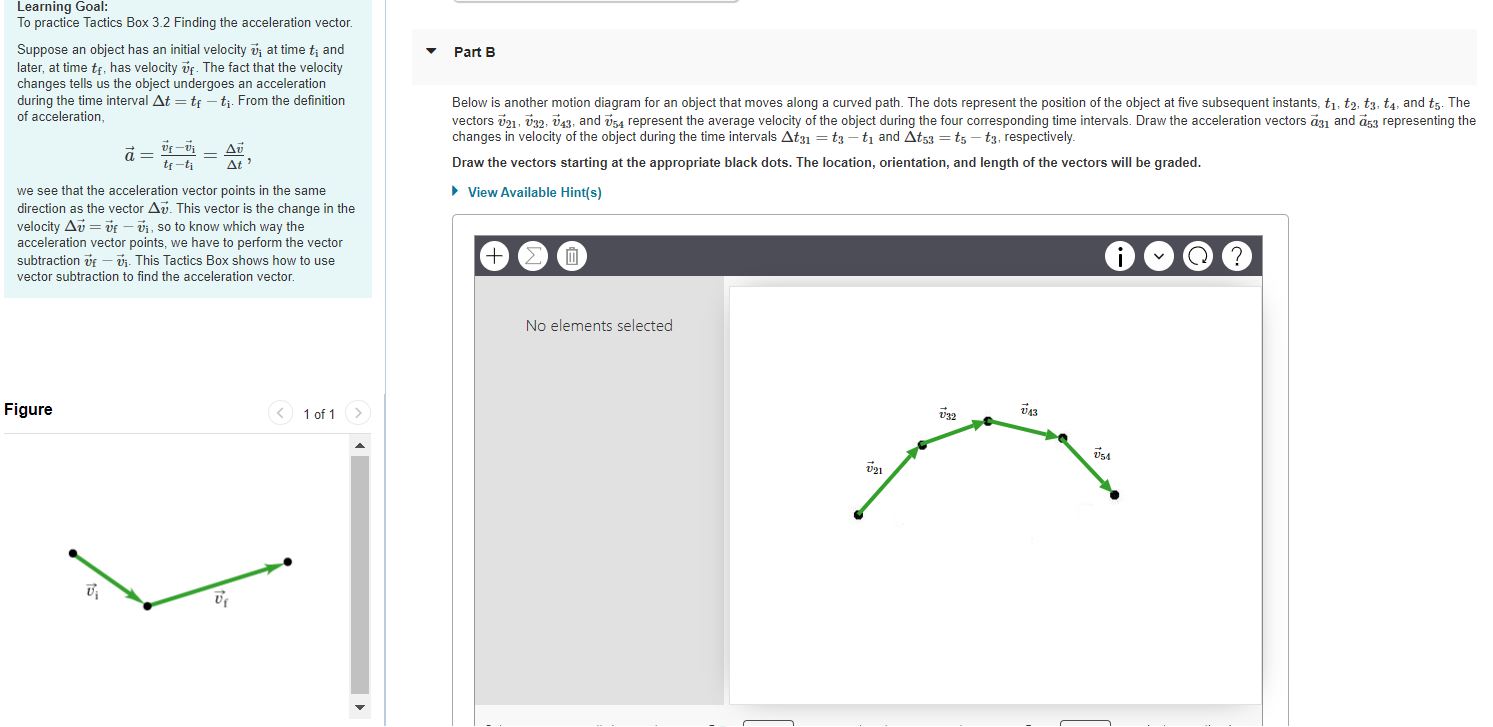
Learning Goal: To practice Tactics Box 3.2 Finding the acceleration vector. Suppose an object has an initial velocity v; at time t; and Part B later, at time to, has velocity of. The fact that the velocity changes tells us the object undergoes an acceleration during the time interval At = tf - ti. From the definition Below is another motion diagram for an object that moves along a curved path. The dots represent the position of the object at five subsequent instants, t1. t2, to, t4, and ts. The of acceleration, vectors v21, 132. 143, and v54 represent the average velocity of the object during the four corresponding time intervals. Draw the acceleration vectors a3, and asg representing the changes in velocity of the object during the time intervals At31 = t3 - t and Ats3 = ts - t3, respectively. a = - Au If - ti At ' Draw the vectors starting at the appropriate black dots. The location, orientation, and length of the vectors will be graded. we see that the acceleration vector points in the same View Available Hint(s) direction as the vector Av. This vector is the change in the velocity Av = vr - vi, so to know which way the acceleration vector points, we have to perform the vector subtraction of - vi. This Tactics Box shows how to use + vector subtraction to find the acceleration vector. No elements selected Figure 1 of 1 > U32 U21
Step by Step Solution
There are 3 Steps involved in it

Get step-by-step solutions from verified subject matter experts
 Study Help