







Question: How to write the Scheme code? 1. norders a pint. The An infinite number of mathematicians walk into a bar. The first mathematician orders a
 How to write the Scheme code?
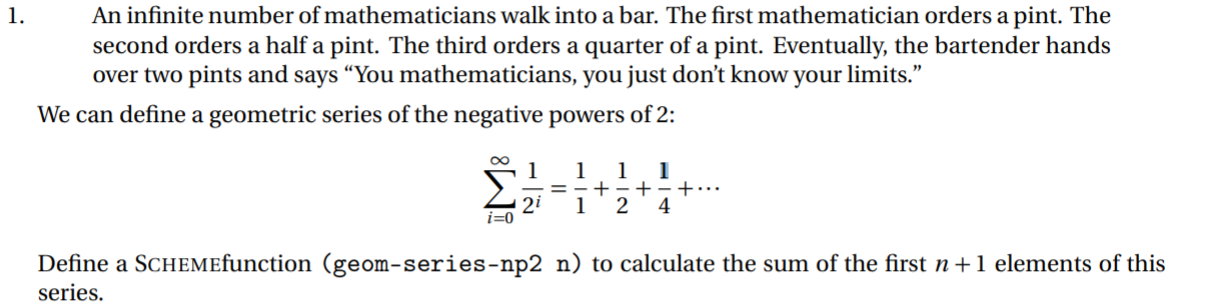
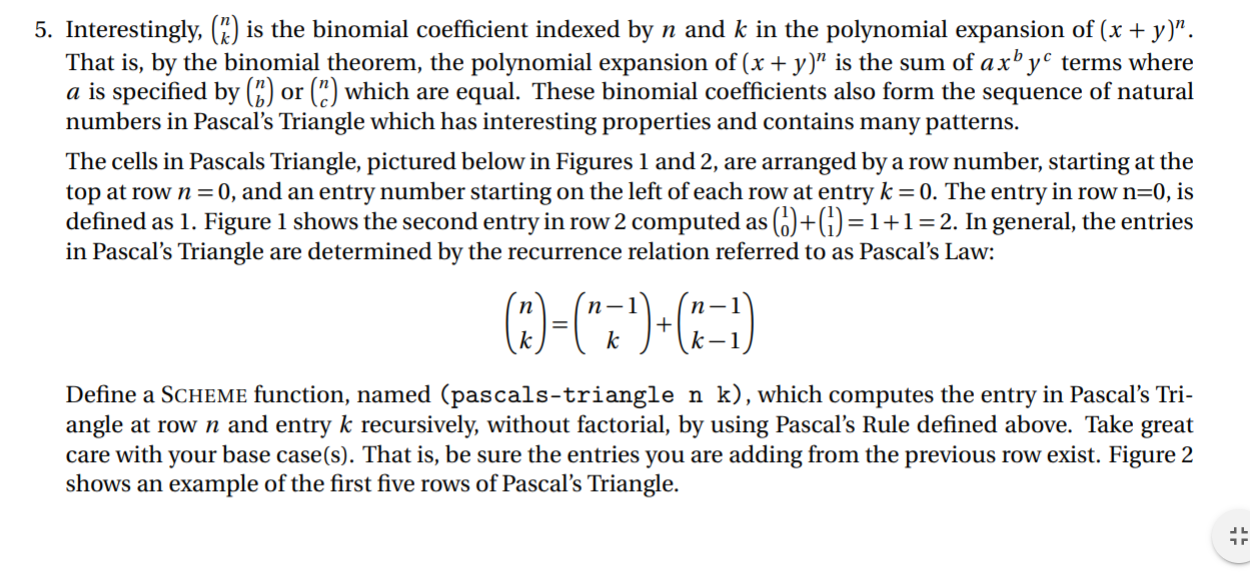
1. norders a pint. The An infinite number of mathematicians walk into a bar. The first mathematician orders a pint. The second orders a half a pint. The third orders a quarter of a pint. Eventually, the bartender hands over two pints and says "You mathematicians, you just don't know your limits. We can define a geometric series of the negative powers of 2: 1 1 -+ 1 = 1 - 2 1 +- 4 > +... 2 Define a SCHEMEfunction (geom-series-np2 n) to calculate the sum of the first n+1 elements of this series. 5. Interestingly, () is the binomial coefficient indexed by n and k in the polynomial expansion of (x + y). That is, by the binomial theorem, the polynomial expansion of (x + y)" is the sum of a xb y terms where a is specified by (7) or ((.) which are equal. These binomial coefficients also form the sequence of natural numbers in Pascal's Triangle which has interesting properties and contains many patterns. The cells in Pascals Triangle, pictured below in Figures 1 and 2, are arranged by a row number, starting at the top at row n=0, and an entry number starting on the left of each row at entry k = 0. The entry in row n=0, is defined as 1. Figure 1 shows the second entry in row 2 computed 1+1=2. In general, the entries in Pascal's Triangle are determined by the recurrence relation referred to as Pascal's Law: (n)(n-1) (n-1) (k)=U***J+(1) -1 Define a SCHEME function, named (pascals-triangle nk), which computes the entry in Pascal's Tri- angle at row n and entry k recursively, without factorial, by using Pascal's Rule defined above. Take great care with your base case(s). That is, be sure the entries you are adding from the previous row exist. Figure 2 shows an example of the first five rows of Pascal's Triangle. ca's Fule defined above, Take great 1. norders a pint. The An infinite number of mathematicians walk into a bar. The first mathematician orders a pint. The second orders a half a pint. The third orders a quarter of a pint. Eventually, the bartender hands over two pints and says "You mathematicians, you just don't know your limits. We can define a geometric series of the negative powers of 2: 1 1 -+ 1 = 1 - 2 1 +- 4 > +... 2 Define a SCHEMEfunction (geom-series-np2 n) to calculate the sum of the first n+1 elements of this series. 5. Interestingly, () is the binomial coefficient indexed by n and k in the polynomial expansion of (x + y). That is, by the binomial theorem, the polynomial expansion of (x + y)" is the sum of a xb y terms where a is specified by (7) or ((.) which are equal. These binomial coefficients also form the sequence of natural numbers in Pascal's Triangle which has interesting properties and contains many patterns. The cells in Pascals Triangle, pictured below in Figures 1 and 2, are arranged by a row number, starting at the top at row n=0, and an entry number starting on the left of each row at entry k = 0. The entry in row n=0, is defined as 1. Figure 1 shows the second entry in row 2 computed 1+1=2. In general, the entries in Pascal's Triangle are determined by the recurrence relation referred to as Pascal's Law: (n)(n-1) (n-1) (k)=U***J+(1) -1 Define a SCHEME function, named (pascals-triangle nk), which computes the entry in Pascal's Tri- angle at row n and entry k recursively, without factorial, by using Pascal's Rule defined above. Take great care with your base case(s). That is, be sure the entries you are adding from the previous row exist. Figure 2 shows an example of the first five rows of Pascal's Triangle. ca's Fule defined above, Take great
Step by Step Solution
There are 3 Steps involved in it

Get step-by-step solutions from verified subject matter experts
 Study Help