







Question: How would my UML look using these classes? I'll also include the basic UML that it'd look like. import java.util.Random; public class Die { private
How would my UML look using these classes? I'll also include the basic UML that it'd look like.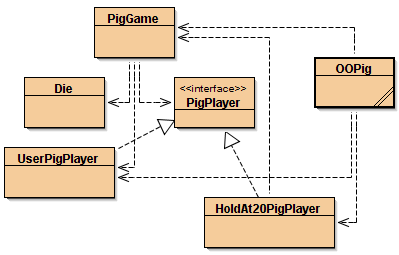
import java.util.Random;
public class Die {
private int dieFaces, minimum;
private int[] results;
public Die() {
this(6, 1);
results = new int[dieFaces];
results[0] = minimum;
results[1] = 2;
results[2] = 3;
results[3] = 4;
results[4] = 5;
results[5] = 6;
}
public Die(int[] outcomes) {
results = outcomes;
}
public Die(int sides, int min) {
dieFaces = sides;
minimum = min;
}
public int nextRoll() {
Random rand = new Random();
return results[rand.nextInt(results.length)];
}
}
-----------------------------------------------------------------------------------
public class HoldAt20PigPlayer implements PigPlayer {
public boolean isRolling(int myScore, int otherScore, int turnTotal) {
return ((turnTotal
}
}
---------------------------------------------------------------
import java.util.*;
public class OOPig {
public static void main (String[] args) {
PigPlayer playerOne, playerTwo;
Random rand = new Random();
int num = rand.nextInt(2);
if(num == 0) {
System.out.println("You will be player 1.");
playerOne = new UserPigPlayer();
playerTwo = new HoldAt20PigPlayer();
}
else {
System.out.println("You will be player 2.");
playerTwo = new UserPigPlayer();
playerOne = new HoldAt20PigPlayer();
}
PigGame game = new PigGame(playerOne, playerTwo);
game.play();
}
}
----------------------------------------------------------
public class PigGame {
public static final int GOAL_SCORE = 100;
private PigPlayer playerOne, playerTwo;
public PigGame() {
UserPigPlayer playerOne = new UserPigPlayer();
UserPigPlayer playerTwo = new UserPigPlayer();
}
public PigGame(PigPlayer player1, PigPlayer player2) {
playerOne = player1;
playerTwo = player2;
}
public void play() {
int playOneScore = 0, playTwoScore = 0, turnTotal1 = 0, turnTotal2 = 0;
Die die = new Die();
while(playOneScore
System.out.println("Player 1 score: " + playOneScore);
System.out.println("Player 2 score: " + playTwoScore);
System.out.println("It is player 1's turn.");
while(playerOne.isRolling(playOneScore, playTwoScore, turnTotal1)) {
int roll = die.nextRoll();
System.out.println("Roll: " + roll);
if(roll >= 2 && roll
turnTotal1 += roll;
continue;
}
else if(roll == 1) {
turnTotal1 = 0;
break;
}
}
playOneScore += turnTotal1;
System.out.println("New Score: " + playOneScore);
turnTotal1 = 0;
if(playOneScore >= GOAL_SCORE) {
break;
}
System.out.println("Player 1 score: " + playOneScore);
System.out.println("Player 2 score: " + playTwoScore);
System.out.println("It is player 2's turn.");
while(playerTwo.isRolling(playTwoScore, playOneScore, turnTotal2)) {
int roll = die.nextRoll();
System.out.println("Roll: " + roll);
if(roll >= 2 && roll
turnTotal2 += roll;
continue;
}
else if(roll == 1) {
turnTotal2 = 0;
break;
}
}
playTwoScore += turnTotal2;
System.out.println("New Score: " + playTwoScore);
turnTotal2 = 0;
}
}
}
----------------------------------------------------------------------
public interface PigPlayer {
boolean isRolling(int myScore, int otherScore, int turnTotal);
}
----------------------------------------------
import java.util.*;
public class UserPigPlayer implements PigPlayer {
public UserPigPlayer() {
System.out.println("Press Enter to roll; enter anything to hold.");
}
public boolean isRolling(int myScore, int otherScore, int turnTotal) {
String input;
Scanner keyboard = new Scanner(System.in);
System.out.print("Turn total: " + turnTotal + " " + "Roll/Hold? ");
input = keyboard.nextLine();
return (input.equals(""));
}
}
Step by Step Solution
There are 3 Steps involved in it

Get step-by-step solutions from verified subject matter experts
 Study Help