Question: How would you solve this problem using EOQ with shortage model? please help me with question 1,2,3. just finding the equations part only! thank you
How would you solve this problem using EOQ with shortage model? please help me with question 1,2,3. just finding the equations part only! thank you
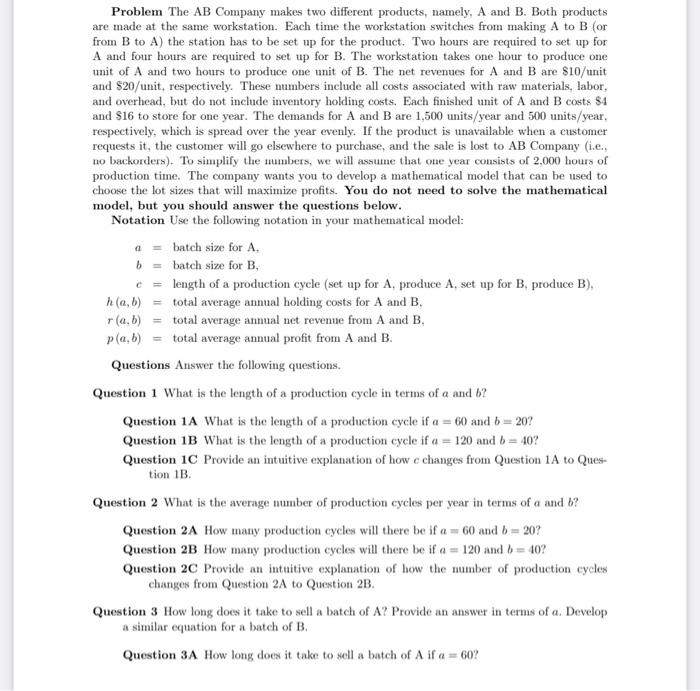
Problem The AB Company makes two different products, namely, A and B. Both products are made at the same workstation. Each time the workstation switches from making A to B (or from B to A) the station has to be set up for the product. Two hours are required to set up for A and four hours are required to set up for B. The workstation takes one hour to produce one unit of A and two hours to produce one unit of B. The net revenues for A and B are $10/unit and $20/unit, respectively. These numbers include all costs associated with raw materials, labor, and overhead, but do not include inventory holding costs. Each finished unit of A and B costs $4 and $16 to store for one year. The demands for A and B are 1,500 units/year and 500 units/year, respectively, which is spread over the year evenly. If the product is unavailable when a customer requests it, the customer will go elsewhere to purchase, and the sale is lost to AB Company (i... no backorders). To simplify the numbers, we will assume that one year consists of 2,000 hours of production time. The company wants you to develop a mathematical model that can be used to choose the lot sizes that will maximize profits. You do not need to solve the mathematical model, but you should answer the questions below. Notation Use the following notation in your mathematical model: a = batch size for A. b = batch size for B, = length of a production cycle (set up for A, produce A, set up for B, produce B). h(a,b) total average annual holding costs for A and B. r(a,b) = total average annual net revenue from A and B. p(a,b) = total average annual profit from A and B. Questions Answer the following questions. Question 1 What is the length of a production cycle in terms of a and b? Question 1A What is the length of a production cycle if a = 60 and b = 207 Question 1B What is the length of a production cycle if a = 120 and b = 40? Question 1C Provide an intuitive explanation of how e changes from Question 1A to Ques- tion 1B. Question 2 What is the average number of production cycles per year in terms of a and b? Question 2A How many production cycles will there be if a = 60 and b = 207 Question 2B How many production cycles will there be if a = 120 and b = 407 Question 2C Provide an intuitive explanation of how the number of production cycles changes from Question 2A to Question 2B. Question 3 How long does it take to sell a batch of A? Provide an answer in terms of a. Develop a similar equation for a batch of B. Question 3A How long does it take to sell a batch of A if a = 60









 Study Help