







Question: How would you solve this using first order predicate logic? B: The expression cons(x, y) denotes the list formed by inserting the element x at
How would you solve this using first order predicate logic?
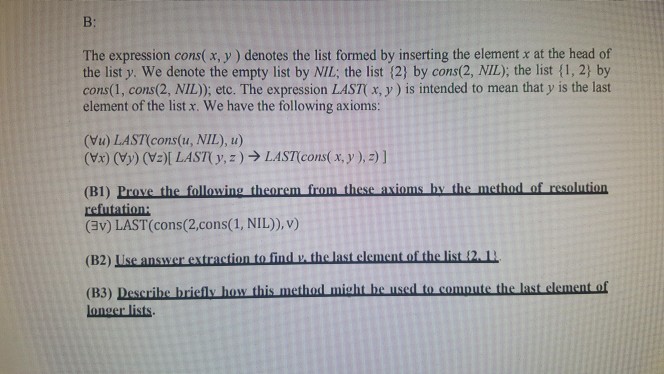
B: The expression cons(x, y) denotes the list formed by inserting the element x at the head of the list y. We denote the empty list by NIL; the list (2) by cons(2, NIL); the list (1, 2) by cons(1, cons(2, NIL); etc. The expression LAST(x, y) is intended to mean that y is the last element of the list x. We have the following axioms: (Vu) LAST(cons(u, NIL), u) (Vr) (Y)) (Vz)[ LAST y, z ) ? LAST(cons(x, y ), z) ] (BI) Prove the following theorem from these axioms by the method of resolution refutation: (3v) LAST (cons(2.cons(1, NIL), v) (B2) lise answer extraction to find v the last clement of the list 12 1 (B3) Descrihe briefly how this method might he used to comnute the last element of longer lists
Step by Step Solution
There are 3 Steps involved in it

Get step-by-step solutions from verified subject matter experts
 Study Help